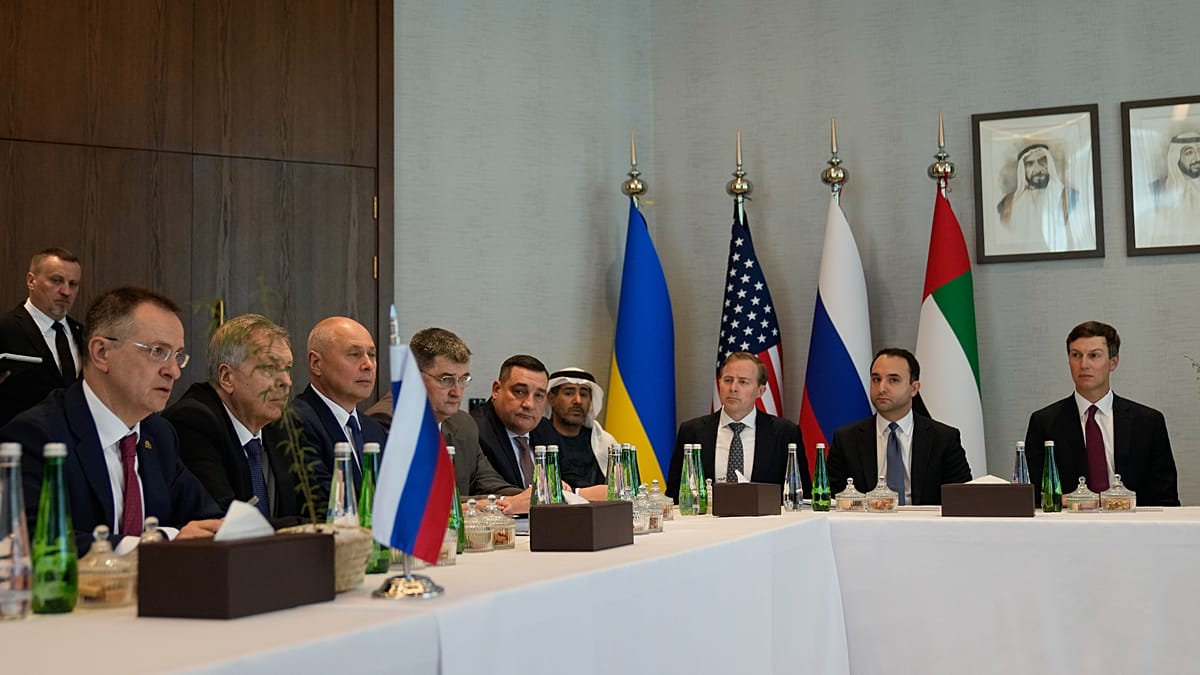
Ukrainian, Russian and US negotiators returned to the table in Abu Dhabi on Wednesday after a first day that produced sharply contrasting assessments. Kyiv and Washington described the discussions as constructive and substantive, with Ukrainian President Volodymyr Zelenskyy calling them “constructive and quite substantive” and US Secretary of State Marco Rubio deeming them “very productive”. The talks covered prisoner exchanges, security guarantees and possible de-escalation steps.
Moscow, however, struck a very different tone. Russian Foreign Minister Sergei Lavrov rejected any ceasefire and accused Europeans of seeking a truce only to deploy troops to Ukraine. He also dismissed the presence of European officials in Abu Dhabi, saying: “Well, they flew to Abu Dhabi. Let them sit there in the hotel.” The Europeans held separate consultations with Kyiv and Washington but remain shut out of the trilateral negotiations, despite US signals that they could eventually join.
Territory remains the core obstacle
The fundamental disagreement over territory shows no sign of narrowing. A senior US official told American media that Ukraine and Russia have reportedly shown some private flexibility, but both remain publicly far apart. The same official said the territorial question cannot be settled before agreeing on Ukraine’s post-war security arrangements. Moscow still demands control of the entire Donbas, including areas it has failed to capture, while Kyiv refuses to surrender any territory.
The prospect that a deal with Russia could redraw Europe’s security architecture has unsettled European capitals, which see it as Moscow’s attempt to re-establish its sphere of influence in Eastern Europe and sow divisions among Western allies. As reported earlier, the slight flexibility on territory has not translated into a breakthrough.
NATO praises Ukraine’s strikes on Russian refineries
NATO is represented in Abu Dhabi by senior officials, including the alliance’s top military commander, Alexus Grynkewich. Euronews NATO correspondent Shona Murray spoke to Deputy Supreme Allied Commander Europe Sir John Stringer at NATO headquarters. He praised Ukraine’s successful strikes on Russian diesel refineries, which US President Donald Trump has urged Kyiv to stop, blaming them for rising energy prices. Stringer said Western allies should “salute” Ukraine’s success in “hurting Putin”.
“What Ukraine has been able to do through imagination, innovation and will is quite incredible and we should salute it,” he added.
Merz’s budget gambit backfires
German Chancellor Friedrich Merz’s attempt to make approval of the EU’s next long-term budget conditional on fresh financial support for Ukraine has backfired within hours. As predicted, the move provoked Slovakia, Czechia, Hungary and Bulgaria, which are poised to opt out of what looks like an inevitable top-up of the Ukraine Support Loan.
Slovak Prime Minister Robert Fico was the most vocal, accusing Merz of political “blackmail” and threatening a veto, arguing that Slovakia has the same voting rights as Germany. Czech Prime Minister Andrej Babiš, who met Fico in Bratislava on Tuesday, also rejected the German initiative, pointing to the €100bn he says the proposed EU budget already earmarks for Ukraine, money that would only become available from 2028.
Hungarian Prime Minister Péter Magyar said linking the two issues was unacceptable for domestic political reasons and argued they should be negotiated separately. Bulgarian Prime Minister Rumen Radev also signalled resistance, citing his country’s high deficit as a reason to avoid further credit lines for Kyiv, while saying Sofia would keep supporting Ukraine by other means, including energy supplies.
The four countries’ opposition adds a new layer to the battle between the EU’s so-called Friends of Cohesion and the frugal countries pushing for cuts to the next long-term budget. All four belong to the 17-member cohesion group, which wants to protect funding for agriculture and regional development. Merz’s strategy is to use Germany’s position as the bloc’s largest net contributor to secure a broader commitment to Ukraine’s financing, but tying the two issues together risks alienating countries that already oppose cuts to cohesion spending.
European Council President António Costa tried to reassure Merz in a letter seen by Euronews, agreeing to “make time for a broad discussion on Ukraine at the upcoming informal European Council in Dublin.”
Rutte draws Portugal’s ire
The Portuguese Foreign Ministry hit back at NATO Secretary General Mark Rutte on X, telling him he should “know better” than to overlook countries that have stood firmly by Ukraine, and should not speak “so lightly on such a serious matter.” On a Dutch TV programme, Rutte said he sometimes talks to Portuguese and Spanish allies, who consider Russia very far away. “Russia’s newest missiles take five minutes longer to reach Lisbon than to reach Warsaw. So we all have to deal with this,” he said.
The NATO chief clearly struck a nerve on the diverging perceptions of the Russian threat. How much each EU country contributes to Ukraine’s support is becoming ever more sensitive, especially as it gets tangled up with the budget negotiations.
Nordic support continues, Italy faces internal rift
Denmark has pledged a new €643 million military support package for Ukraine, plus €20 million for its energy sector, as Zelenskyy met Nordic leaders in Copenhagen on Tuesday. Danish Prime Minister Mette Frederiksen hosted the leaders of Sweden, Norway and Finland, with talks focused on military support, air defence and protecting critical energy infrastructure.
While the Nordics keep the aid flowing, the next arms package for Kyiv is becoming a headache for Italian PM Giorgia Meloni. It could turn into a diplomatic debacle just as she has secured a place among the European delegations in Abu Dhabi. Meloni’s coalition has always been split over military aid to Ukraine, but the rift is now surfacing at a delicate moment. As some former NATO chiefs have argued, Europe must earn its place at the table, but internal divisions may undermine that effort.