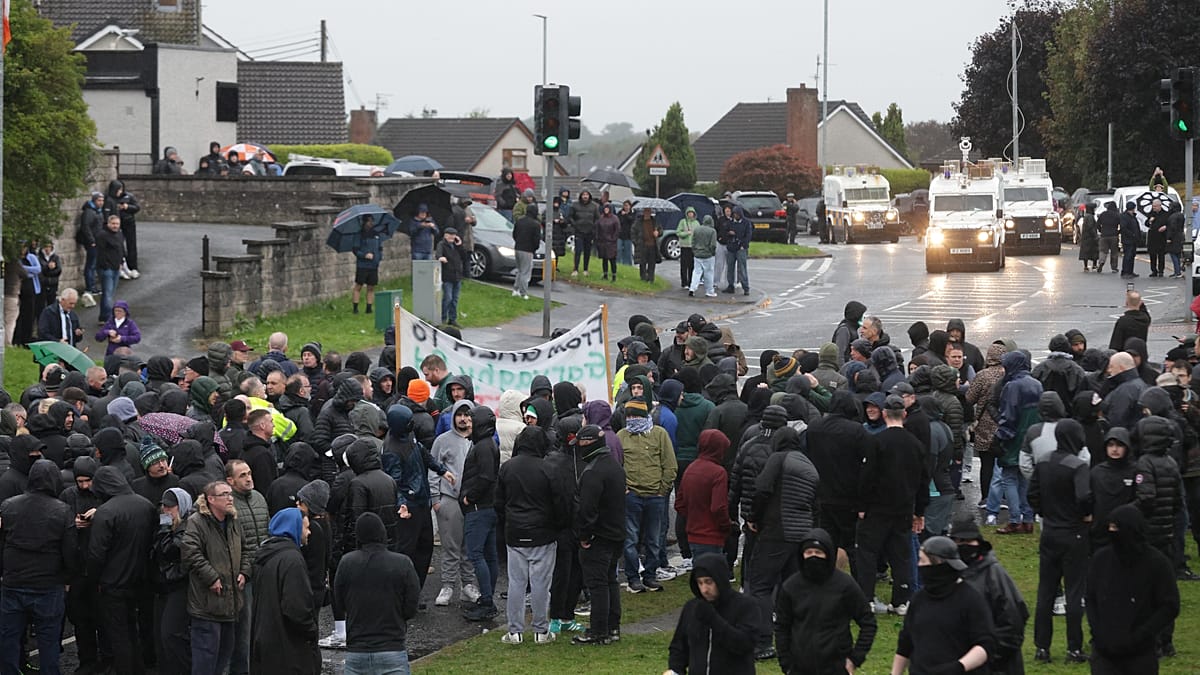
Around 2,000 demonstrators occupied a road in Portadown, County Armagh, on 27 September, halting an Orange Order parade before it could reach the Garvaghy Road, a district that is overwhelmingly Catholic and nationalist. The confrontation revived one of Northern Ireland's most enduring sectarian flashpoints, nearly three decades after the Good Friday Agreement reshaped the region's politics.
The Orange Order, a Protestant fraternal organisation, had sought to march through the contested route as part of its annual commemorations. Residents and nationalist activists, who have long argued that such parades amount to an assertion of territorial dominance, formed a human blockade instead. Video footage from the scene showed a dense line of protesters stretching across the carriageway, with police deployed to keep the two sides apart.
A dispute that refuses to fade
The Garvaghy Road standoff is not a new grievance. It dates back to the mid-1990s, when the British government's decision to force a parade through the area triggered some of the worst rioting seen in Northern Ireland since the Troubles. The Drumcree church parade, held each July, became a symbol of the unresolved tensions between unionist tradition and nationalist consent. The September march, while smaller in scale, carries the same unresolved question: who gets to decide which streets are open to whom?
Under the framework established by the Parades Commission, a quasi-judicial body created in 1998, contested routes are subject to restrictions and mediation. But the commission's rulings have rarely satisfied both communities. Unionist groups argue that their cultural expression is being criminalised; nationalist residents insist that their consent must be a precondition, not an afterthought.
The timing of this latest confrontation is significant. Northern Ireland's power-sharing institutions at Stormont have been unstable for much of the past decade, and the region's political discourse remains deeply shaped by questions of identity, Brexit's legacy and the constitutional future. A parade dispute that might once have been contained locally now feeds into a wider conversation about whether the peace settlement's compromises are holding.
Policing a fault line
The Police Service of Northern Ireland, which has faced sustained budget pressures, was left managing a volatile standoff with limited resources. Officers did not immediately attempt to force the protesters aside, a decision that likely reflected lessons learned from past confrontations in which heavy-handed policing inflamed rather than defused tensions. No serious injuries were reported, but the standoff underscored how quickly a single march can become a test of the region's stability.
Local politicians responded along familiar lines. Unionist representatives described the blockade as an attack on cultural rights, while nationalist figures framed it as a legitimate act of community self-defence. Neither side showed appetite for a negotiated solution in the immediate aftermath, suggesting the dispute will persist into future marching seasons.
The episode also resonates beyond Northern Ireland. Across Europe, questions of minority rights, public space and historical memory are being contested with renewed intensity — from Catalonia's independence movement to debates over colonial monuments in Belgium and France. Northern Ireland's parade disputes are a particularly stark example of how unresolved history can harden into ritual confrontation.
For now, the Garvaghy Road remains blocked, the parade remains halted, and the underlying argument remains exactly where it was three decades ago. The peace process has delivered much, but it has not settled the question of whose streets these are.