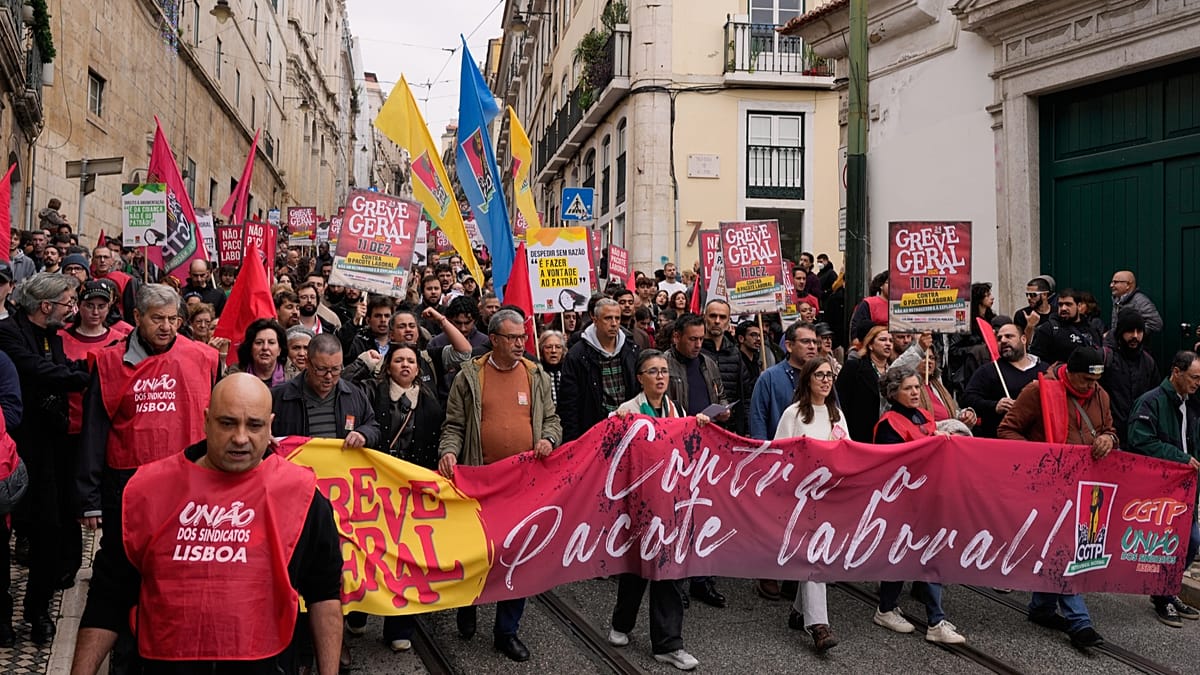
Portugal is set to experience widespread disruption on Wednesday, 3 June, as the General Confederation of Portuguese Workers (CGTP) leads a nationwide general strike. The walkout, announced on Labour Day, 1 May, targets the government's proposed overhaul of labour legislation, known as “Trabalho XXI”. The reform, introduced by the centre-right PSD/CDS-PP coalition led by Prime Minister Luís Montenegro, aims to introduce over 100 changes to the Labour Code.
The package was negotiated within Portugal's social concertation framework, but the government failed to secure an agreement with social partners. The CGTP argues the changes constitute an “assault on workers' rights” and an “affront to the Constitution of the Portuguese Republic”. The government, however, presents the bill as “a structural revision of labour legislation to boost productivity, improve wages and adapt the labour market to the challenges of the digital economy”. The bill has been submitted to the Assembly of the Republic, though no date has been set for debate or a vote, according to Jornal Económico.
This strike follows a joint action by the CGTP and the General Union of Workers (UGT) in mid-December, the first such coordinated strike in 12 years. That stoppage drew broad support across sectors, and similar backing is expected this time.
Transport Sector Hit Hard
Unions under FECTRANS (Federation of Transport and Communications Unions) have issued strike notices for 3 June. Services operated by CP (Comboios de Portugal), Carris buses and trams, Transtejo Soflusa's ferries across the Tagus, and the Lisbon, Porto, and Mondego metro systems will all be affected.
The Lisbon Metro announced on its website that “there will be no train service from 23:00 on 2 June and throughout 3 June”, with normal service “expected to resume at 06:30 on 4 June”. Metro do Porto will operate a “restricted service”, running only on the Yellow Line between Santo Ovídio and Hospital de S. João, and on the Blue Line between Senhora da Hora and Estádio do Dragão. All other lines will be suspended, and services will shut down early on Tuesday evening, with last departures between 22:00 and 23:00. Full service is expected to resume on Thursday, 4 June.
CP has warned of disruptions to train services, with possible impacts on the preceding and following days. The company is offering full refunds or free rebooking for affected passengers. Minimum service levels have been set for rail traffic, covering workers at Infraestruturas de Portugal (IP) and CP, as well as Alfa Pendular, Intercidades, InterRegional, and Regional services, and suburban trains in Coimbra, Porto, and Lisbon.
Air travel will also be affected. The Aviation and Airport Workers’ Union (SITAVA) and the National Union of Civil Aviation Flight Personnel (SNPVAC) have joined the strike. TAP Air Portugal announced that, under minimum services, only 79 flights will operate on 3 June, with the rest cancelled. The airline is contacting affected customers to arrange alternative travel.
Health Workers Join the Protest
The Portuguese Nurses’ Union (SEP) has mobilised its members across public, private, and social sectors for a 24-hour stoppage from midnight on 3 June. The strike will affect all shifts, and may extend to services beginning on Tuesday evening. Minimum services deemed “indispensable to meet ‘unavoidable social needs’” will be maintained.
Doctors are also striking. The Northern Doctors’ Union (SMN), the Central Region Doctors’ Union (SMZC), and the Southern Region Doctors’ Union (SMZS), all affiliated with the National Federation of Doctors (FNAM), have called a full-day strike for all doctors in public, social, and private sectors, regardless of contract type. The strike covers all health services under the Ministry of Health, including hospitals and health centres. Minimum staffing will ensure a level of operation equivalent to a Sunday or public holiday, guaranteeing chemotherapy, radiotherapy, dialysis, emergency services, palliative care, and other essential treatments.
Education Sector to Stop
The education sector will also feel the impact. The National Federation of Teachers (FENPROF) has issued a strike notice, with schools and universities expected to close or operate with reduced services. The union has not specified minimum service levels, but disruption is anticipated across the country.
This strike comes amid broader European debates over labour rights and economic reform. In neighbouring Spain, Prime Minister Pedro Sánchez faces intense scrutiny from multiple legal cases, as reported in Nine Legal Cases Converge on Spanish PM Sánchez as PSOE Faces Intense Scrutiny. Meanwhile, Portugal has also seen a surge in nicotine pouch use amid regulatory gaps, as detailed in Nicotine Pouches Surge in Portugal Amid Regulatory Gaps and Health Warnings.
The outcome of this strike and the labour reform debate will be closely watched across Europe, as governments grapple with balancing worker protections and economic competitiveness.