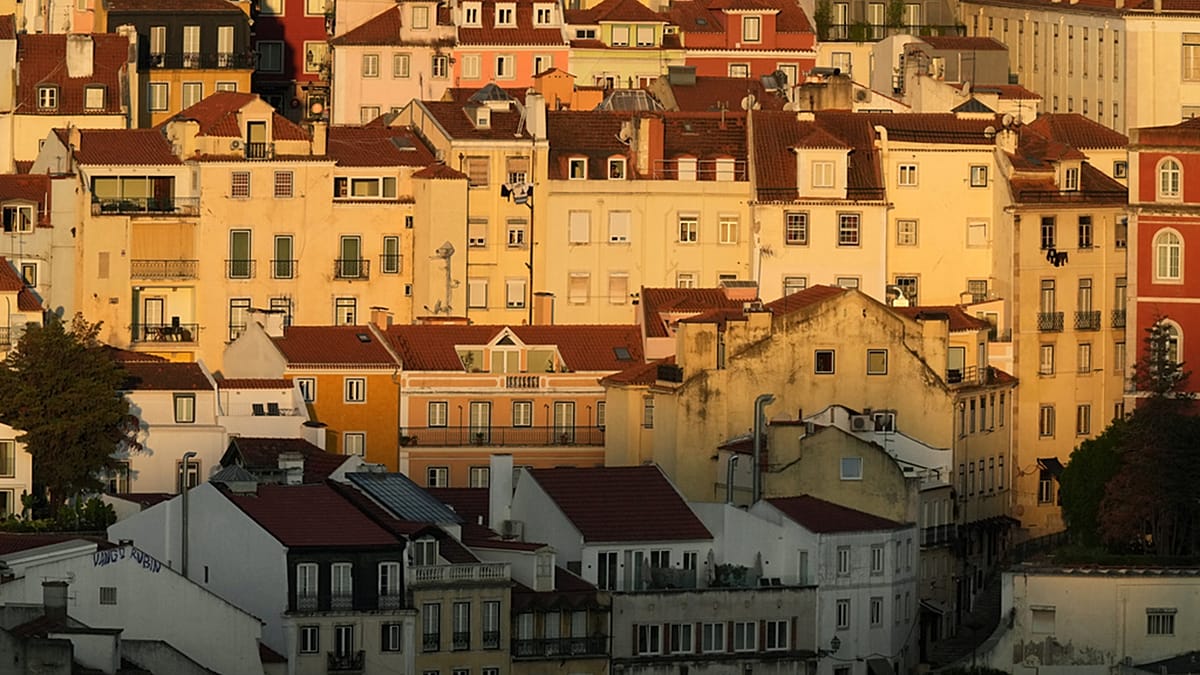
Renting a one-bedroom flat in Portugal now costs more than the monthly minimum wage, according to fresh data from the property portal idealista. The median asking price for such a home reached €1,128 in the second quarter of 2026, roughly €200 above what a worker on the national minimum wage takes home each month. The figure marks a renewed upward push after rents had eased in the first half of the year, with prices climbing again from August.
The gap between a self-contained flat and a single room in a shared house is stark. A room rents for a median €505 a month, meaning a one-bedroom flat is 123% more expensive. Studios sit in between, at €908, which is 80% above a room but still 20% cheaper than a one-bedroom apartment.
Lisbon and the islands lead the way
By district, the Lisbon region is the most expensive place to rent a one-bedroom flat, with a median of €1,354 a month. The island of Madeira follows at €1,295, then Faro at €1,171, Porto at €983, Setúbal at €981 and São Miguel in the Azores at €979.
At the other end of the scale, the cheapest districts are Guarda (€456), Castelo Branco (€527) and Bragança (€529). The pattern holds when looking at district capitals: Lisbon city commands €1,409 a month, Funchal €1,340, Porto €1,003 and Faro €1,001. The most affordable capitals are Guarda (€438), Bragança (€520) and Castelo Branco (€538), with Beja at €790.
For individual rooms, Madeira (€565) edges out the Lisbon district (€551), with Porto third at €457. The cheapest rooms are found in Bragança and Guarda (both €205) and Castelo Branco (€246). In city rankings, Lisbon and Funchal are effectively tied at €570 a month, while Guarda (€200), Beja (€270) and Viseu (€271) offer the lowest prices.
A widening affordability crunch
The data underscores a housing squeeze that has become a central political issue in Portugal, where wages have lagged far behind property prices. The minimum wage, even after recent increases, remains below the median rent for a one-bedroom flat in most urban districts. For younger workers and those in low-paid sectors such as tourism and hospitality, the arithmetic is increasingly impossible without sharing or commuting from cheaper inland areas.
The idealista report compares median asking prices for rooms in shared flats, studios and one-bedroom flats advertised on its platform between April and June 2026, and only includes markets with a sufficiently representative sample. Asking prices are not the same as signed contracts, but they are a reliable indicator of where the market is heading.
The regional divide is pronounced. Coastal and island markets — Lisbon, Madeira, Faro, Porto, Setúbal and the Azores — are all above or near €1,000 for a one-bedroom flat, while inland districts such as Guarda, Castelo Branco and Bragança remain below €550. That gap reflects both tourism demand and the concentration of jobs in the larger cities.
Renters are also contending with broader cost pressures. Energy and transport costs have risen across much of Europe, and Portugal is no exception. Recent analysis has highlighted how public transport costs have surged in many European capitals, adding to the monthly burden for commuters who might otherwise move further from city centres in search of cheaper housing.
The Portuguese government has acknowledged the strain. In recent months, the prime minister unveiled a cost-of-living package aimed at easing household budgets, though it ruled out VAT cuts on essential goods. Separately, a tax relief plan has drawn support but also warnings from economists about economic headwinds that could limit its impact.
For now, the rental market shows little sign of cooling. With a one-bedroom flat costing more than a full month's minimum wage in much of the country, the pressure on Portuguese households — and on the politicians who represent them — is only likely to intensify.