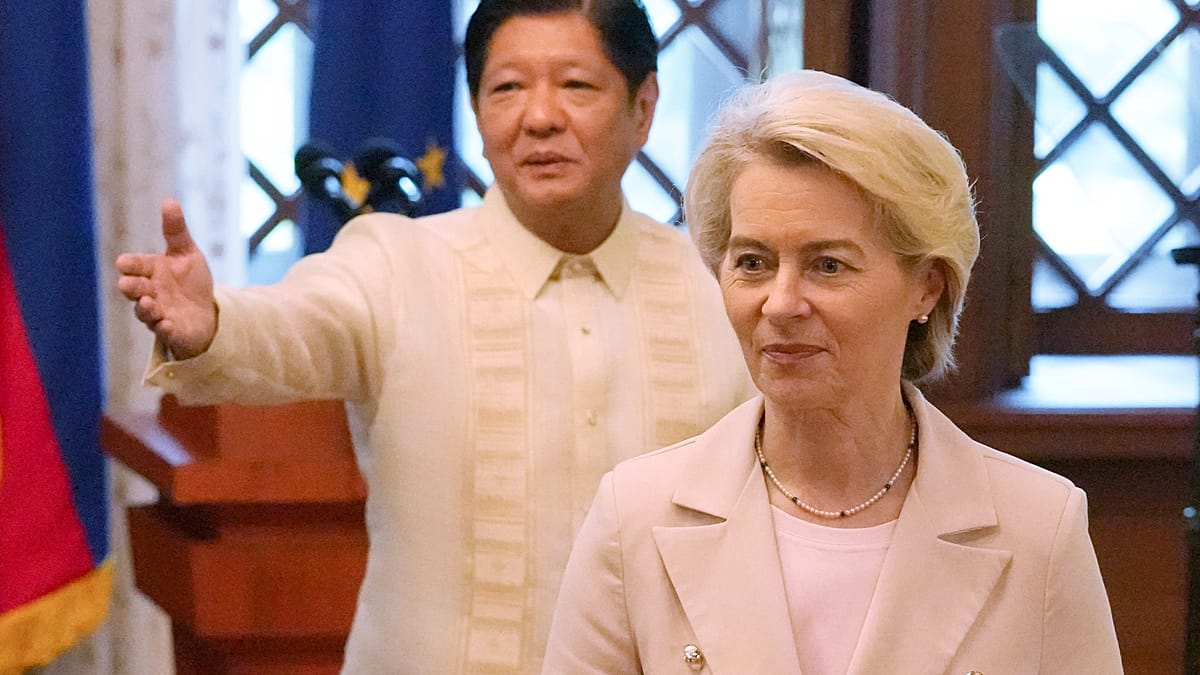
The European Commission concluded a free trade agreement with the Philippines on Tuesday, extending Brussels' effort to build commercial ties across the Indo-Pacific as global trade tensions continue to reshape supply chains.
The accord arrives more than a year after Washington imposed sweeping tariffs on many of its trading partners, triggering countermeasures and unsettling established trade routes. Since then, the EU has moved to lock in new partnerships, recently finalising major deals with India, Australia and Indonesia. The bloc has also been pressing Beijing for concrete results on trade, with Trade Commissioner Maroš Šefčovič heading to Beijing for talks.
What the agreement covers
Under the terms announced in Brussels, the deal will give EU exporters access to a market of 113 million people and eliminate more than 94% of customs duties. It covers over 97% of bilateral trade, including European machinery, pharmaceuticals and medical devices, alongside agricultural products such as meat, pork, poultry and spirits.
Philippine exports to Europe are dominated by semiconductors, integrated circuits and industrial machinery. The agreement is also expected to ease EU investment in Philippine raw materials — a priority as Brussels seeks to reduce reliance on China, which holds a dominant position in several critical materials.
Bilateral trade in goods between the EU and the Philippines reached €17.6 billion in 2025, while services trade stood at €10.3 billion in 2024. The stock of EU foreign direct investment in the archipelago amounted to €15.4 billion.
A signal to the region
Šefčovič framed the deal as evidence of the EU's deepening commitment to the region. "This agreement sends a clear signal that the EU is reinforcing its engagement with the Indo-Pacific," he said on Tuesday.
He added that half of global consumers are covered by European free trade agreements, a reach he described as unmatched by any other trading power.
The commissioner also pointed to what he called a "mutual interest" among Indo-Pacific partners in addressing "the current global turbulence" and "the squeeze on the supply chains."
"This agreement sends a clear signal that the EU is reinforcing its engagement with the Indo-Pacific." — Maroš Šefčovič, EU trade commissioner
Diversification amid turbulence
Brussels has accused Beijing of weaponising critical products for European industry — including chips and rare earths — during 2025, putting sectors such as car manufacturing at risk. The Philippines deal is part of a broader strategy to spread commercial risk and secure alternative sources of supply.
The EU's recent run of agreements in the region reflects a deliberate shift. Canberra has cooled talk of associate membership in favour of a trade-focused relationship, a recalibration that fits Brussels' preference for pragmatic trade deals over institutional expansion.
Not every EU trade file has moved smoothly. The bloc's pact with Canada remains unratified, with CETA still at a crossroads years after it was signed — a reminder that concluding an agreement in Brussels is only the first step.
For now, the Philippines accord gives European firms a firmer footing in Southeast Asia and hands Brussels a fresh argument that its trade agenda is delivering. Whether it can be ratified and implemented without the delays that have dogged other deals will determine how much of that promise is realised.