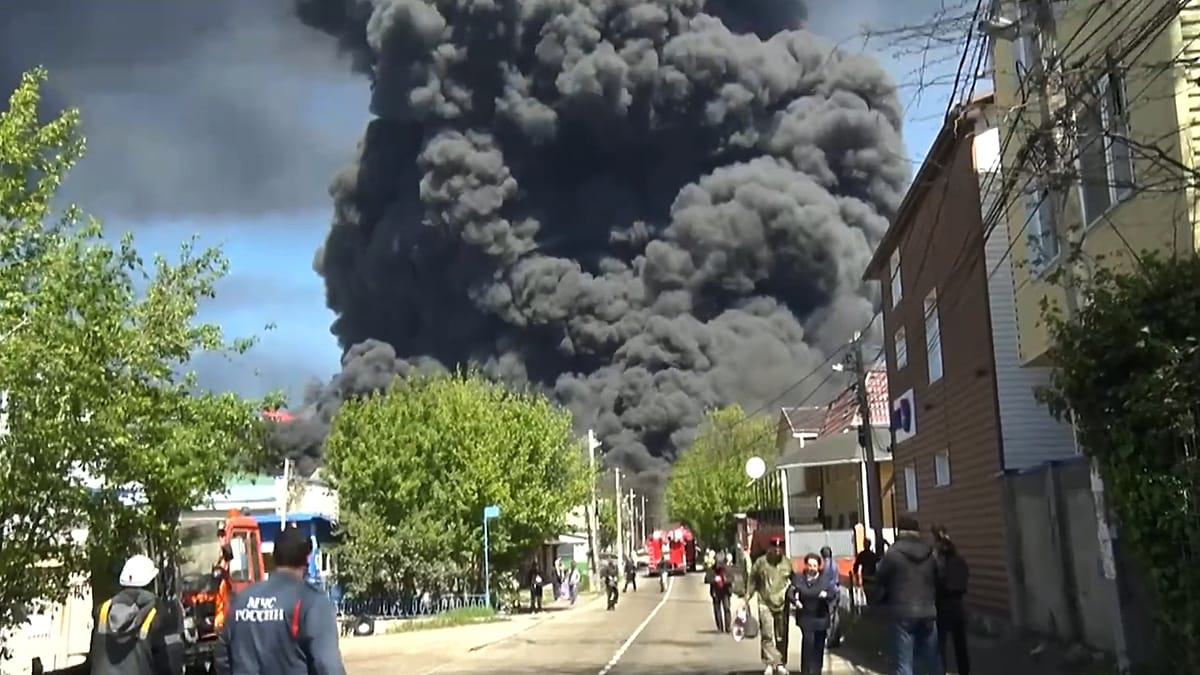
Russian President Vladimir Putin acknowledged for the first time on Sunday that the country is facing a “certain deficit” of fuel, as Ukraine continues its campaign of long-range strikes on Russian energy infrastructure. The admission came after a fresh overnight assault set fire to the Sloviansk refinery in southern Russia, one of the region’s largest oil processing facilities.
Regional Governor Veniamin Kondratyev reported that falling debris from the attack killed one person in the town of Sloviansk and wounded another in a nearby village in eastern occupied Crimea. The Sloviansk refinery, which processes close to 4 million tonnes of crude annually, is a critical source of petroleum products—including fuel oil, naphtha, and marine fuel—that are exported through Russia’s Black Sea ports.
Ukrainian President Volodymyr Zelenskyy claimed that another refinery in the Yaroslavl region, roughly 700 kilometres from the Ukrainian border, was also hit during the night. Russian authorities did not immediately confirm that strike.
Putin’s Response and Vows to Ramp Up Defences
Speaking at a Kremlin meeting focused on domestic fuel supplies, Putin acknowledged that Russia is “going through a difficult period” but insisted Moscow would “honour all its social obligations.” He later told state television that the country’s arms industries would quickly increase production of air defence systems to fend off Ukrainian attacks.
Putin described the fuel shortage as a “temporary deficit” and said Russia would import more fuel and accelerate repair work at oil facilities. He specifically pledged to address fuel shortages in Crimea, stating that deliveries by land and sea would increase and expressing confidence that “this task will be accomplished.”
The Russian leader framed the Ukrainian strikes on oil refineries as an attempt to “cause a split in Russian society and force Russia to halt, even if only briefly, the advance of our troops along the line of contact, and create conditions for launching a negotiation process on terms advantageous to our adversary.” He added, “We will not give them that chance,” and claimed that the strikes “have absolutely no effect on the situation at the front.”
Ukraine’s Long-Range Campaign and Its Impact
Kyiv has intensified its long-range attacks on Russian military and energy facilities in recent months, aiming to cripple the revenue streams that fund the full-scale invasion of Ukraine, now in its fifth year. “Our ‘long-range sanctions’ reached two oil refineries in Russia,” Zelenskyy wrote on Telegram on Sunday. “Each (strike) means a reduction in the resources that fuel the Russian war machine, and another step toward peace.”
The campaign has choked Russian fuel supplies, causing widespread shortages and long queues at petrol stations across the country. Several regions have introduced fuel rationing. According to Western analysts, the disruptions have also slowed Moscow’s battlefield efforts, increasing pressure on the Kremlin to consider negotiations. For more on the broader strategy, see Ukraine Strikes Two Russian Oil Refineries in Continued Energy Campaign.
Putin revealed for the first time that Ukraine had proposed a mutual halt on deep strikes behind enemy lines. He argued that Kyiv made the offer only because Russia’s own deep-strike capabilities are far more powerful. According to Putin, Ukraine also proposed limiting active fighting exclusively to the four regions Russia unilaterally annexed in 2022—Donetsk, Luhansk, Kherson, and Zaporizhzhia—which it has never fully captured. Putin dismissed the proposal as a strategic manoeuvre to allow Ukraine to concentrate its forces against Russian attacks in those areas.
The admission of a fuel deficit marks a notable shift in tone from the Kremlin, which has previously downplayed the economic impact of the war. As the conflict drags on, the ability of both sides to sustain their military operations increasingly depends on energy security and industrial resilience. The situation also has broader implications for European energy markets, as disruptions to Russian exports affect global supply chains. For context on how such tensions play into wider geopolitical dynamics, see Brussels Warns Poland-Ukraine Spat Plays Into Putin's Hands.