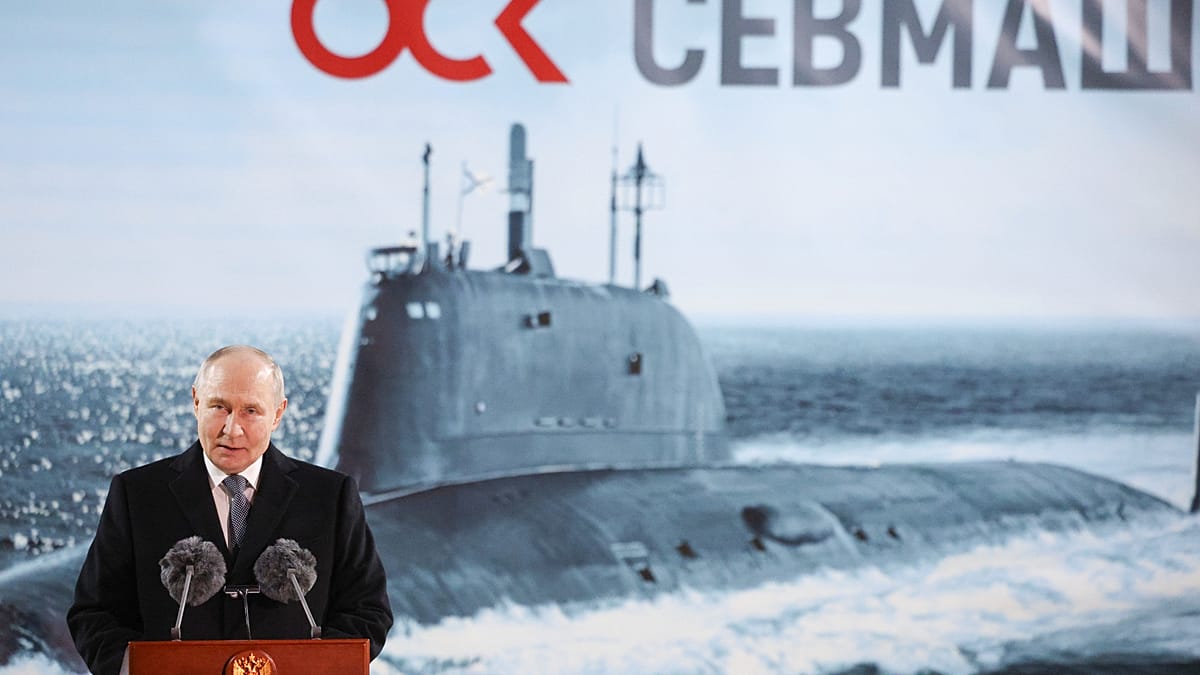
Russian President Vladimir Putin travelled to the White Sea port of Severodvinsk on Friday to preside over the flag-raising ceremony for the Perm, the latest addition to the country's nuclear-powered submarine fleet. The vessel is the fifth of the Yasen-M class to enter service in six years, underscoring Moscow's continued investment in its underwater deterrent despite mounting international pressure over its war in Ukraine.
Speaking at the Sevmash shipyard, Putin said Russia was among a small group of nations capable of building submarines of this scale and sophistication. "Such powerful nuclear-powered submarines can only be built by countries with advanced technological and industrial capabilities," he told assembled officers and shipbuilders. He also announced that five missile-carrying submarines, including three Yasen-M class vessels, are scheduled for delivery to the Russian Navy by 2030.
Strategic signalling in the High North
The commissioning of the Perm comes at a time of heightened military activity across the Baltic and Arctic regions. NATO has responded to recent incidents with increased patrols, including deploying AWACS surveillance aircraft to Poland after Russian missiles crossed into allied airspace. The new submarine, armed with Kalibr and Zircon cruise missiles, is designed to project power far beyond Russia's coastal waters, a capability that European defence planners are watching closely.
Severodvinsk, a closed city in Arkhangelsk Oblast, has been the centre of Russia's submarine construction for decades. The Yasen-M class, also known as the Project 885M, is considered the most advanced attack submarine in the Russian fleet, with improved stealth and a wider array of weaponry than its predecessors. The Perm is expected to be based with the Northern Fleet, which operates from the Kola Peninsula, just a few hundred kilometres from Norway and Finland.
The timing of the ceremony is significant. With winter setting in, Russia has intensified its aerial campaign against Ukraine, and drones have killed civilians and crippled Ukraine's power grid. The submarine unveiling serves as a reminder that Moscow retains a formidable nuclear arsenal even as its conventional forces face setbacks on the battlefield.
European security implications
For European allies, the expansion of Russia's submarine fleet raises questions about the balance of power in the North Atlantic and the Baltic Sea. NATO has already responded to Russian activity near its borders, with fighter jets scrambling to intercept drones over Latvia and other allied territory. The alliance has also strengthened its naval presence in the Norwegian Sea, where Russian submarines regularly operate.
Finland, which joined NATO in 2023, now shares a long border with Russia and has become a frontline state in the alliance's northern flank. Sweden, a recent member, has also increased its focus on submarine detection in the Baltic. The Perm's deployment is likely to accelerate these efforts, as European navies invest in anti-submarine warfare capabilities.
Beyond the military dimension, the ceremony in Severodvinsk carries political symbolism. Putin has repeatedly sought to project strength at home, and the submarine launch offers a rare piece of positive news for the Kremlin. However, the broader picture is one of strain: Russia's defence budget is stretched, and its military has suffered significant losses in Ukraine. The announcement of five more submarines by 2030 suggests a long-term commitment to modernising the fleet, but it remains to be seen whether the industrial base can deliver on that promise.
For now, the Perm is a tangible sign that Russia's nuclear submarine programme remains on track, even as other parts of its military face challenges. European defence officials will be analysing the vessel's capabilities and its potential impact on regional security for years to come.