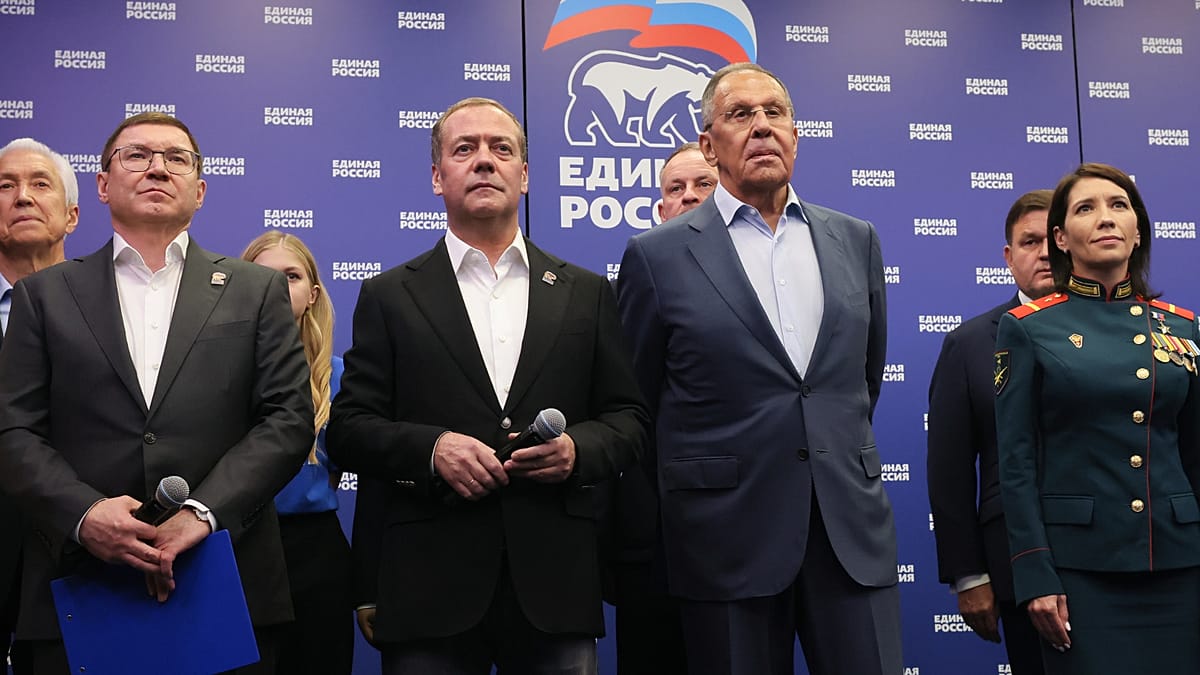
Vladimir Putin's United Russia party has won a record supermajority in the State Duma, according to preliminary results released on Monday. The three-day vote, tightly controlled by the Kremlin, excluded every party critical of the government or its war in Ukraine.
Central Election Commission chief Ella Pamfilova announced that United Russia had secured 355 of the 450 seats, surpassing its previous best of 343 set in 2016 and far exceeding the 301 needed to amend the constitution. Final results are expected later this week.
The Communist Party finished second with 40 seats, followed by the nationalist LDPR with 25, New People with 20, and A Just Russia with four. Turnout was reported at over 59 percent.
This was Russia's first parliamentary election since the full-scale invasion of Ukraine began in 2022. Criticism of the war is banned, and Yabloko, the only party calling for an end to the fighting, was barred from running for the national parliament, though it was allowed to stand in some regional contests.
Kremlin spokesman Dmitry Peskov hailed the result as evidence of "the highest level of consolidation within Russian society around the head of state." State media reported that 49 veterans who fought in Ukraine are expected to enter the Duma for United Russia.
Voting also took place in occupied parts of Ukraine, including Crimea and the Donetsk, Luhansk, Kherson, and Zaporizhzhia regions. On Sunday, the final day of polling, Kyiv launched its largest drone attack of the war on Moscow, killing two people and setting an oil refinery ablaze. Russia's defence ministry accused Ukraine of trying to disrupt the vote and vowed to intensify strikes on Kyiv.
EU condemns 'veneer of democracy'
The EU's top diplomat, Kaja Kallas, said the Kremlin had "silenced dissent" and shut out international election monitors. "The veneer of democracy is all that remains in Russia," she said in a statement on behalf of the bloc. "The State Duma elections held by Russia on 18–20 September underscored the continued and deepening erosion of democracy in Russia, taking place in an increasingly authoritarian political environment."
Kallas announced that the EU would impose sanctions on those who organised the vote or stood as candidates in occupied Ukrainian territory. "The European Union reiterates that it does not and will never recognise either the holding of these so-called 'elections' in the temporarily occupied territories of Ukraine or their results," the statement said.
Britain, Australia, Canada, New Zealand, and Norway issued a joint statement calling the vote in occupied areas a "gross violation" of Ukraine's sovereignty and the UN Charter. They stressed that the election could not change the status of those territories under international law. "These sham elections are part of a wider system of occupation: the imposition of Russian administration, law, media, education, language and citizenship, backed by coercion and repression," the statement read.
Ukraine's foreign ministry had earlier dismissed the voting in occupied regions as a "farce" and said it would not recognise the results.
The election produced one surprise: in the Novgorod region, where Yabloko was allowed on the ballot for regional elections held simultaneously, it won just over six percent of the vote, enough to enter the regional parliament.
The EU's response comes amid broader discussions on Russia sanctions, with delisting debates and renewal deadlocks complicating unity. Meanwhile, the drone assault on Moscow has added to pressure on European leaders, as Germany's Friedrich Merz faces new setbacks in navigating the crisis.