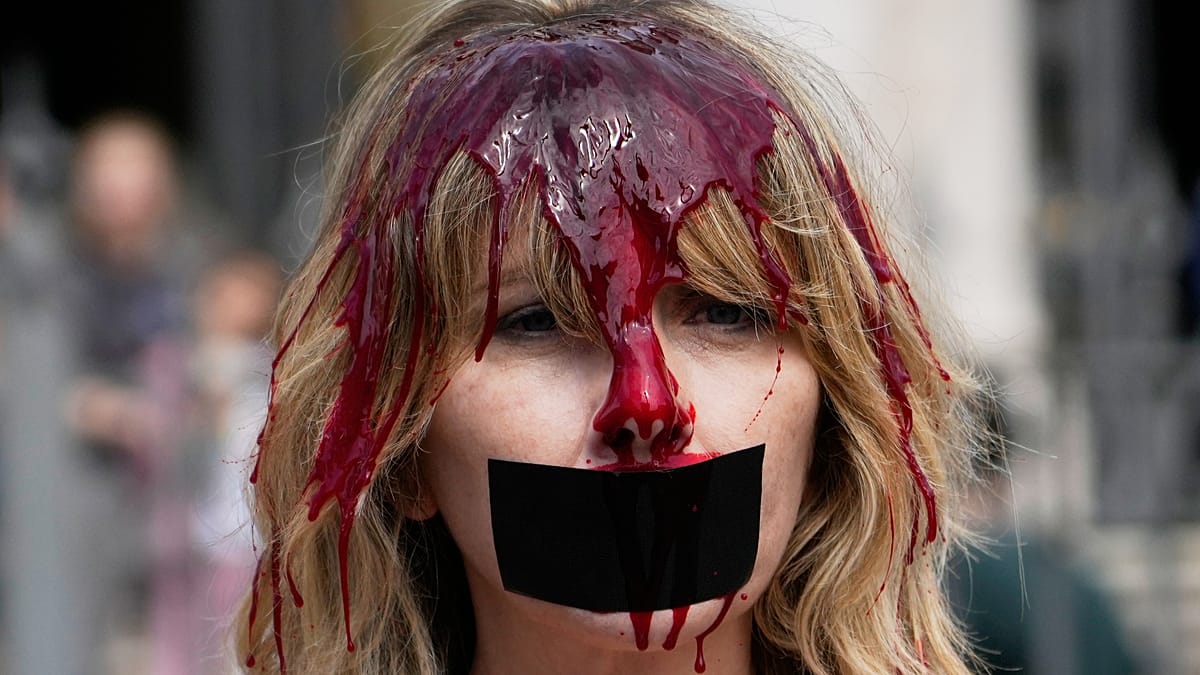
In the days leading up to the San Fermín festival, a group of animal rights activists staged a striking protest in Pamplona, covering themselves in red paint to symbolize the bloodshed of bullfighting. The demonstration, which took place in the city's main square, aimed to draw attention to the suffering of bulls during the annual event that attracts thousands of visitors from across Europe and beyond.
Symbolism and Strategy
The activists, members of the organization AnimaNaturalis, stood motionless with their bodies painted crimson, holding signs that read "Stop Bullfighting" and "Torture is Not Culture." The choice of red paint was deliberate, evoking the blood spilled in the bullring during the corridas that are central to San Fermín. Pamplona, the capital of Navarre, has long been a focal point for the debate over bullfighting, a tradition deeply rooted in Spanish culture but increasingly contested both domestically and internationally.
"We are here to remind people that behind the festivities lies a brutal practice that causes immense suffering to animals," said a spokesperson for AnimaNaturalis. "Bullfighting is not a sport or art; it is a form of torture that has no place in a modern, compassionate society." The protest comes as public opinion in Spain shifts, with younger generations more skeptical of the tradition. According to a 2023 survey by the Spanish Center for Sociological Research, nearly 60% of Spaniards oppose bullfighting, though support remains strong in regions like Navarre and Andalusia.
San Fermín: A Festival Under Scrutiny
The San Fermín festival, which runs from July 6 to 14, is famous for its daily encierro—the running of the bulls through Pamplona's narrow streets—followed by bullfights in the afternoon. The event draws hundreds of thousands of tourists, contributing significantly to the local economy. However, it has also become a flashpoint for animal rights activism, with protests occurring annually. In recent years, similar demonstrations have taken place in other Spanish cities, including Madrid and Barcelona, where bullfighting has been banned since 2010.
The debate over bullfighting extends beyond Spain's borders. In France, where bullfighting is legal in some southern regions, activists have also campaigned against the practice. The European Union has not taken a formal stance, leaving the matter to member states. This has led to a patchwork of regulations: Portugal permits bullfighting but prohibits killing the bull in the ring, while the UK and Germany have outright bans.
Broader Context of Activism in Europe
The Pamplona protest is part of a wider wave of activism across Europe, where citizens are increasingly using direct action to challenge established norms. In France, nationwide protests have demanded a comprehensive law against sexual violence, while in Germany, 20,000 people protested the AfD party conference in Erfurt. These movements reflect a growing willingness to confront institutions and traditions through visible, often disruptive, means.
In Italy, a novel approach to animal welfare has emerged with Milan's Animal Parliament, which gives urban wildlife a voice in city planning. This initiative, while different in method, shares the underlying goal of rethinking humanity's relationship with animals. The Pamplona protest, though more confrontational, taps into the same ethical concerns.
Local Reactions and Future Outlook
Reactions in Pamplona were mixed. Some locals expressed frustration, viewing the protest as an attack on their cultural heritage. "San Fermín is part of who we are," said a resident who declined to give his name. "These activists come from outside and don't understand our traditions." Others, however, voiced support. A young woman from the city noted, "I grew up with the festival, but I've never been comfortable with the bullfighting. It's good that people are speaking out."
The future of bullfighting in Spain remains uncertain. While the national government has not moved to ban it, regional authorities have taken steps to limit its reach. The Canary Islands banned bullfighting in 1991, and Catalonia followed in 2010, though Spain's Constitutional Court later overturned the Catalan ban, ruling that it infringed on cultural rights. The European Court of Human Rights has also weighed in, rejecting a challenge to bullfighting in 2014. As the debate continues, protests like the one in Pamplona ensure that the issue remains in the public eye, challenging Spaniards and Europeans alike to reconsider what traditions are worth preserving.