As heatwaves and drought continue to stoke wildfire risk across western and central Europe, a quiet revolution is taking place on Spanish farmland. Regenerative farmers are using grazing, tree management, and water storage to protect their land—and their communities—from the flames. Yet this approach remains an underused tool, and practitioners say they need far more support.
This summer has already forced around a third of a million people from their homes in France and Spain, and the season is far from over. Near Athens, a mid-air collision between two firefighting helicopters killed a Greek and a Danish national, and further evacuations were ordered as flames spread. The 2025 fire season saw 10,000 square kilometres burned across Europe, a record that may yet be broken as temperatures on the continent rise more than twice as fast as the global average.
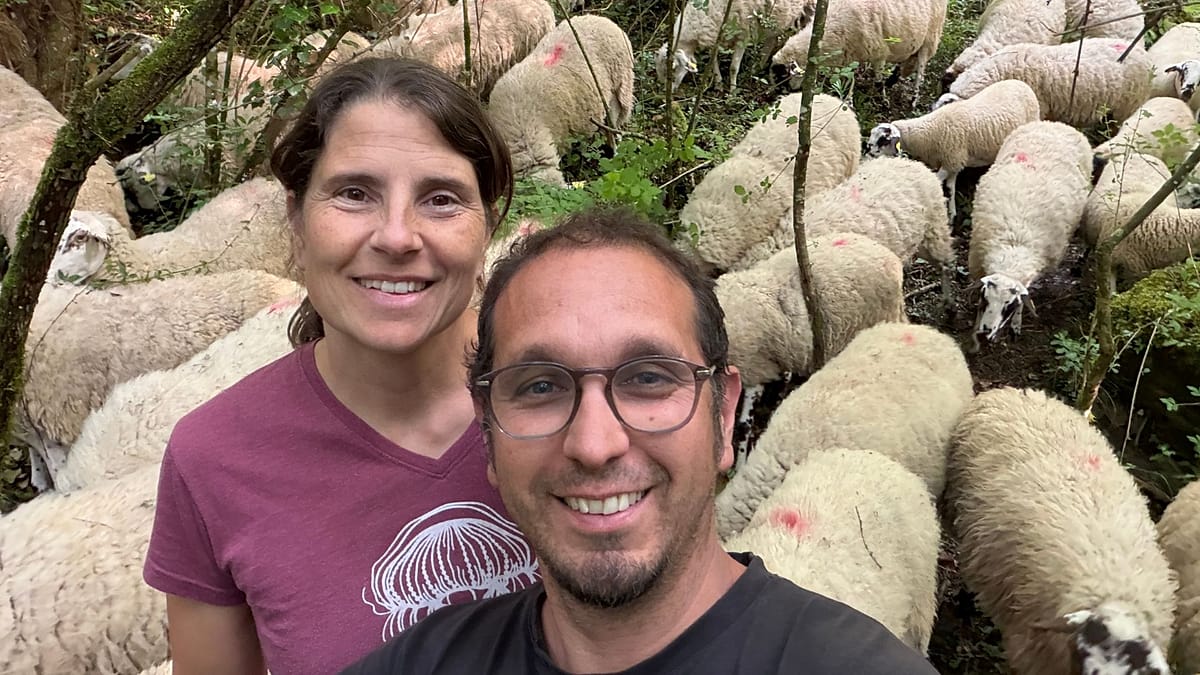
In Catalonia, Sergi Caballero, co-founder of the permaculture farm and cooperative Mas Les Vinyes, describes this as the most dangerous summer he has ever experienced. “We’re inland, we get minus 12 in winter – but this year I’ve measured 45°C in the field. I’ve never had to use a fan at night before,” he says. Trained as a volunteer with Catalonia’s ADF forest defence firefighters, Caballero has positioned water tanks at key points around his farm, ready to respond to any blaze.
Prevention through landscape management
Caballero’s approach goes beyond reaction. Over more than a decade, he has mapped the most vulnerable areas of his farm, removed fire-prone pine trees while retaining fire-resistant oaks and holm oaks, and used wood chippers to turn dead branches into soil fertiliser. Livestock graze on dry grass before it can become fuel, and two water-cleaning ponds, holding around a million litres between them, sit in the farm’s most exposed western sector, acting as firebreaks and water sources for firefighters.
“The single most important thing we can do is stop grass from drying out and building up – keeping it grazed – and managing the forest understorey with livestock,” Caballero explains. These practices have tripled the farm’s soil organic matter, boosting its water retention. But even this is not enough against the current drought: three years ago, a similar dry spell wiped out an entire apricot crop, and this year Caballero has counted 20 more dead pear trees. He has replaced apricots with figs, which are more drought-resilient but sell for less. “The crops that survive the climate crisis are worth the least. That’s a problem policymakers need to solve,” he says.
Commonland, an international non-profit working on landscape restoration in more than 50 countries, argues that such regenerative practices are Europe’s most overlooked defence against fire. “Our ecosystems have been stripped bare by industrial land use practices and we’re witnessing the results in real time,” says Lily Maxwell-Lwin, Commonland’s head of advocacy. “Our most underused tool to fight wildfires is restoring our landscapes. As well as moving away from a fossil fuel economy, we must invest in green infrastructure as a vital risk management tool.”
Commonland’s 4 Returns Framework links land restoration to social impact, biodiversity, financial return, and a sense of pride in place. The approach is gaining traction, but it remains far from mainstream.
Striking differences on conventional farms
In Andalucía, Carmen Bueno, a farmer and founder of the regenerative agriculture association Serranías Vivas, implemented a preventive fire plan in May. Her land, grazed by sheep and horses, escaped this year’s wildfires unscathed. Even her cork oaks, though scorched, are expected to recover. “The key to this is that we did not remove the cork during the last 11 years: the cork is the trees’ greatest protection,” she says. “While it may look burnt on the outside, it is protecting the tree itself.”
The contrast with conventional farms is stark. The Spanish Association for Regenerative Agriculture analysed a recent fire’s impact on farmland managed both conventionally and regeneratively. “The conclusions are striking,” says president Ana Digón. Where sheep were moved daily to clear areas around buildings and regenerate prairies, the fire ran through quickly, and trees, though affected, will recover. On neighbouring farms with unplanned grazing, dense bush allowed the fire to linger, causing far more damage.
As Europe braces for more extreme fire seasons, the evidence is mounting that regenerative farming is not just a niche practice but a vital part of the continent’s defence. Yet without policy support and financial incentives, farmers like Caballero and Bueno remain the exception. The question is whether European governments will recognise the value of green infrastructure before the next record-breaking summer arrives.