Removing three Banksy artworks from public sites in London has cost UK taxpayers almost £150,000 (€175,000), according to figures obtained through a freedom of information request. The bill covers removal, security, and related expenses, and it has reignited a familiar argument: is Banksy’s work valuable public art or costly vandalism?
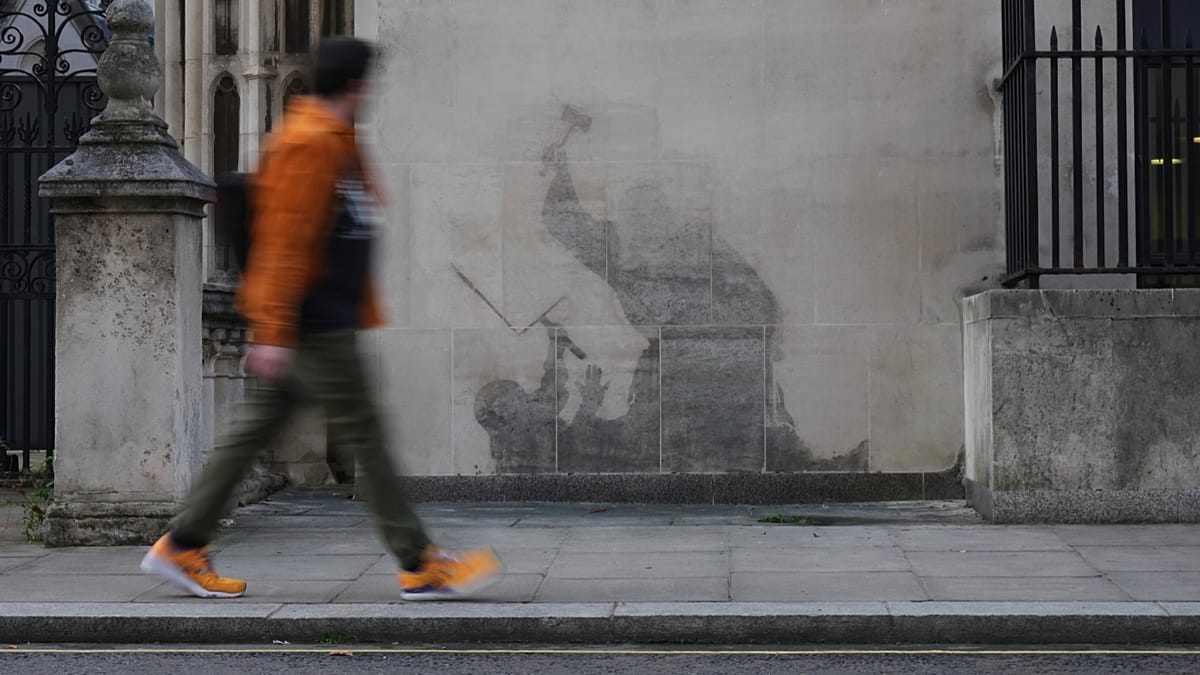
The largest single expense came from a mural painted on the Royal Courts of Justice in September 2025. The artwork, which showed a protester lying on the ground holding a blood-spattered placard while a judge loomed above with a gavel, was widely read as a response to the UK government’s crackdown on the activist group Palestine Action. So far, removal and security at the Grade II-listed building on Carey Street have cost more than £85,000 (€100,000), and the process is still ongoing, meaning the final bill is expected to climb.
A breakdown of the costs shows that £50,000 (€59,000) went towards stripping the paint from the historic facade, while an additional £35,000 (€41,000) covered overtime and security. The HM Courts and Tribunals Service defended the expenditure, stating: “The Royal Courts of Justice is a listed building and HMCTS are obliged to maintain its original character.”
Banksy’s work has also generated costs elsewhere in the capital. In April, a statue appeared in Waterloo Place depicting a man walking off the end of a plinth, holding a flag pole with the fabric covering his face. Protecting that piece cost around £60,000 (€70,000) in security barriers, staff, and administrative expenses. Earlier, in August 2024, Banksy transformed a City of London police sentry box into a giant piranha tank; that artwork was removed at a cost of £2,200 (€2,500) and is slated for permanent display at the London Museum later this year.
Vandalism or art?
The recent cases have renewed debate over the place of Banksy’s work in public spaces and the extent to which public money should be spent protecting or removing it. Art critic Estelle Lovatt defends Banksy’s work and highlights its tourism appeal. “Some people visit Buckingham Palace and others visit Banksy’s art,” she told the BBC. “His work brings people together in a way that politics can divide us. He’s like the Pied Piper or a town crier.”
But Shadow Justice Secretary Nick Timothy took a very different view, describing the use of taxpayers’ money to deal with the artwork as “outrageous”. “Our courts are a national symbol of justice and the rule of law,” he said. “Banksy’s vandalism should be stopped and he should foot the bill for the costs he imposes on others.”
The debate is not unique to London. Across Europe, cities grapple with the line between street art and graffiti. In Rome, the problem is less glamorous: monuments, homes, and newly restored buildings are covered in anonymous tags. The Italian capital has become the unlikely workplace of 28-year-old architectural restorer Valerio Tuveri, who has built a following on Instagram and TikTok by travelling around the city removing tags and graffiti from its historic walls. Using a sandblaster and a camera phone, Tuveri has become known online as “the guy who cleans Rome”.
His latest project has been Villa Sciarra, a historic landmark in Rome, where fresh graffiti had appeared on newly restored walls. Wearing protective equipment and using a high-pressure sand blaster, he carefully removed the spray paint while preserving the stone underneath. “I decided to take this path, this 'battle', against graffiti because Rome is, in my opinion, the most beautiful city in the world, but at the same time the most vandalised city in Europe,” he says. “There is meaningless writing everywhere: on monuments, private homes, cars and shutters.”
Tuveri believes there is a clear distinction between street art and the indiscriminate tags that cover many of the city's historic buildings. While Banksy’s works may provoke debate, the costs of removing them are a tangible burden for taxpayers, and the question of who should pay—artist or public—remains unresolved. As London and Rome show, the challenge of balancing preservation, public enjoyment, and fiscal responsibility is a shared European one.