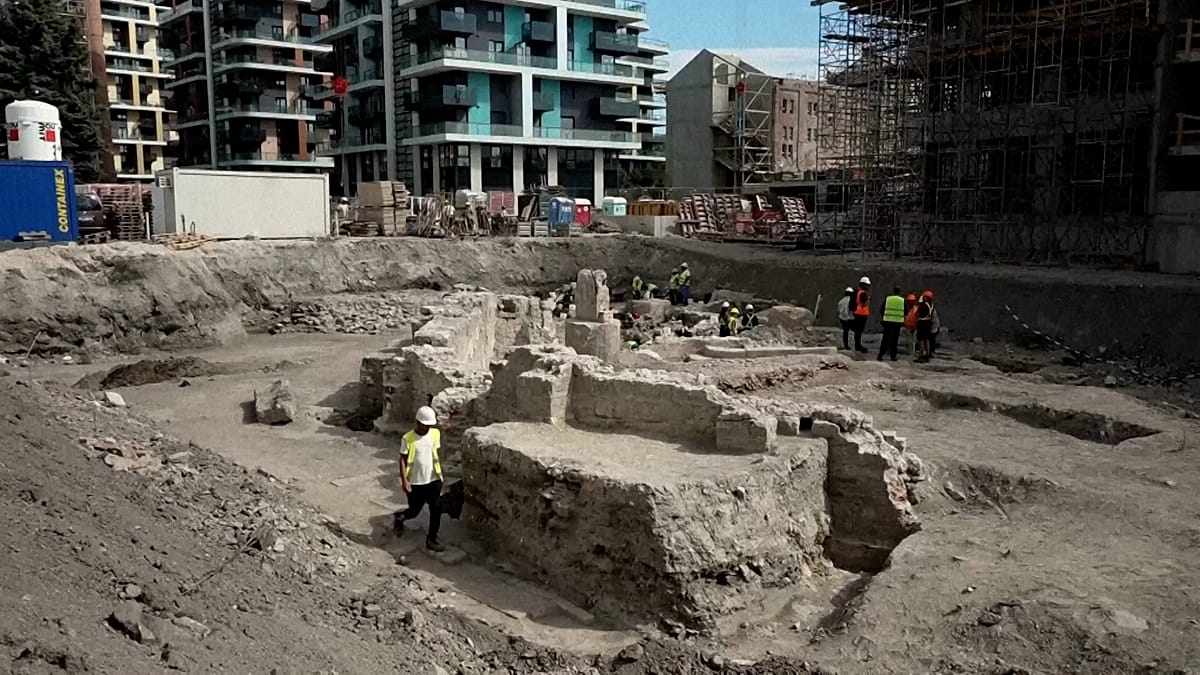
For nearly two millennia, a massive Roman structure lay hidden beneath the streets of Budapest. Now, archaeologists have exposed its remains, but the discovery has raised more questions than answers. The building, which dates from the 3rd or 4th century AD, extends for hundreds of metres and terminates in an unusual polygonal tower. Despite its scale, its purpose remains elusive.
A public building with military ties?
The structure is thought to have been an important public edifice, possibly connected to the Roman military. Its sheer size suggests it played a significant role in the life of the ancient settlement, which was known as Aquincum and served as the capital of the Roman province of Pannonia Inferior. However, the walls are notably thin, which makes it unlikely to have been a fortress or defensive installation.
Adding to the puzzle, the building does not appear on any surviving Roman maps or records. This absence is striking, given that Aquincum was a well-documented military and civilian centre. The site has yielded a wealth of artefacts over the years, from mosaics and frescoes to everyday objects, yet this structure seems to have been overlooked by history.
Archaeologists are now working to determine what the building was used for. Some speculate it could have been a basilica or a praetorium—a headquarters for a military commander. Others suggest it might have been a warehouse, a bathhouse, or even a meeting hall for a religious cult. The polygonal tower is particularly baffling, as such designs are rare in Roman architecture of this period.
Unanswered questions
The discovery was made during routine excavation work in the central part of the Hungarian capital, not far from the Danube. The river, which has long been a lifeline for the city, also served as a natural boundary for the Roman Empire. The building's proximity to the river could hint at a logistical or commercial function, but without further evidence, that remains speculation.
One of the most intriguing aspects is the building's longevity. It appears to have been in use for several centuries, with evidence of modifications and repairs. This suggests it was not a temporary structure but a permanent fixture in the urban landscape. Yet, its absence from historical records is a mystery that may never be fully solved.
The find has captured the imagination of both scholars and the public. In a city that has already yielded remarkable Roman treasures, this new discovery adds another layer to Budapest's rich archaeological heritage. It also serves as a reminder that even in a well-studied city, the past can still surprise us.
As excavations continue, researchers hope that further analysis of the site—including soil samples, pottery shards, and carbon dating—will provide clues. For now, the structure stands as a silent testament to the ingenuity of the Roman builders and the enduring mystery of their world.
Budapest's Roman past is a major draw for tourists, and this discovery is likely to become a new point of interest. The city has long been a crossroads of cultures, and its underground layers tell the story of successive civilizations. This latest find is a vivid example of how much remains to be uncovered.
While the building's exact purpose may remain unknown, its discovery underscores the importance of continued archaeological research. As one expert put it, “Every dig in Budapest has the potential to rewrite history.” For now, the polygonal tower and its vast hall stand as a puzzle waiting to be solved.