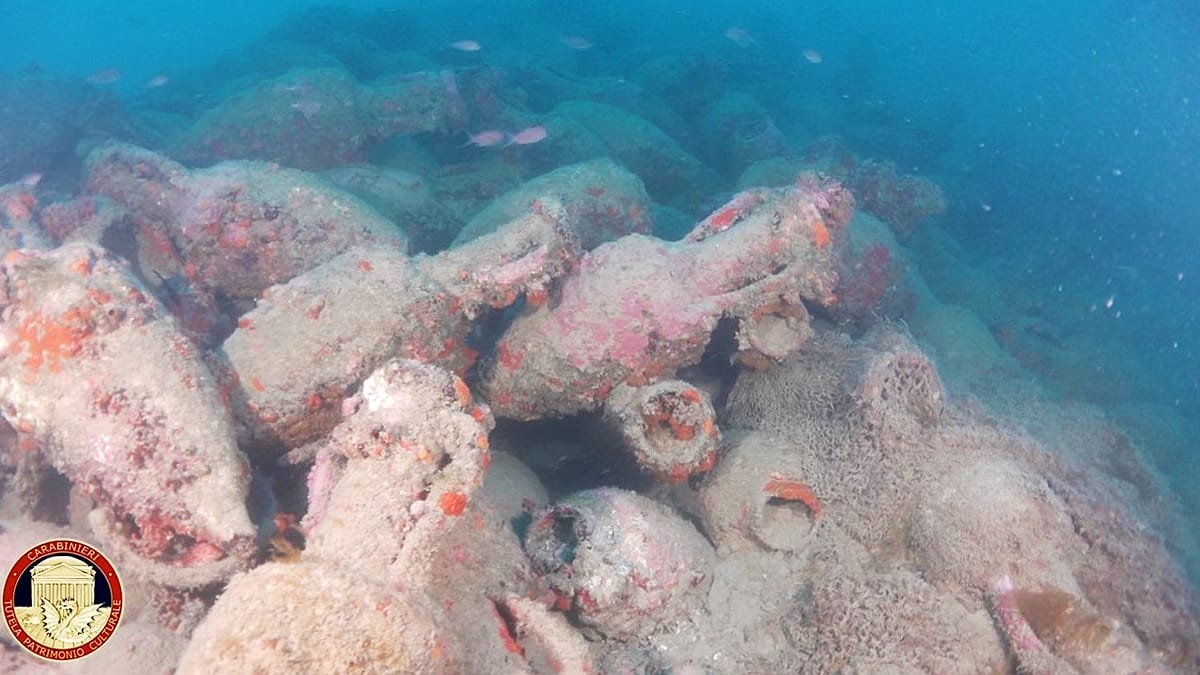
Off the western coast of Sicily, near the port town of Mazara del Vallo, archaeologists have located a well-preserved Roman shipwreck lying on the seabed. The vessel, believed to date from between the 2nd and 1st centuries BC, rests at a depth of 46 metres, roughly three nautical miles from shore. The Italian Ministry of Culture announced the find on Tuesday, describing a scatter of hundreds of amphorae, mostly of the Dressel 1A type—large, sturdy containers used for transporting wine and olive oil across the Mediterranean.
Alongside the amphorae, divers and remote-operated vehicles identified two lead anchor stocks and another structure made of the same metal, likely part of the ship's rigging or hull fittings. The site was first flagged by private citizens, prompting a joint inspection by the Carabinieri Cultural Heritage Protection Unit in Palermo, the Sea Superintendency of the Sicilian Region, and the Carabinieri Underwater Unit in Messina, with support from a patrol boat in Trapani.
A window into ancient trade routes
Italian Culture Minister Alessandro Giuli hailed the discovery as "extraordinary," noting that it offers a rare glimpse into the maritime commerce that once linked the shores of the Mediterranean. "The sea continues to give back precious fragments of our history," Giuli said in a statement. "The wreck of Mazara del Vallo tells us about the people, the routes and the trade that made the Mediterranean a crossroads of civilisations." He also praised the Carabinieri and the regional superintendency for their expertise and dedication.
The Dressel 1A amphora type is particularly significant for archaeologists. Produced in the late Republican period, these vessels were widely used for shipping wine from the Italian peninsula to Gaul and other western provinces. Their presence suggests the ship was likely a merchant vessel plying a well-established route, possibly between Campania and southern France or Spain. The discovery adds to a growing body of evidence about the scale and sophistication of Roman-era seafaring.
The site will now undergo further documentation and research led by the Sea Superintendency of the Sicilian Region. The goal is to reconstruct the archaeological context, map the distribution of artefacts, and implement protective measures to safeguard the wreck from looting and environmental damage. Underwater archaeology in Sicily has a strong track record, with notable finds such as the famous "Satyros of Mazara" bronze statue recovered in 1998.
This is not the only recent maritime discovery off Sicily. Just days earlier, scientists announced the identification of a large submerged crater and new hydrothermal vents off the island of Panarea in the Aeolian archipelago. That geological find, located about one nautical mile northeast of Panarea at depths between 60 and 80 metres, measures roughly 100 metres long and 60 metres wide. The vents emit gases from the seabed, offering researchers fresh opportunities to study the island's volcanic system and its evolution.
While the Panarea discovery is geological rather than archaeological, both finds underscore the rich layers of history and natural phenomena hidden beneath the waters around Sicily. For archaeologists, the Mazara del Vallo wreck is a reminder of how much remains to be uncovered. As Giuli put it, research will continue "to uncover its story and share it with the public."
Similar underwater treasures have been found elsewhere in the Mediterranean, but the sheer number of amphorae at this site makes it particularly valuable. The amphorae themselves are likely to provide clues about the cargo's origin, the ship's route, and even the economic conditions of the era. Analysis of residues inside the vessels could reveal what was being transported—wine, oil, fish sauce, or other goods—and where they came from.
The discovery also highlights the importance of collaboration between state agencies and local communities. The initial tip-off from private citizens was crucial, and the Carabinieri's specialised units, including divers and heritage protection experts, played a key role in verifying the find. Such teamwork is essential for preserving underwater cultural heritage, which is often vulnerable to illegal salvage and damage from fishing or anchoring.
For now, the wreck remains under the protection of the Italian state, and further surveys are planned. The public may eventually get a chance to see some of the artefacts in museums, as has happened with other Sicilian shipwrecks. Until then, the site off Mazara del Vallo stands as a silent testament to the maritime networks that once bound the Mediterranean world together.