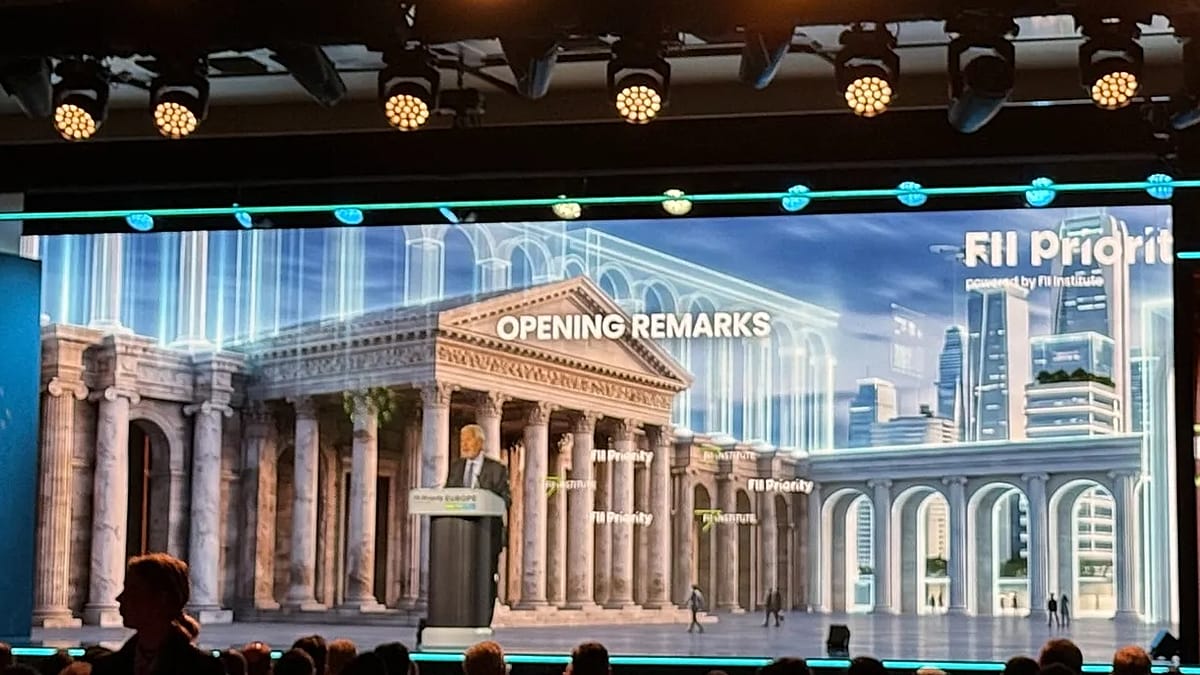
ROME — Europe stands at a crossroads: it has the talent, innovation, and industrial base to lead the next global economic wave, but investors warn that bureaucratic inertia and regulatory complexity are holding it back. That was the central message from the FII Priority Europe summit held in the Italian capital, where political leaders, business executives, and sovereign wealth fund managers gathered to assess the continent’s investment climate.
While the G7 meetings in the same city focused on geopolitics and security, the FII summit zeroed in on economics. The message from global capital was clear: Europe must streamline its regulatory environment if it wants to compete with the United States and fast-moving Asian economies for the trillions of dollars needed to finance its industrial and technological transformation.
Investors Demand Speed and Certainty
Richard Attias, executive chairman of the FII Institute, delivered a blunt assessment to European policymakers. “Europe remains one of the most attractive markets in the world, but investors are looking for clarity, predictability and speed in decision-making,” he said. Attias argued for greater regulatory flexibility and a simplification of administrative procedures to channel capital into strategic sectors such as artificial intelligence, digital infrastructure, clean energy, and advanced manufacturing.
He warned that Europe is not only competing with the United States but also with emerging economies that are fast-tracking reforms to attract companies and major industrial projects. The challenge, he stressed, is not to abandon European standards but to strike a balance between regulation, innovation, and growth. “The world is moving at high speed, and so is capital. Europe has an extraordinary opportunity to lead the next economic transformation, but it must ensure that the conditions for investing are as competitive as in other regions,” Attias added.
The debate echoes a broader discussion across the continent about how to boost competitiveness without sacrificing the social and environmental protections that define the European model. A related EU competitiveness debate has pitted advocates of deeper integration against those calling for deregulation, a tension that the FII summit brought into sharp relief.
Sovereign Wealth Giants Eye Long-Term Bets
Yasir O. Al Rumayyan, governor of Saudi Arabia’s Public Investment Fund (PIF) and chairman of Aramco, reinforced the message. The PIF, which manages assets worth around $1.15 trillion, sees Europe as a key destination for long-term capital. “Europe has enormous opportunities in areas such as the energy transition, technological innovation and strategic infrastructure,” Al Rumayyan said. His words carry weight: Aramco posted profits of $93.5 billion last year, making it one of the world’s most profitable companies.
The choice of Rome as the summit venue was deliberate. For the organisers, the Italian capital symbolises Europe’s ability to combine its historical legacy with a reform agenda focused on the future. The city’s ancient streets and modern conference halls provided a backdrop for discussions on how to turn Europe’s potential into sustained economic growth.
Yet the summit also highlighted persistent challenges. While global capital is interested in Europe, investors remain cautious about fragmented regulations, slow permitting processes, and political uncertainty in some member states. The gap between AI hype and actual business adoption in Europe was cited as an example of where regulatory clarity could accelerate investment.
Attias placed the investment challenge within the broader debate on European strategic autonomy. He argued that the continent’s ability to finance its energy transition, develop home-grown technologies, and strengthen supply chains will depend on mobilising both public and private capital on a large scale. Without a more investment-friendly environment, Europe risks falling behind in the global race for economic leadership.
The summit concluded with a call for action: Europe has the assets, but it needs the agility to turn them into advantages. As one delegate put it, the continent must decide whether it wants to be a museum or a powerhouse.