The European Union has long styled itself as an economic superpower: a single market of 450 million consumers, home to global corporate giants and the world's largest trading bloc. But as competition with the United States and China intensifies, that self-image is under strain.
Growth across the EU remains sluggish. Entire industrial sectors — from automotive to chemicals — face mounting pressure. Businesses complain of high energy costs, a thicket of regulations, and insufficient investment. Meanwhile, Washington is pouring billions into strategic industries through the Inflation Reduction Act and CHIPS Act, while Beijing deploys state-backed capital to dominate artificial intelligence, rare earths, and clean-tech supply chains.
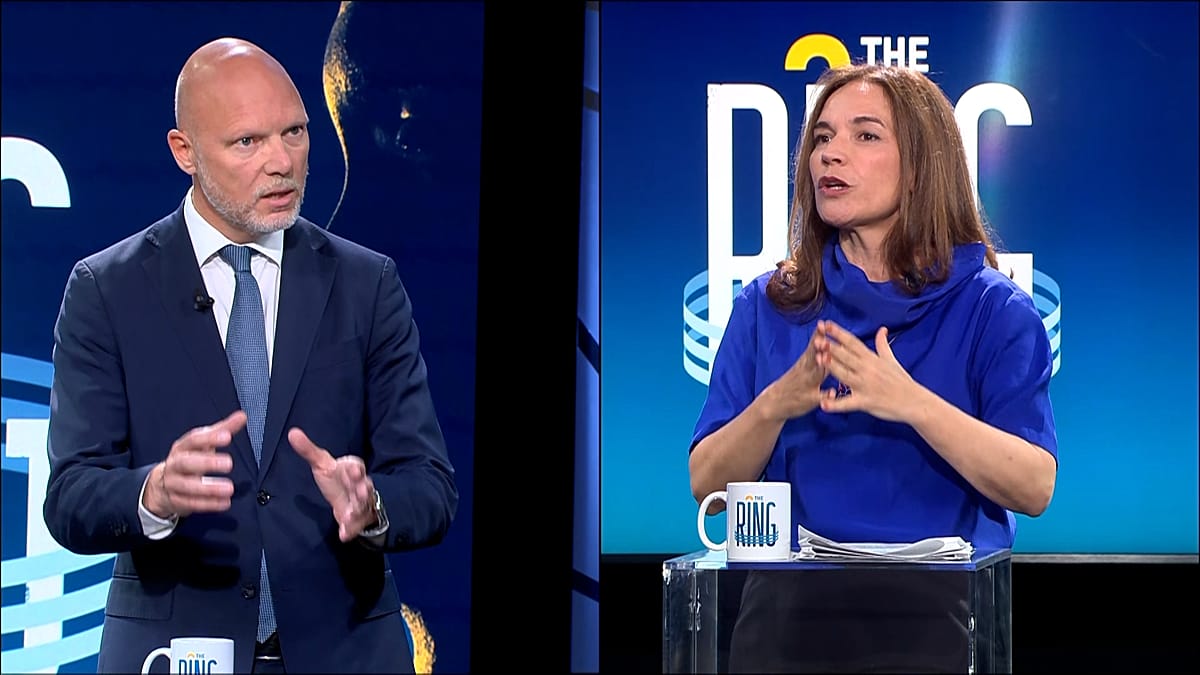
These challenges were the focus of a recent edition of The Ring, a debate programme recorded at the European Parliament in Strasbourg. The two participants — Spanish Socialist MEP Lina Gálvez and Swedish centre-right MEP Jörgen Warborn — offered sharply contrasting prescriptions for how Europe should respond.
Two Visions for Europe's Economic Future
For Gálvez, the answer lies in deeper integration. “If Europe wants to compete with the US or China, we need to advance in the integration of the Union. The answer is not to deregulate, it's to integrate,” she said. She called for completing the single market, finally delivering a genuine capital markets union, and investing collectively in the technologies that will define the next decade — from AI to clean energy. “That is how Europe competes, without sacrificing the social model or the climate goals,” she added.
Warborn took a different line. “Europe will only remain a global heavyweight if we reinvent our economy by cutting the regulatory burden that holds our companies back,” he argued. He stressed the need for affordable and reliable energy — including nuclear power — opening new markets through more free trade deals, and putting competitiveness at the heart of every EU decision. His vision is one of deregulation, risk-taking, and a leaner state.
The debate reflects a broader tension in Brussels. On one side, those who believe the EU must pool sovereignty and resources to match the scale of American and Chinese state capitalism. On the other, those who argue that Europe's problem is too much regulation, not too little, and that the bloc should emulate the flexibility of the US economy.
Both sides agree on the diagnosis: Europe is falling behind in critical areas. In artificial intelligence, the EU has no equivalent of OpenAI or DeepSeek. In clean technology, Chinese manufacturers dominate solar panels and batteries. In defence, Europe remains fragmented and underinvested. And in critical raw materials, the bloc is heavily dependent on imports from China.
The fear in Brussels is that without bold reforms, Europe risks being squeezed between a protectionist America — as seen in Trump's threats of tariffs on French wine — and an assertive China that is already using its economic leverage to shape global supply chains.
Yet the two MEPs' prescriptions lead in opposite directions. Gálvez's integrationist approach would require member states to surrender more control over fiscal policy and investment decisions — a politically fraught proposition in capitals like Berlin and The Hague. Warborn's deregulatory agenda would mean rolling back environmental and social protections that many Europeans hold dear.
The stakes are high. As the EU struggles to finalise a new trade deal with the US amid renewed tariff threats, and as companies like BMW slash profit forecasts due to the China slump, the urgency for a coherent strategy has never been greater.
What is clear is that Europe cannot afford to stand still. Whether through deeper integration or deregulation — or some combination of both — the continent must find a way to compete without abandoning the values that define it.