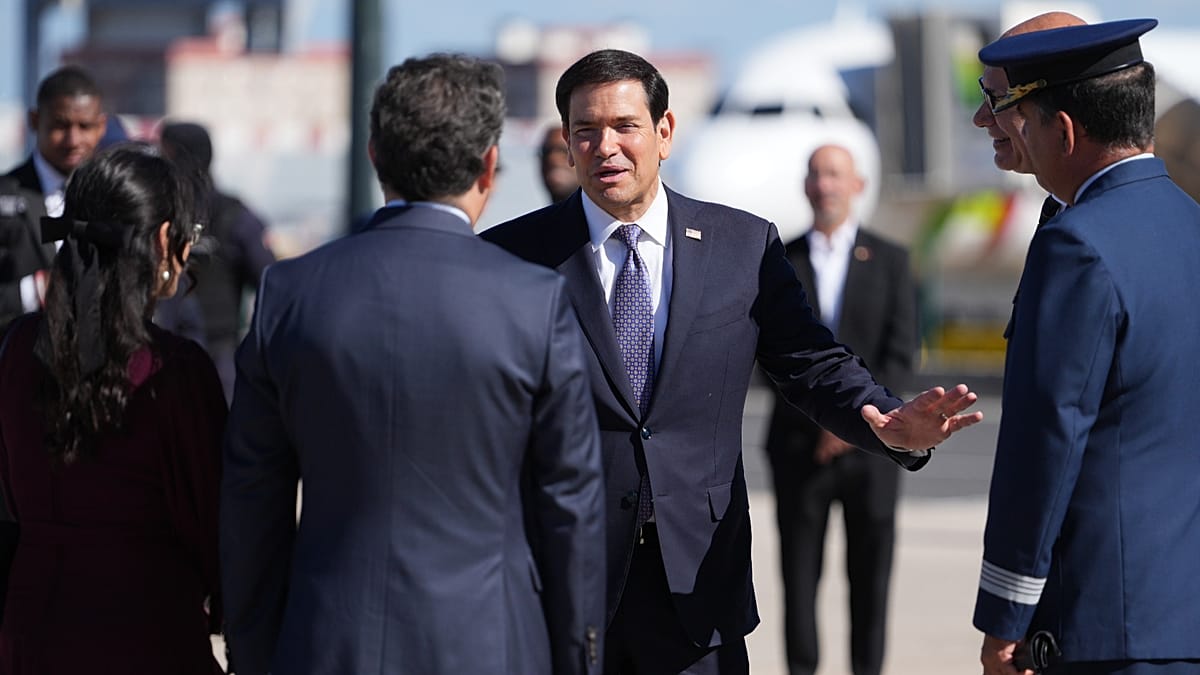
US Secretary of State Marco Rubio arrived in Lisbon on Thursday, capping a three-nation tour of NATO allies with a visit that underscored Portugal's strategic value to Washington. The trip followed a speech in Athens in which Rubio urged European nations to defend Western civilisation by upholding the values and traditions of ancient Greece.
“Portugal is a great ally, very cooperative ally of the United States and a country with which we already have a solid and growing relationship,” Rubio said before leaving Athens. “And we visit these countries in order to reinforce those ties. That’s the purpose of the trip.”
In Lisbon, Rubio met with Portuguese Prime Minister Luís Montenegro and Foreign Minister Paulo Rangel. Neither leader addressed reporters after the talks, but the discussions covered defence, trade, and security cooperation.
Defence spending and NATO solidarity
Rubio praised Portugal’s investment in defence, stressing that such spending “is not a hostile act” and that NATO members must “be strong” and “have capabilities.” He framed the alliance as a defensive deterrent that has kept the peace for decades.
“NATO exists, more than anything else, as a defensive alliance that acts as a deterrent against hostility, and it has served us well for decades. If we want it to continue to serve us, we must ensure that it remains strong,” he said.
His remarks echo the broader push he made in Athens, where he urged European allies to boost defence budgets in the face of evolving security threats.
Economic ties and the 'ideal gateway'
Rubio highlighted the strength of transatlantic commerce, describing Portugal as “the ideal gateway, from a geographical and economic point of view” for US technology companies seeking access to the European market. He noted that American investors poured more than $20 billion (€17.2 billion) into Portugal last year, while Portuguese firms invested over $2 billion (€1.72 billion) in the United States.
This economic message comes as the EU and the US navigate trade tensions, with Rubio warning Europe to wake up to the competitive challenge posed by China. Portugal’s position as a stable, English-friendly hub on the Atlantic coast makes it an attractive entry point for US businesses.
Lajes Field and the Iran war
A key item on the agenda was the use of Lajes Field, the US air base in the Azores, for operations linked to the Iran conflict. Rubio was expected to thank Portugal for granting access, but the visit unfolded against a backdrop of legal scrutiny.
On Saturday, Portugal’s attorney general’s office said it was examining whether the use of Lajes Field was lawful, following a formal complaint by the small left-wing party Left Bloc. Foreign Minister Paulo Rangel said Portugal’s approval for US military operations did not cover actions that violate international law.
Unlike neighbouring Spain, where Prime Minister Pedro Sánchez refused to allow US forces to use Spanish bases for strikes on Iran, Portugal has taken a more moderate approach, permitting Washington to use Lajes after the conflict erupted. The base, first used by the US during World War II, has a long runway that accommodates heavy military aircraft and remains a vital logistics hub.
Cooperation on drug trafficking
Rubio also praised Portugal’s efforts to combat drug trafficking, noting that Portuguese authorities, working with US agencies, have seized 200 tonnes of cocaine in recent years. This cooperation is part of a broader transatlantic security partnership that extends beyond traditional defence.
Portugal, one of the smallest members of both NATO and the EU, has long sought to cultivate strong ties with larger powers. Its strategic location in the Atlantic and its history of maritime exploration make it a natural partner for the United States, even as questions about the legal basis for certain military operations linger.
The visit underscores the delicate balance Portugal maintains between its NATO commitments and its domestic legal and political constraints. As the war in the Middle East continues, the use of Lajes will likely remain a point of contention, but the broader US-Portugal relationship appears set to deepen.