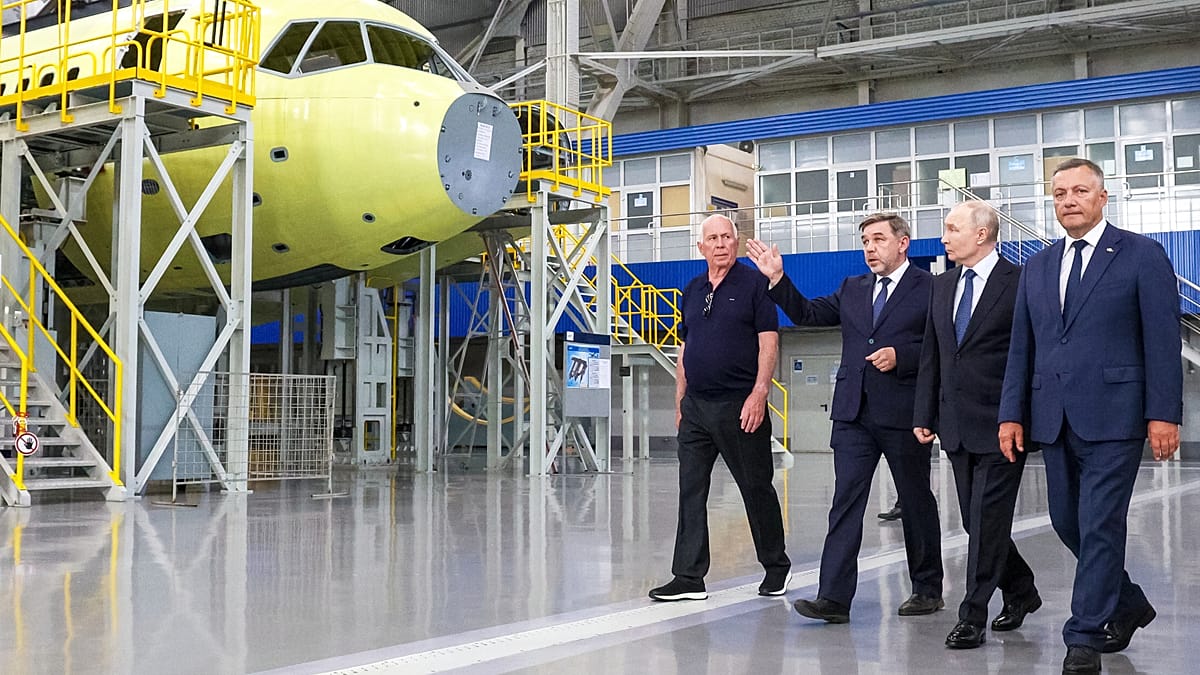
Russia is preparing to introduce a surcharge on airline tickets from 2027 to help finance its beleaguered civilian aircraft industry. According to the State Duma's budget and tax committee, domestic passengers would pay 500 roubles (€5.4) per ticket, while those flying internationally would be charged 1,000 roubles (€10.8). The measure, developed by the Ministry of Industry and Trade on President Vladimir Putin's instructions, aims to cover the leasing and operating costs of 258 aircraft under the Comprehensive Programme for Expanding the Production of Aircraft. This includes models such as the MS-21, Tu-214, SJ-100, and Il-114-300.
The Russian civilian aviation sector has been in deep trouble since the full-scale invasion of Ukraine in February 2022. No new serial aircraft have been produced since then, and production deadlines have been repeatedly missed. Between 2022 and 2025, Russian airlines received just 13 new aircraft against a planned 120, many of them assembled from components acquired before the imposition of Western sanctions.
Production delays and revised timelines
The production schedule has been revised several times. In summer 2026, the target for large-scale production was pushed back from 2030 to 2035. Certification and the start of serial production for the MS-21 and SJ-100 are now scheduled for 2027, while deliveries of the Il-114-300, which has already passed certification, are promised from December 2026.
The Russian airline fleet has shrunk during the war, as ageing foreign-built aircraft are retired without replacement. Spare parts have become scarce and increasingly expensive to source, and Russia has turned to Vietnam to obtain aircraft for lease. Western sanctions have cut off Russia from purchasing or leasing Western aircraft, as well as from obtaining spare parts and maintenance services.
In response, Moscow passed a law allowing airlines to re-register more than 400 foreign-leased Western aircraft domestically rather than return them to their owners. This move violates international aviation law, which prohibits the dual registration of a single aircraft. The International Civil Aviation Organisation (ICAO) has no enforcement mechanism to compel their return, leaving lessors to file insurance claims totalling around $8 billion (€7.1bn), with many cases still unresolved.
Before the invasion, roughly 850 of Russia's 900 commercial aircraft were US and European-made Boeing or Airbus planes, of which about 85% were leased from foreign companies. With Western spare parts and technical services now sanctioned, airlines have been cannibalising the seized fleet for components, further reducing the number of operational aircraft.
The proposed ticket surcharge is part of a broader effort to revive the domestic aircraft industry, but experts remain sceptical about its feasibility. The industry has struggled to meet even modest production targets, and the lack of access to Western technology and components continues to hamper progress. The surcharge, if implemented, would add to the cost of air travel for Russian passengers, who already face limited options and higher prices due to sanctions.
This development comes amid ongoing tensions between Russia and the West, with renewed attacks on Ukraine and European nations refusing to engage with Russia in various arenas. The aviation levy is another sign of Moscow's efforts to insulate its economy from the effects of sanctions, even as the costs of the war continue to mount.
For European observers, the situation highlights the broader challenges of Russia's industrial policy under sanctions. The country's reliance on foreign technology and components, once a strength of its aviation sector, has become a vulnerability. Whether the ticket surcharge can provide the necessary funding to turn the tide remains uncertain, but the industry's track record suggests that significant hurdles lie ahead.