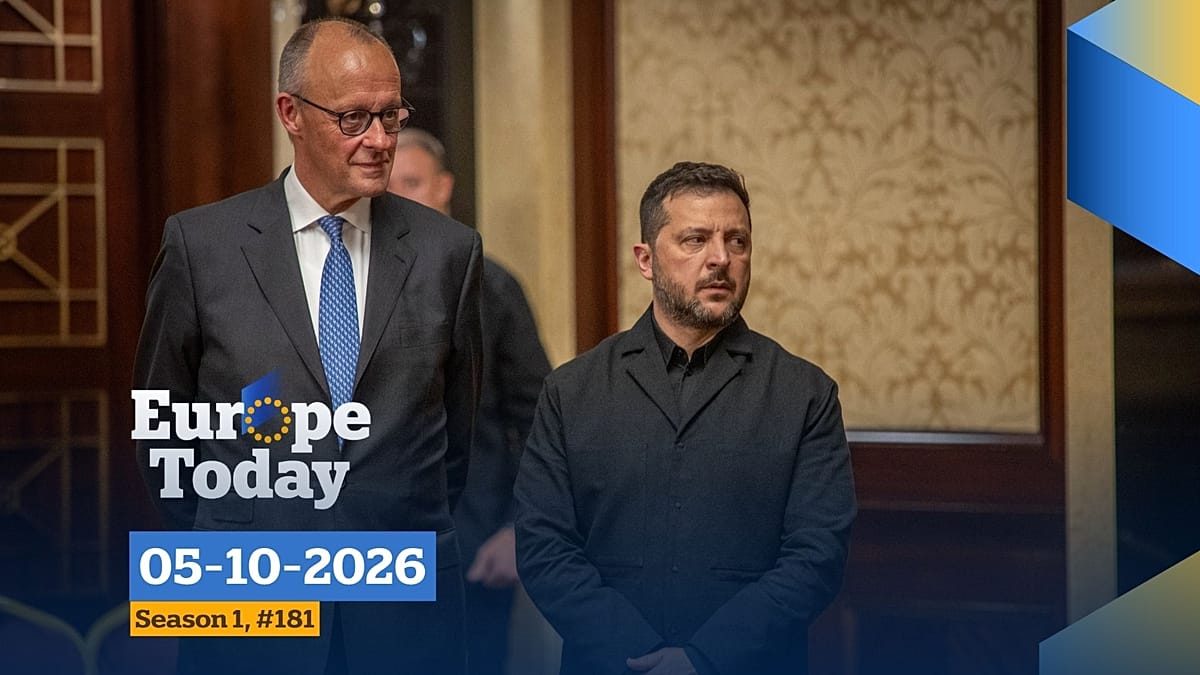
Russian forces launched a wave of drones and missiles at Kyiv on Thursday, causing significant damage to the city's Northern Bridge, as German Chancellor Friedrich Merz held talks with Ukrainian President Volodymyr Zelensky. The attack underscored the fragility of Ukraine's infrastructure and the continuing threat to its capital, even as European leaders seek to bolster support for Kyiv.
Merz, who arrived in the Ukrainian capital on an unannounced visit, used the occasion to announce a new €1.3 billion aid package, including drones, cash, and a commitment to joint arms production. The pledge comes at a critical moment, as Ukraine faces renewed Russian offensives and uncertainty over the future of Western military assistance. The German chancellor's presence in Kyiv, despite the obvious security risks, was intended to signal Berlin's unwavering solidarity with Ukraine.
Speaking to the EU's ambassador to Ukraine, Katarina Mathernová, our correspondent Méabh Mc Mahon highlighted the symbolic and practical importance of the visit. Mathernová noted that the attack on the Northern Bridge, a vital crossing over the Dnipro River, was part of a broader Russian strategy to disrupt Ukrainian logistics and civilian life. The bridge had already been hit two days earlier, and the repeated strikes are straining the city's infrastructure and the resilience of its residents.
Iran war: Washington reviews Tehran's proposal
In a separate development, Iran's Deputy Foreign Minister announced that Washington has responded to Tehran's proposal to end the ongoing conflict, and that the response is now under internal review in Tehran. The statement, made in Doha where our correspondent Aadel Haleem is following the story, suggests a possible diplomatic opening, though both sides remain cautious. The war, which has drawn in regional powers and raised global energy prices, continues to dominate European security concerns.
Former European Council President Charles Michel, joining the show, called on European leaders to fundamentally rethink their approach to the Iran conflict. Michel argued that the EU must move beyond a reactive stance and take a more proactive role in mediating, warning that the current strategy risks leaving Europe on the sidelines. His comments reflect growing frustration in Brussels over the bloc's limited influence in the region.
Bardella scandal: French far-right leader denies antisemitic posts
In France, Jordan Bardella, the young leader of the far-right National Rally, is facing a scandal after the investigative outlet Mediapart alleged that he posted antisemitic messages in 2013. Bardella has categorically denied the allegations, calling them a smear campaign. The controversy comes at a delicate time for the party, which has sought to distance itself from its extremist roots and present a more mainstream image. The story has dominated French political discourse, with opponents seizing on the claims to question Bardella's fitness for leadership.
Brazil: Bolsonaro's son wins first round, runoff with Lula set
In Brazil, the first round of the presidential election delivered a surprise: Flávio Bolsonaro, the son of former president Jair Bolsonaro, who is currently behind bars, won the most votes, beating incumbent left-wing president Luiz Inácio Lula da Silva. The result sets up a runoff that will be closely watched across the Atlantic, given Brazil's role as a major trading partner and its significance for global climate policy.
Portuguese political analyst and former MEP João Albuquerque provided context, noting that Flávio Bolsonaro's success reflects a deep political polarization in Brazil, but also a protest vote against Lula's handling of the economy and corruption scandals. Albuquerque pointed out that the runoff will be a test of whether the Bolsonaro family's political machine can overcome Lula's formidable grassroots support. The outcome will have implications for Europe, particularly in areas like trade and environmental cooperation, as Brazil is a key player in the Amazon and a major agricultural exporter.
The election has drawn parallels to recent European political trends, where populist and anti-establishment candidates have gained ground. In Latvia, for instance, the pro-EU ruling party won the election, but populists made significant gains, a pattern seen across the continent. The Brazilian runoff will be a case study in how such dynamics play out in a large democracy.
As Europe watches these developments, the continent faces its own set of challenges, from the war in Ukraine to internal political shifts. The coming weeks will be crucial, with the runoff in Brazil and continued diplomatic efforts on Iran, all set against the backdrop of a volatile security environment in Eastern Europe.