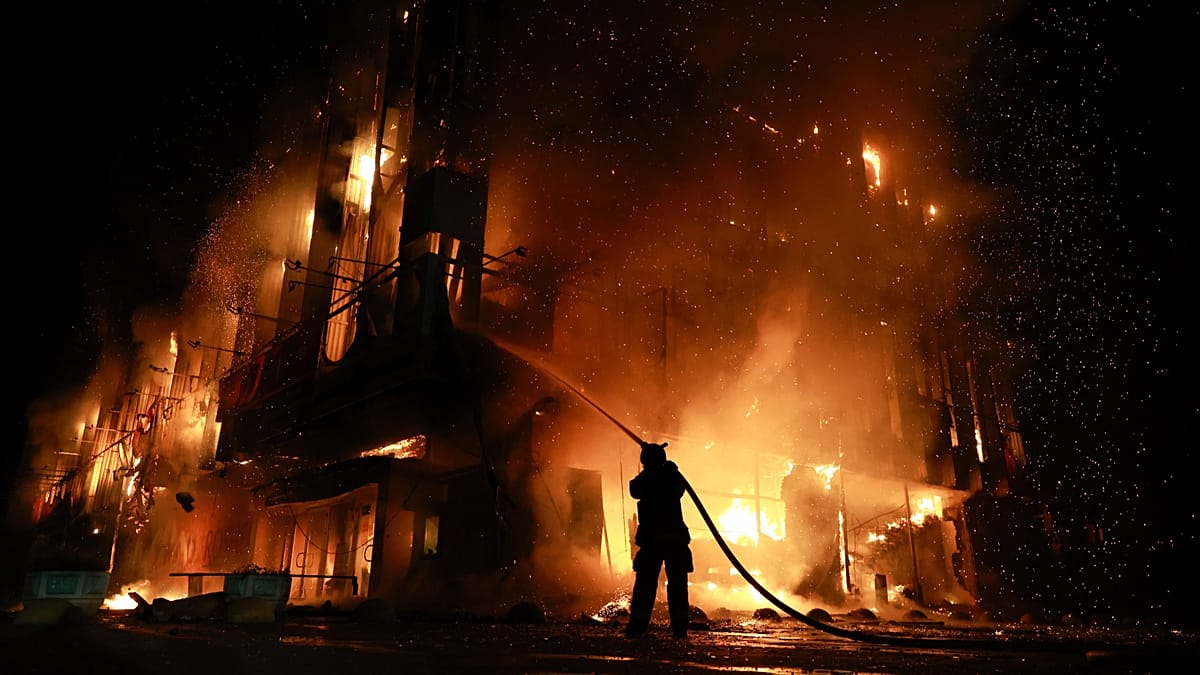
Russian drones struck the southern Ukrainian city of Zaporizhzhia late on Sunday, hitting residential buildings, a university, and a shopping centre, according to Ukrainian officials. Five people were wounded in the attack, which came just hours after Kyiv's forces launched a record-breaking barrage of more than 1,000 drones against targets across Russia.
The overnight assault on Zaporizhzhia was part of a broader wave that also targeted nine other Ukrainian regions, President Volodymyr Zelenskyy said on Monday. “Russia is not backing down from its escalation and is sending many signals that it is ready to expand the war,” he wrote on social media. “At the UN General Assembly, we will discuss how we can achieve peace through joint efforts.”
The attacks underscore the absence of any meaningful progress in diplomatic efforts to end the conflict, now in its fifth year since Russia's full-scale invasion. With world leaders converging on New York for the annual UN General Assembly, there is little expectation of a breakthrough. Zelenskyy said he plans to meet US President Donald Trump on the sidelines, while Russian President Vladimir Putin is not expected to attend.
Ukraine's largest drone offensive
Ukraine's weekend drone operation, which peaked on Saturday and Sunday, marked its most extensive aerial campaign of the war. Hundreds of drones were directed at Moscow, forcing the closure of airports and disrupting daily life in the Russian capital. The strikes coincided with the final day of Russia's parliamentary elections, a vote that was overshadowed by the unprecedented attack.
Russia's Defence Ministry claimed on Monday that its air defences had shot down 244 Ukrainian drones overnight over Russian territory and the Black Sea. Ukraine's air force, in turn, reported that it had destroyed or suppressed 148 Russian drones in the same period. The duelling figures are typical of wartime reporting, but the scale of the exchanges points to a conflict that shows no signs of de-escalation.
The drone war has also spilled beyond the two countries' borders. Moldova's Defence Ministry said on Monday that it had temporarily closed part of its northern airspace after detecting an “aerial object” entering its territory shortly after midnight. In recent weeks, Moldovan officials have repeatedly reported drone incursions and have found debris on its soil, raising concerns in Chișinău about being dragged into a wider conflict. It remains unclear whether the drones were Russian or Ukrainian, as electronic jamming can knock them off course, but officials have often blamed Moscow.
European leaders, wary of Russia's intentions on the continent, have been pressing Putin to withdraw from Ukraine, but the Kremlin has given no indication of a change in strategy. The daily strikes on Ukrainian cities continue to exact a heavy toll on civilians, while the economic and political fallout reverberates across Europe.
For now, the war grinds on, with no end in sight. As the UN General Assembly convenes, the gap between diplomatic rhetoric and battlefield reality remains as wide as ever.