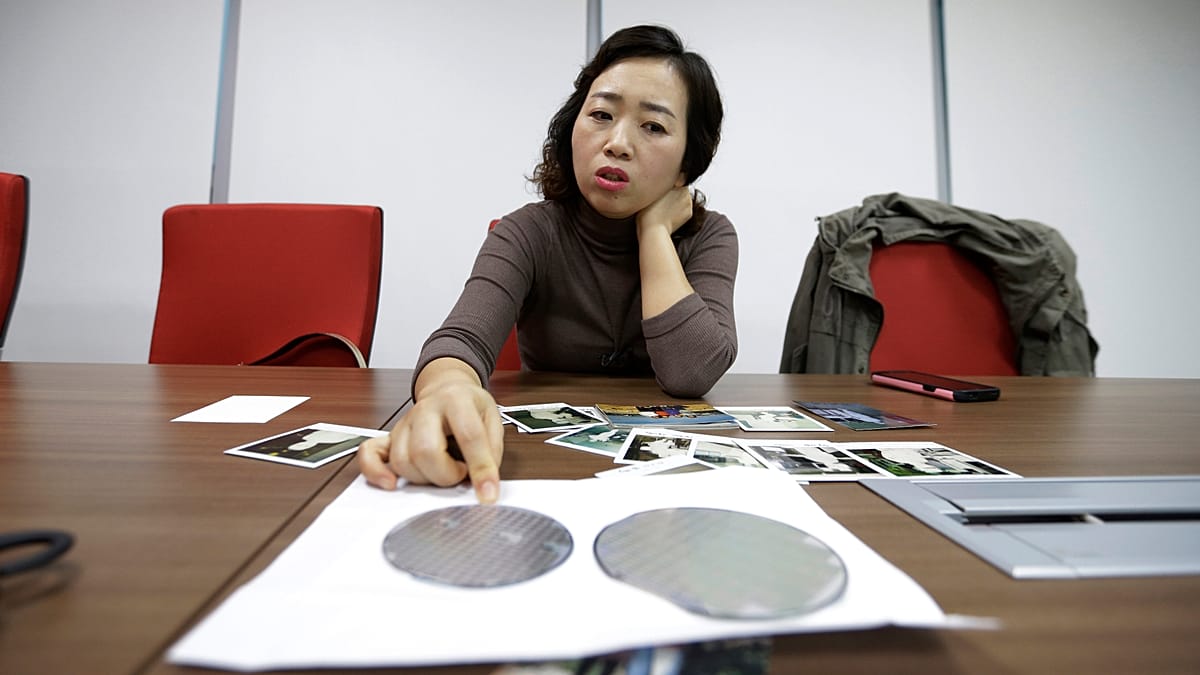
Two of Asia's semiconductor giants have reported exceptional quarterly figures, underscoring the relentless global demand for artificial intelligence hardware. Samsung Electronics, the world's largest memory chipmaker, said on Thursday that its operating profit for the third quarter likely soared to 107.4 trillion won ($80.2bn, €71.5bn), a 782.5% increase from the same period last year. That would mark the company's most profitable quarter ever and the first time a South Korean firm has surpassed the 100 trillion won threshold in quarterly operating income.
The preliminary estimate, which Samsung will confirm in full results on 29 October, also beats the $63.7bn operating income that Nvidia, the US chip designer, reported in its latest quarter. Analysts had forecast a slightly lower figure of 106.1 trillion won, according to LSEG data. Sales are projected at 195 trillion won ($145.6bn, €129.9bn), up 127% year-on-year, implying an operating margin of roughly 55%.
The boom is driven by AI data centres that are snapping up high-bandwidth memory (HBM) — stacked chips that feed data to AI processors — while tight supply has also pushed up prices for DRAM and NAND memory. Samsung's shares, however, closed 2.42% lower in Seoul at 262,000 won, as investors took profits and questioned the durability of the memory upcycle. The stock has still nearly quadrupled since last September.
TSMC's record quarter and Taiwan's export surge
Taiwan Semiconductor Manufacturing Company (TSMC), the world's largest contract chipmaker and a key supplier to Nvidia and Apple, also reported stellar numbers. September revenue rose 54.6% year-on-year to NT$511.86bn (about $16bn, €14bn), just 0.6% below August's all-time monthly high. That pushed estimated third-quarter revenue to a record NT$1.49 trillion ($46.8bn, €41.8bn), up 51% from a year earlier and 17.6% sequentially, beating the company's own guidance of $44.6bn to $45.8bn.
For the first nine months of the year, TSMC's revenue climbed 41.1% to NT$3.9 trillion ($122.1bn, €108.9bn). The figures come as Taiwan reported a 60.9% jump in exports for September, reaching a record $87.2bn, driven by global demand for AI hardware. The island's GDP expanded 12.9% year-on-year in the second quarter, fueled by this export boom.
The upcoming earnings reports from TSMC and Dutch chip equipment maker ASML will offer a clearer picture of whether this momentum can be sustained. TSMC is set to release its full third-quarter results and outlook on 15 October, a day after ASML. Both companies are bellwethers for the semiconductor industry, and their guidance will be closely watched by investors across Europe and beyond.
For Europe, the AI chip boom has broader implications. European tech firms and data centres are increasingly reliant on these Asian suppliers, while the EU has been pushing to boost its own semiconductor production under the European Chips Act. The record profits at Samsung and TSMC highlight the scale of the global AI investment wave, which is also driving record diesel prices in Europe, as energy demand from data centres and manufacturing rises.
While the immediate focus is on the tech sector, the ripple effects are felt in European markets and supply chains. The surge in AI-related exports from Asia has contributed to global trade imbalances, and European policymakers are watching closely as they seek to strengthen the continent's digital sovereignty.
As the AI boom continues, the question remains whether it can sustain such extraordinary growth. Samsung's record quarter and TSMC's strong performance suggest that, for now, the appetite for AI chips shows no signs of abating. But investors are already weighing the risks of a potential slowdown, as seen in the profit-taking that followed Samsung's announcement.