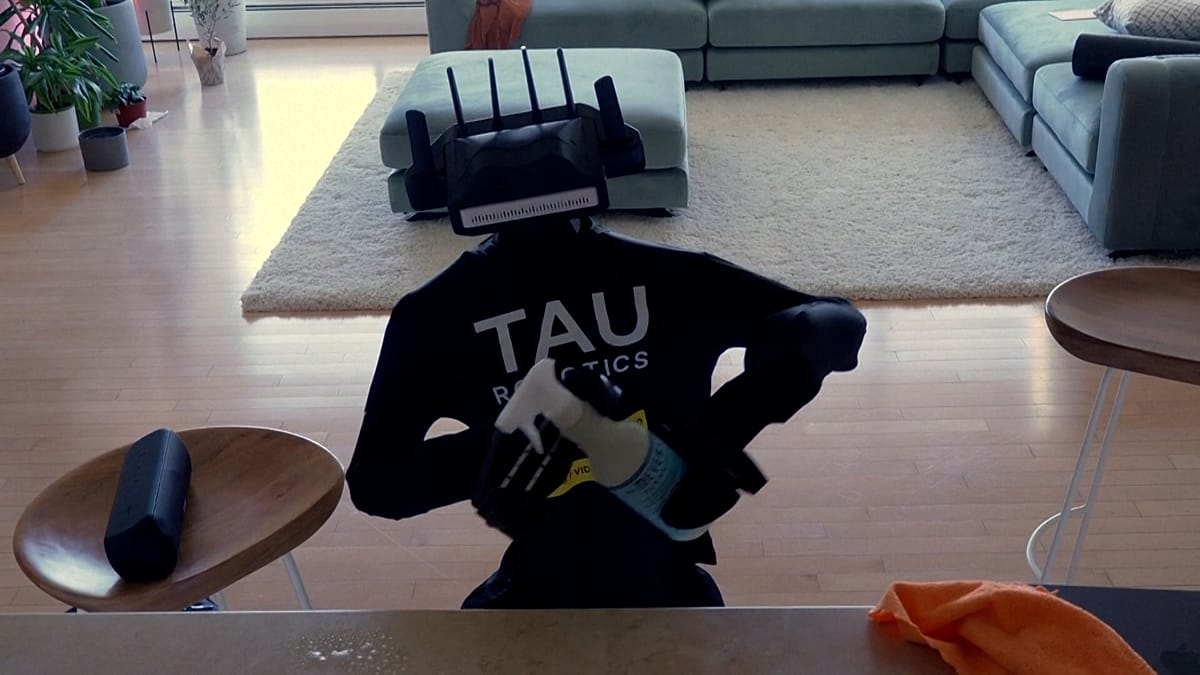
For €26 an hour, a humanoid robot will vacuum your floors, scrub your toilet, and wipe down your kitchen counters. That is the offer from Tau Robotics, a San Francisco-based start-up that has begun deploying its machines as domestic cleaners in the city.
The service has been running for about a month and has already cleaned more than 50 apartments and condominiums. The company says demand is rising, and prospective customers are now joining a waiting list.
Tammie Siew, who let the robot clean her apartment for the first time, found the experience surprisingly charming. "The fact that it stumbles a little bit almost makes it endearing. A little bit like watching a child," she said. "I think that's kind of like how it's entering society. It's not about expecting it to be completely perfect."
For Siew, the appeal is straightforward: there are chores she would happily hand over to a machine. "I don't want to clean the toilet. I'm willing to wait a little bit more and read a book or do some work. So I'm very excited," she said.
How the robots work
Tau Robotics says its robots are designed to operate in ordinary homes, using cameras and depth sensors to perceive their surroundings. They can vacuum, clear clutter, take out rubbish, and wipe down surfaces. They can also move everyday objects like chairs, laundry baskets, and small tables to clean around them.
At present, each robot works for only one hour at a time. A single-robot session costs $30 (about €25.7), while sending two costs $60 (about €51.5). The company plans to offer longer cleaning sessions in the future.
Humanoid robots have long been a staple of tech demonstrations, but limited dexterity, speed, and reliability have kept them from performing genuinely useful everyday work. Tau Robotics acknowledges that its machines are not yet as fast or capable as a human cleaner.
And for now, they are not autonomous. A trained human operator controls each robot remotely, seeing the home through cameras mounted on the robot as it works. This remote operation raises privacy concerns, especially since the robots continuously record video through cameras on their heads and wrists, while depth data maps the layout of rooms and objects.
According to Tau Robotics' privacy policy, footage and other robot data are used to train its AI models and are kept indefinitely unless customers request deletion. Microphones are disabled, and no audio is recorded. The company says it does not sell personal information or use the footage for behavioural advertising.
The long-term goal, the company says, is to gradually increase the robots' autonomy as they learn from real-world cleaning jobs. That ambition echoes broader trends in robotics and AI across the Atlantic, where European firms and regulators are also grappling with how to integrate autonomous machines into daily life. The arrival of robotaxis in Munich has already sparked debate about safety and public acceptance, and similar questions will likely follow for domestic robots.
As the technology matures, the prospect of a robot maid may become more common in European households too. But the privacy trade-offs and the need for human oversight will remain central to the conversation.