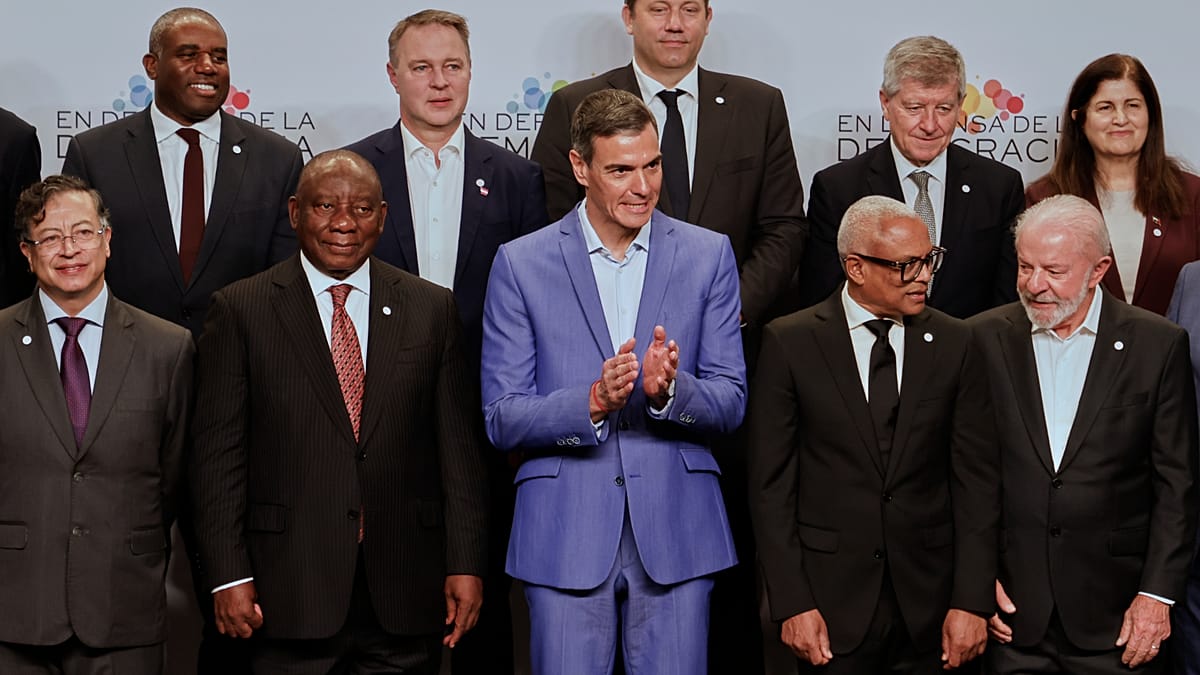
Spanish Prime Minister Pedro Sánchez positioned himself as a leading voice of the international left this weekend, hosting a two-day convention in Barcelona that brought together progressive leaders from across the globe. The event, informally dubbed the 'progressive CPAC,' was designed to counter the influence of US President Donald Trump and the broader right-wing populist movement, even as Sánchez faces mounting legal troubles at home.
In his keynote speech on Saturday, Sánchez warned of a global 'reactionary wave' fueling hate speech, sexism, war, and division, without explicitly naming Trump. 'It doesn't matter how much they scream, or how many lies they spread,' he declared. 'The time for the reactionary, ultra-right has come to an end.' The audience at the Fira auditorium responded with chants of 'No to war.'
Brazilian President Luiz Inácio Lula da Silva echoed Sánchez's sentiments, criticizing those 'who call themselves patriots but put their sovereignty up for sale and call for sanctions.' Lula also praised Sánchez for denying US forces access to Spanish military bases for strikes on Iran, a move that has drawn ire from Washington.
The guest list included South African President Cyril Ramaphosa, Colombian President Gustavo Petro, and Mexican President Claudia Sheinbaum—all of whom have clashed with Trump over tariffs and migration. South Africa has also faced allegations of 'anti-white' racism, claims amplified by tech billionaire Elon Musk. Minnesota Governor Tim Walz, who ran as Kamala Harris's vice-presidential candidate, addressed the crowd, describing Trump as 'trigger-happy' and accusing him of fostering a drift toward authoritarianism. 'We need to call that what it is. That's fascism. Or at least it's fascist curious as they would be,' Walz said.
European representation included German Vice-Chancellor Lars Klingbeil, UK Foreign Secretary David Lammy, Italian opposition leader Elly Schlein, and Belgian politician Paul Magnette. Economist Gabriel Zucman, known for advocating higher taxes on the wealthy, also attended. European Council President António Costa canceled at the last minute, citing personal reasons, likely to avoid the event's overtly political nature.
A Political Lifeline at Home?
The convention capped a difficult week for Sánchez, as his wife, Begoña Gómez, was formally charged with corruption and is set to face trial following a two-year investigation. Both have denied any wrongdoing. The legal developments have added pressure on Sánchez's minority coalition government, which relies on support from Catalan and Basque separatist parties.
By taking independent stances on issues like Gaza and the Iran conflict, Sánchez has sought to build an international profile that could bolster his domestic standing. Trump has repeatedly criticized Sánchez, saying he 'wants nothing to do with Spain' and accusing him of not paying his fair share for NATO protection. The US president has also threatened a full trade blockade, though no measures have been announced.
The Barcelona gathering, originally planned for later in the year, was moved to April at Brazil's request, according to a source involved in the preparations. While no leaders mentioned Trump by name, references to his policies—from tariffs to the war in Iran—were pervasive. Mexico's Sheinbaum participated in a session on protecting democracies but skipped the more political rally, as her government is engaged in delicate talks with the Trump administration over the US-Mexico-Canada trade agreement.
The convention underscores a broader effort by left-wing leaders to coordinate a response to what they see as a rising tide of right-wing populism. Whether it translates into tangible political gains for Sánchez at home remains uncertain, but the event has cemented his role as a convenor of the international left.



