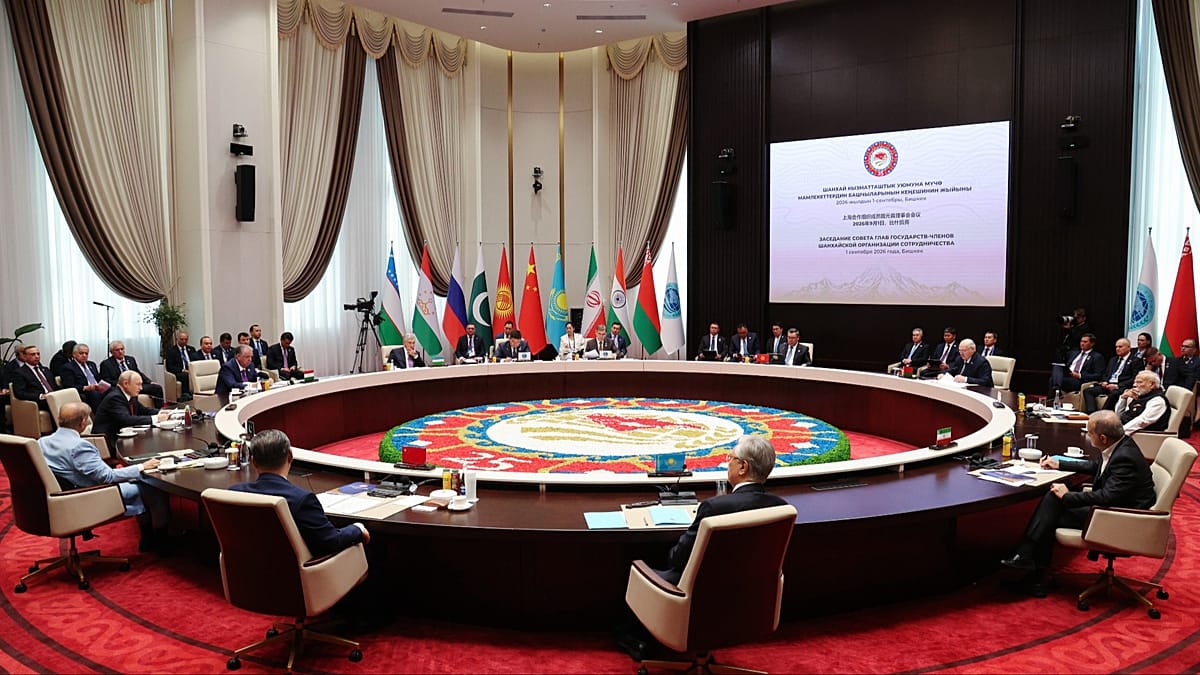
The Shanghai Cooperation Organisation (SCO) wrapped up its 25th summit in Kyrgyzstan on Tuesday, projecting an image of a rising counterweight to Western dominance. Yet beneath the headlines, the gathering of ten member states—China, India, Iran, Pakistan, Russia, Belarus, Kazakhstan, Kyrgyzstan, Tajikistan, and Uzbekistan—laid bare the fractures and competing ambitions that complicate any unified front.
Held in Bishkek, the summit drew leaders and dialogue partners from Central Asia, the Caspian region, the Middle East, and beyond. The agenda was dominated by the wars in Ukraine and Iran, which have upended global supply chains and accelerated geopolitical realignments. But the bloc's diversity meant that consensus often remained elusive, with members pursuing divergent interests.
Modi's blunt message to Putin
The most striking moment came when Indian Prime Minister Narendra Modi, in a live televised exchange, directly urged Russian President Vladimir Putin to end the war against Ukraine. “Every single day spent in war pushes humanity backwards,” Modi said, visibly catching Putin off guard. “We need to move from endless war to the end of war, to the end of hostilities.”
Modi framed his appeal in moral terms, invoking India's heritage: “This is India's message—the message from the land of Gandhi, the land of Buddha: a message of peace, a message of humanity.” Putin offered no immediate reply, but later in his summit speech drew a parallel to World War II, saying, “Today, 1 September, is the day World War II began. We must do everything to exclude from world practice any provocation of armed conflicts.” The remark underscored how Russia's invasion of Ukraine has now lasted longer than the Second World War.
Another setback for Moscow emerged in a bilateral meeting between Putin and Chinese President Xi Jinping. Despite the symbolism of their alliance, no progress was reported on the long-stalled Siberian natural gas pipeline—a project Russia urgently needs as Ukrainian strikes on its energy infrastructure take a toll on the economy.
Iran seeks support, China pushes multipolarity
Iranian President Masoud Pezeshkian used the summit to thank Putin for Russia's backing, saying, “Thank you for your positions at every stage.” Putin, in turn, expressed solidarity with Iran, praising its “courage and steadfastness” against the United States and Israel. Pezeshkian warned of an “erosion of the foundations upon which international order is built,” asking, “If such actions are met with no effective response from the international community, what state can be certain that its sovereignty and security will be protected in the future against the use of force?”
China, which views the SCO as an alternative to Western-led institutions like the G7, used the platform to advocate for a broader role. Xi Jinping called for “an environment of universal security” and criticized “hegemony, unilateralism, and protectionism” as running “counter to the tide of history.” He insisted that multipolarity is an “irreversible trend” and that “dominance by just one or several countries, or bloc politics are not true multilateralism.”
Turkey, a dialogue partner, also sought to leverage the SCO to bolster its regional standing. President Recep Tayyip Erdoğan described the organisation as “a rising star in every field” and “an indispensable element of a multipolar order,” noting its combined population of 3.5 billion and GDP of $35 trillion. He framed the SCO as a “complement to the UN” and aligned with Turkey's “multidimensional foreign policy centred on regional ownership.” Erdoğan also highlighted the bloc's potential to secure alternative transport and energy corridors, a priority as the Iran war disrupts traditional routes.
Central Asia's economic ambitions
Leaders from Central Asia and the South Caucasus used the summit to push for investment in infrastructure projects that could position their regions as new trade hubs. With the Iran conflict and Middle East instability rerouting global commerce, these countries see an opportunity to capitalise on their geographic location. The SCO's focus on connectivity and energy security resonated with their ambitions, even as the bloc's internal disagreements remained unresolved.
The summit's outcome reflects a broader trend: the rise of a multipolar world where no single power—or bloc—can dictate terms. But as the SCO's own divisions show, that multipolarity is messy, with members often at odds over the very conflicts that define the new order. For Europe, the implications are significant, as the bloc's expansion and its members' actions continue to shape global politics and economics. The SCO's growing assertiveness, coupled with its internal frictions, will be a key dynamic to watch in the coming years.