South Korea's National Intelligence Service (NIS) has told lawmakers that a summit between the United States and North Korea could take place "at any time," according to a briefing relayed on Tuesday. The assessment comes as Washington and Pyongyang show tentative signs of re-engaging, though no concrete talks have been confirmed.
Lawmaker Youn Kun-young, who attended the NIS briefing, said the agency noted that while no specific contacts between the two sides have been verified, there are indications that dialogue is being explored. "Regarding the North Korea-US summit, there was an analysis that it should be viewed as possible at any time," Youn told reporters in Seoul.
The remarks follow President Donald Trump's repeated expressions of interest in meeting North Korean leader Kim Jong-un again. In August, Trump said it was important to "get along" with Kim and floated the idea of a new summit. He also claimed that Pyongyang now possesses 57 "very powerful" nuclear weapons, a figure that has not been independently verified.
North Korea's official responses have been cautious. Kim Yo-jong, the leader's sister, acknowledged that Kim retains "good memories and feelings" about Trump and described their relationship as "excellent," but she stopped short of accepting any meeting proposal. Analysts note that Pyongyang's silence on the specifics suggests a wait-and-see approach.
Military signals and regional unease
Trump's overtures have been accompanied by a notable shift in US military posture. In August, Washington scaled back joint exercises with South Korea, a move that alarmed allies in the region and fueled speculation that Trump is seeking a foreign policy achievement as the conflict in Iran stalls. The reduction in drills was described by Kim Yo-jong as Seoul's "comeuppance," a pointed rebuke of South Korea's reliance on US military support.
Pyongyang has also responded to the diplomatic signals with missile tests. Hours after Trump's August comments, North Korea launched more than ten short-range ballistic missiles from the Pyongyang area. Further maritime exercises involving the US, South Korea, and Japan, scheduled to begin on 7 September, have drawn angry condemnations from the North.
Yang Moo-jin, former president of the University of North Korean Studies, argues that Pyongyang has little incentive to engage in talks. "From North Korea's perspective, as one of the biggest beneficiaries of the Russia-Ukraine war and the deepening confrontation with South Korea, the US and Japan on one side and North Korea, China and Russia on the other, there appears to be little incentive for dialogue," he said.
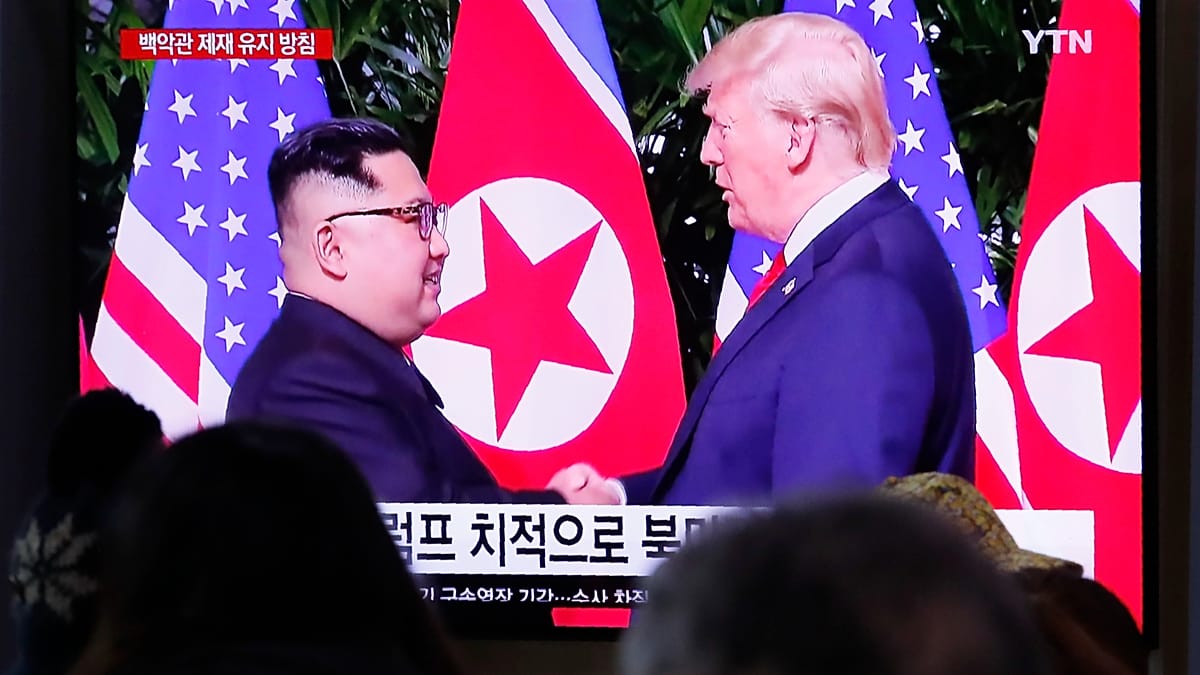
The geopolitical landscape has shifted significantly since Trump's first term, when he met Kim three times in high-profile summits aimed at securing a denuclearisation deal. Those meetings, which included Trump's memorable declaration that he and Kim were "in love," produced no tangible progress. In October 2025, Trump broke with decades of US policy by calling North Korea "sort of a nuclear power," and he has since said he is "100 percent" open to meeting Kim again—though Pyongyang has not responded to that offer.
China remains a crucial factor. As Washington's chief geopolitical rival, Beijing has been North Korea's main trading partner and a key source of diplomatic and economic support, despite multiple international sanctions. Any US-North Korea rapprochement would inevitably have implications for Beijing's regional strategy.
South Korea's current president, Lee Jae-myung, who took office in June 2025, has pursued a more conciliatory approach toward the North, in contrast to his hardline predecessor Yoon Suk-yeol. Lee's dovish stance has been welcomed by some but criticized by others who fear it may undermine the US-South Korea alliance.
For now, the prospect of a summit remains uncertain. The NIS's assessment suggests that the door is open, but both Washington and Pyongyang appear to be weighing their options carefully. As the region watches for the next move, the stakes are high—not just for the Korean Peninsula, but for the broader balance of power in East Asia.