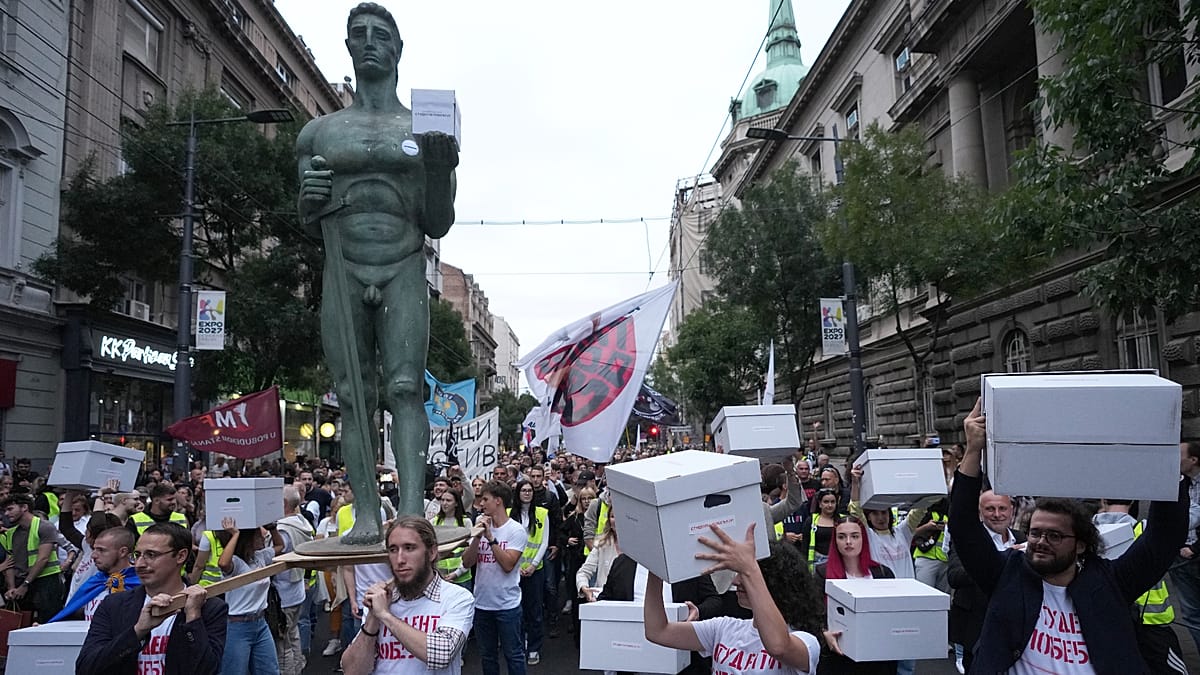
In a bold move that has reshaped Serbia's political landscape, university students have formally registered a 'student list' to contest the early parliamentary elections scheduled for 25 October. The announcement, made on Monday 14 September, positions the student movement as a direct challenger to President Aleksandar Vučić and his Serbian Progressive Party (SNS), which has dominated the country's politics for over a decade.
The student list, which emerged from months of protests and campus activism, aims to channel widespread discontent among young Serbians into electoral representation. Organisers say their platform focuses on transparency, rule of law, and a break from the clientelist politics that they argue has stifled Serbia's democratic development. The move is unprecedented in recent Serbian history, where student movements have often influenced public debate but rarely translated into formal political candidacies.
From protests to parliament
The decision to enter the electoral fray follows a series of demonstrations that began in late 2024, initially triggered by demands for accountability in the wake of the Novi Sad railway station tragedy. What started as a student-led protest movement quickly evolved into a broader civic platform, drawing support from across the political spectrum. The student list now seeks to convert that momentum into seats in the National Assembly, a challenge that analysts say could disrupt the ruling party's grip on power.
Political observers in Belgrade note that the student list's appeal lies in its authenticity and its distance from traditional party structures. "These are young people who have no political baggage," said Milica Đorđević, a political analyst at the University of Belgrade. "They represent a generation that has grown up with the failures of the system and is now demanding a different kind of politics." The list has also attracted support from some opposition figures, though it remains independent of established parties.
The electoral campaign is set against a backdrop of heightened tensions, with the ruling party controlling most media outlets and state resources. The student list has pledged to run a clean campaign, relying on social media and grassroots organising. Their manifesto includes proposals for judicial reform, anti-corruption measures, and greater investment in education and youth employment—issues that resonate with a demographic that has seen limited economic opportunities despite Serbia's EU candidate status.
The timing of the election, called by Vučić after months of political instability, has been criticised by opposition groups as an attempt to capitalise on a fragmented opposition. However, the entry of the student list adds a new variable. Recent polls suggest that while the SNS remains the largest party, its support has eroded, and a significant portion of the electorate is undecided. The student list could attract not only young voters but also disillusioned older citizens who see it as a credible alternative.
International reactions have been cautious. The European Union, which has repeatedly urged Serbia to ensure free and fair elections, has welcomed the participation of new political actors. Brussels has also linked Serbia's EU accession progress to democratic reforms, a point that the student list has embraced. The movement's leaders have stated that their goal is not just to win seats but to strengthen Serbia's democratic institutions and align the country more closely with European standards.
However, the road ahead is fraught with challenges. The student list faces logistical hurdles, limited funding, and potential legal obstacles. There are also concerns about voter intimidation and electoral fraud, which have marred previous elections. The student organisers have called on international observers to monitor the vote, and they have vowed to remain vigilant against any irregularities.
As the campaign unfolds, the student list has already made an impact by forcing the ruling party to address issues it had long ignored. Vučić has dismissed the movement as "inexperienced" and "naive," but the very fact that he has acknowledged it suggests its significance. The election on 25 October will be a test not only for the student list but for Serbia's democratic resilience.
In a broader European context, the student movement echoes similar youth-led political initiatives across the continent, from climate activism to anti-corruption protests. The outcome in Serbia could inspire or caution other movements considering a leap from the streets to the ballot box. For now, all eyes are on Belgrade, where a new generation is attempting to rewrite the rules of political engagement.