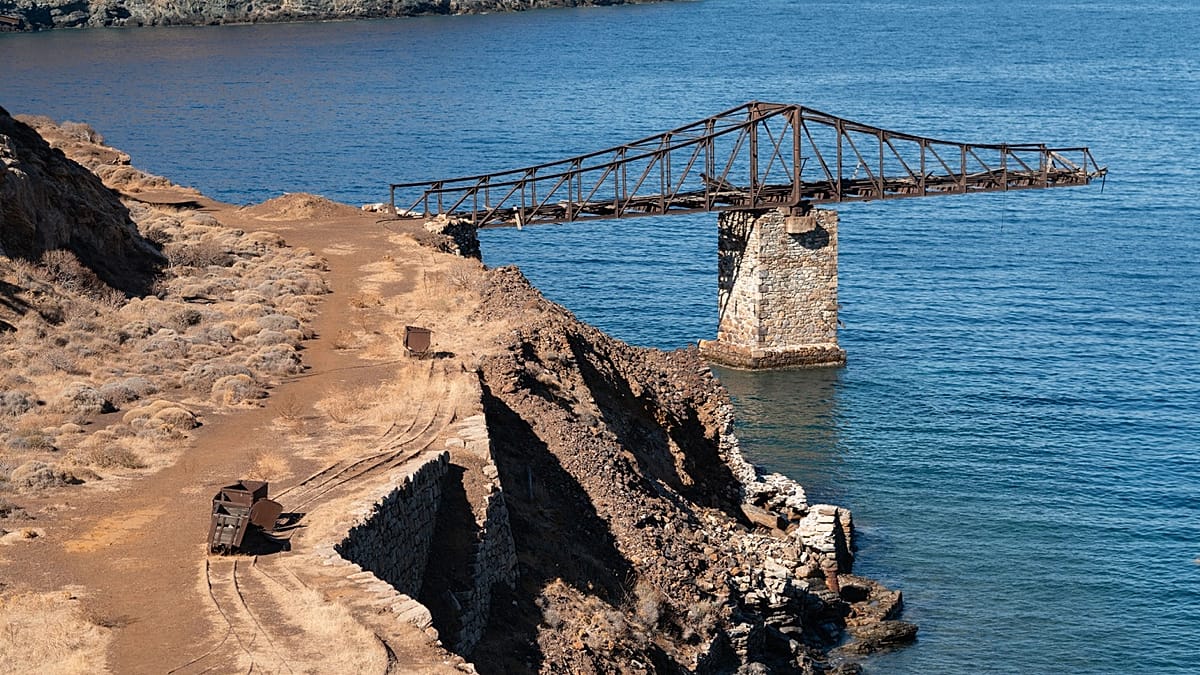
Serifos, a sun-drenched island in the Cyclades, is known today for its beaches and whitewashed villages. But beneath the tourist veneer lies a rugged industrial past that defined the island for over a century. From antiquity, its hills were mined for iron ore, and by the late 19th century, Serifos had become one of Greece's most important mining centres, second only to Lavrio. The remains of that era—rusted rails, crumbling loading piers, and abandoned machinery—still dot the southwestern coast at Mega Livadi and Koutalas.
Now, a new initiative aims to ensure that the human stories behind those ruins are not lost. The Friends of Serifos Association, with support from the Cycladic Identity programme of the Museum of Cycladic Art, has created a digital archive titled “The Living History of the Serifos Mines.” The project, which took a year to complete, gathers over 250 photographs, rare documents, press clippings, and ten first-hand testimonies from surviving miners and their descendants.
A history kept alive by memory
For decades, the story of the Serifos mines survived mainly through oral accounts. As the generation that worked underground passes on, those memories risk disappearing. The archive was designed to capture them before it was too late. In addition to the digital collection, information panels with QR codes have been installed at the mining sites, allowing visitors to listen to the miners' own words while standing amid the ruins.
Katerina Papathoma, vice-president of the Friends of Serifos Association and programme manager, explained the dual purpose of the project. “First, to save and preserve this living history through recordings and live interviews. Second, to share this story—because even those of us who live here do not really know this history,” she said. “When all the material was brought together, I realised how much of this place's past is completely unknown. So we first have to learn ourselves, and then pass it on to young people. They will soon be the ones dealing with Serifos's issues. They need to know these places to become attached to them and, if possible, to protect them.”
The project was presented to the local community earlier this month, with a round-table discussion involving miners and their descendants, followed by a guided tour of the Mega Livadi sites led by historian Thodoris G. Livanios.
From boom to bloodshed
Iron ore extraction on Serifos began in earnest in 1870, becoming systematic by 1885. At its peak, annual production reached 200,000 tonnes, attracting workers from across Greece. But the industry was built on harsh conditions. The German company Grohmann, which operated the mines, paid starvation wages and imposed punishing hours with little regard for safety. Accidents were frequent, often fatal.
In 1916, the miners rose up, demanding an eight-hour working day and dignified treatment. The strike was universal, but it ended in tragedy. Four strikers—Th. Kouzoupis, M. Zoilis, M. Mitrofanis, and I. Protopappas—were killed, along with two gendarmes. The strike's leader, Konstantinos Speras (1893–1943), born on Serifos, went on to become a prominent figure in Greece's labour movement. A bust of Speras stands today at Mega Livadi, a reminder of the struggle.
The mines closed for good in 1963, forcing most workers to migrate and find new livelihoods. The sites were abandoned, but their imprint on the island's identity remained. The Municipality of Serifos has long sought to transform the area into an open-air mining museum, and the new digital archive is a significant step in that direction.
For visitors, the archive offers a deeper layer to the island's beauty—a chance to understand the toil and resilience that shaped Serifos. As Papathoma put it, “We need to know these places to become attached to them.” The project ensures that the voices of the miners will continue to echo, not just in the galleries beneath the island, but in the digital realm for generations to come.