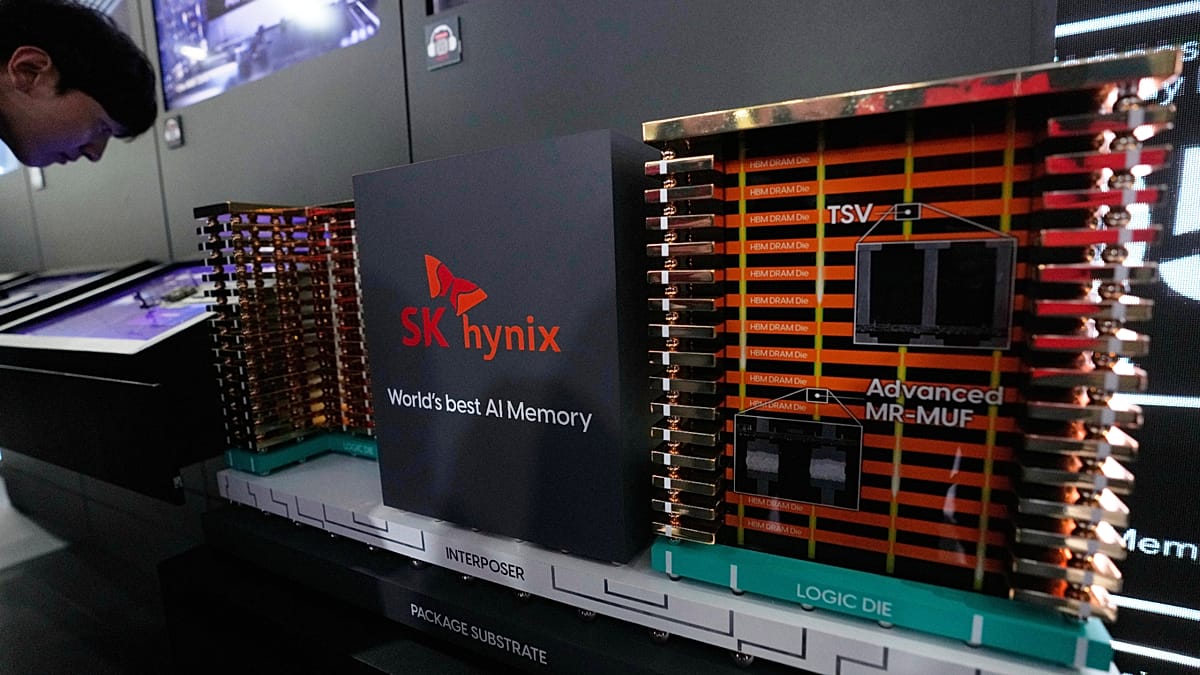
SK hynix, the South Korean semiconductor manufacturer whose high-bandwidth memory (HBM) chips are essential for AI data centres, is set to list on the Nasdaq this week. The company aims to raise roughly $28 billion (€24.5bn) in one of the largest share sales in history, second only to SpaceX's record flotation last month. Trading under the ticker SKHY, the listing is expected to begin on Friday after pricing on Thursday.
The offering consists of 17.79 million American depositary receipts (ADRs), each representing one-tenth of a share traded on Seoul's Kospi index. Cornerstone investors, including Baillie Gifford and funds managed by Coatue Management, have expressed interest in up to $7 billion (€6.1bn) of the stock. The target was slightly reduced from an initial $29.6 billion (€25.9bn) after recent share price declines.
This is not SK hynix's stock market debut; its primary listing remains in Seoul. The Nasdaq offering opens a second, dollar-denominated avenue for American investors to gain exposure without dealing in foreign currency. The move is partly about valuation: Korean-listed chipmakers have historically traded at a discount to their US peers, and a Nasdaq listing offers a chance to close that gap.
From Near-Collapse to AI Boom
SK hynix's journey is remarkable. The company traces its roots to Gukdo Construction, founded in 1949, which moved into electronics in 1983 as Hyundai Electronics, part of the Hyundai conglomerate. The Asian financial crisis of the late 1990s brought disaster. Under an IMF-backed restructuring, Hyundai absorbed LG's semiconductor business, creating a giant that soon buckled under its own debts.
Salvation came in stages. Renamed Hynix Semiconductor in 2001—a contraction of 'high' and 'electronics'—the firm cut jobs, shed assets, and split from Hyundai. Profits returned, but the violent swings of the DRAM market left it perpetually exposed. In 2012, the telecoms conglomerate SK Group rescued it, pouring money into high-bandwidth memory, then a costly and unprofitable technology that few believed in.
Today, SK hynix is worth over $1 trillion (€876bn), a threshold also crossed by rivals Samsung Electronics and Micron, after a surge of more than 200% this year. The AI build-out has transformed the industry's economics. As hyperscalers invest hundreds of billions in data centres, memory prices have exploded: DRAM up 44% and NAND flash up 53% in a single quarter, according to Citi Research. Manufacturers have already sold most of their 2026 production.
SK hynix reported first-quarter revenue above 50 trillion won (€29bn) and operating margins north of 70%, figures unheard of for a chipmaker. It commands about 60% of the HBM market, according to Counterpoint Research. Proceeds from the Nasdaq listing will fund new fabrication plants, chiefly a vast cluster in Yongin, plus its first US packaging facility in Indiana.
Risks and European Implications
Yet the timing is delicate. Memory has always been a brutally cyclical business. The AI-driven rally that transformed SK hynix has begun to wobble as chip stocks sold off sharply across Asia last week. Samsung lost more than $100 billion (€87.5bn) in market value despite posting a record profit. Investors are increasingly questioning whether the vast sums spent on AI infrastructure will earn a return—a concern the Bank for International Settlements raised in late June, warning that the boom could seed the next financial crash.
For European readers, the story carries broader significance. Europe's own semiconductor ambitions, from the European Chips Act to investments in manufacturing in Germany and France, are set against a backdrop of global supply chain dependencies. South Korea's chipmakers, including SK hynix, are key suppliers to European tech firms and data centre operators. Any downturn in the memory market could ripple through the continent's digital economy.
Moreover, the listing underscores the growing financial integration between Asian tech giants and US capital markets, a trend that European exchanges have struggled to capture. While the Euronext and Deutsche Börse have attracted some listings, the scale of SK hynix's Nasdaq offering highlights the dominance of Wall Street in funding the AI revolution.
As SK hynix prepares for its Nasdaq debut, the company embodies both the promise and peril of the AI era. Its survival story is a testament to strategic investment and technological foresight, but the cyclical nature of memory chips and the spectre of overinvestment mean that the road ahead is far from certain.