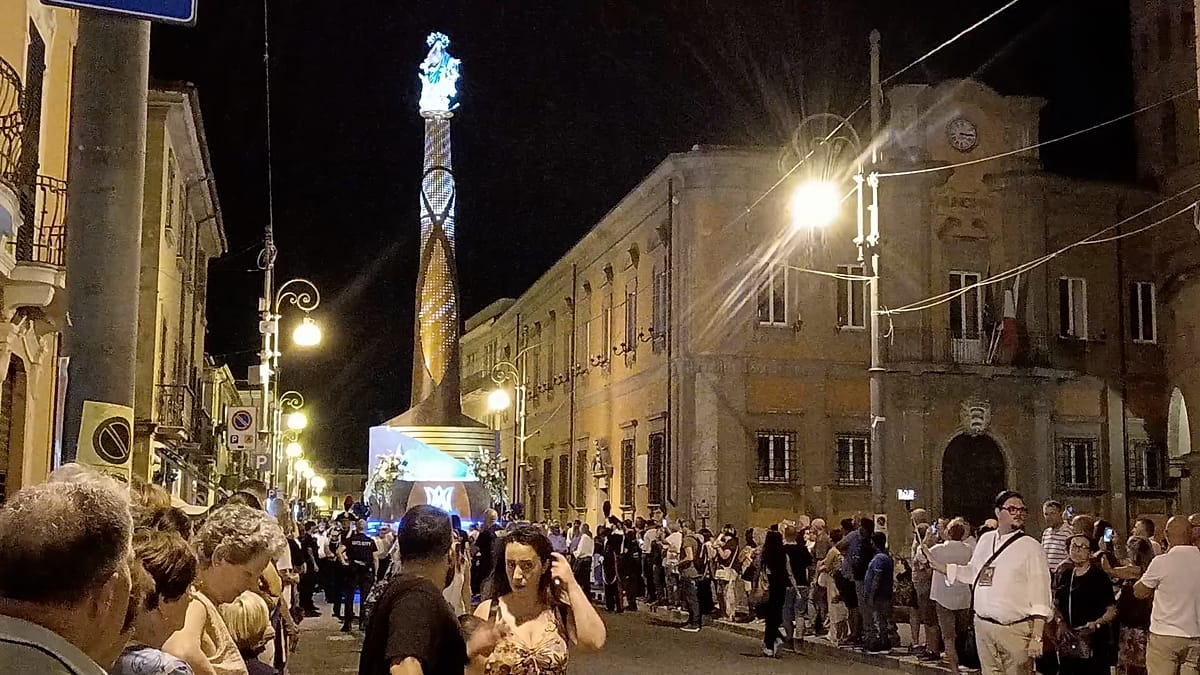
In the central Italian town of Sora, the Feast of the Assumption took on its most spectacular form as thousands of residents and visitors lined the streets to witness a towering, illuminated statue of the Virgin Mary being carried through the historic centre. The structure, which reaches 16 metres in height, is a centrepiece of the town's annual religious celebrations, drawing crowds from across the Lazio region and beyond.
The procession, held on 15 August, is one of the most visually striking Marian devotions in Italy. The statue, mounted on a framework carried by dozens of devotees, is adorned with lights that glow against the evening sky as it winds through Sora's narrow alleys and main piazzas. For many participants, the event is as much a cultural landmark as a religious ritual, reflecting the deep-rooted Catholic heritage of this part of central Italy.
A tradition that unites the community
Local organisers say the procession requires months of preparation. The structure, often referred to as a macchina, is assembled by volunteers who carefully balance its weight and height to ensure it can navigate the town's streets. The bearers, dressed in traditional white and blue, move in slow, coordinated steps, responding to the chants and hymns of the crowd.
“It is a moment of collective prayer, but also a moment when Sora shows its identity to the world,” said one of the event's coordinators, speaking to local media. The feast commemorates the Assumption of the Virgin Mary into heaven, a dogma of the Catholic Church that is particularly venerated in southern and central Italy.
This year's procession took on added significance as Italy continues to see a revival of religious festivals after the pandemic years. Many towns across the country have reported larger crowds and renewed participation, and Sora was no exception. The event also attracted a number of tourists, who came specifically to see the towering structure, which is among the largest of its kind in Europe.
The tradition in Sora is distinct from other Marian celebrations in Italy, such as the Varia in Palmi or the Macchina di Santa Rosa in Viterbo, but it shares the same spirit of communal effort and devotion. In recent years, similar processions have gained attention beyond Italy's borders, with some European towns adopting their own versions. For instance, Poland's Konotopie unveiled Europe's tallest Virgin Mary statue in 2023, a sign of the enduring popularity of such monuments across the continent.
The Sora procession also highlights the broader role of religious festivals in European tourism. As Greece's tourism surge is expected to last through 2027, other Mediterranean destinations are looking to cultural events to attract visitors. Italy, with its rich calendar of religious and folkloric celebrations, is well positioned to benefit from this trend.
For the people of Sora, however, the procession is not about tourism. It is a promise kept year after year, a way of honouring a figure they consider their protector. The statue, which is stored in a local church for most of the year, is brought out only for this occasion, and its journey through the town is followed by a solemn Mass and fireworks display.
As the last rays of light faded, the illuminated figure continued its slow progress, casting a warm glow on the faces of the faithful. The event concluded late in the evening, but its memory will linger in the town until next August, when the bearers will once again take up their burden and carry the Virgin Mary through the streets of Sora.