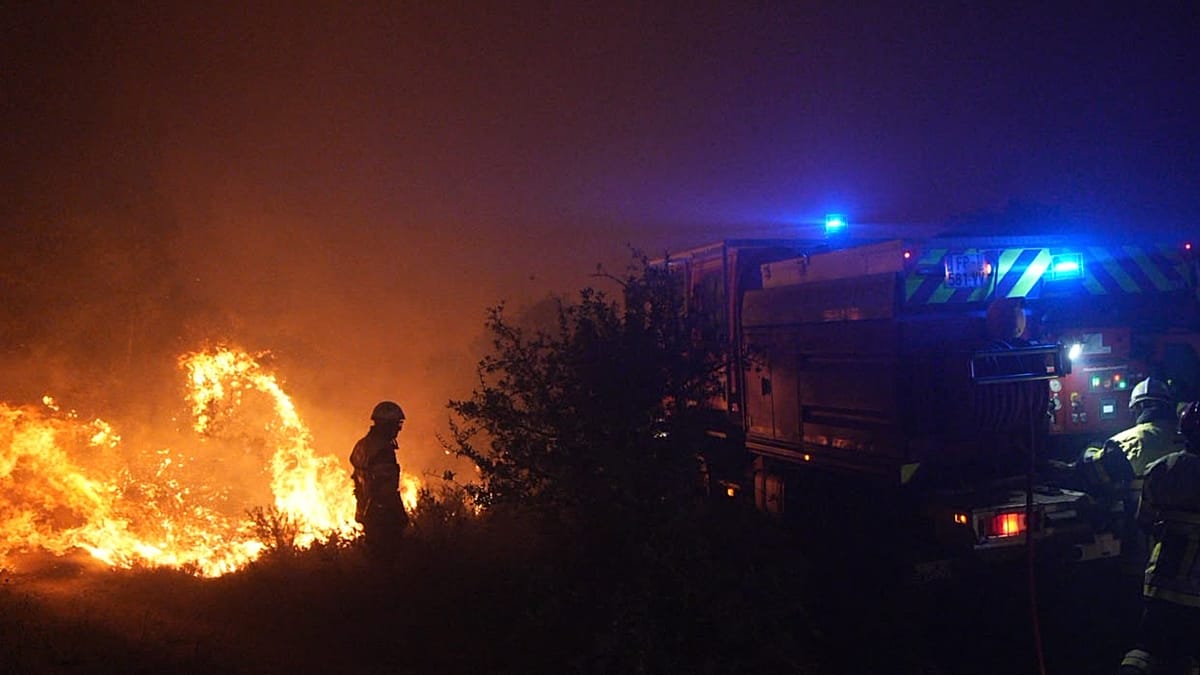
Nearly 3,000 people have been evacuated from coastal areas in southern France as wildfires, fueled by a lingering heatwave and strong winds, continue to spread. The blazes broke out in the town of Sainte-Marie-la-Mer and quickly advanced toward Canet-en-Roussillon, forcing tourists and local residents to flee.
Pierre Regnault de La Mothe, the top regional official for the Pyrénées-Orientales department, confirmed that two firefighters suffered minor injuries during the operations. Half of those evacuated were from three campsites in the affected zone, he added.
Firefighting Efforts Intensify
Two hundred firefighters and four water-bombing aircraft have been deployed to combat the flames. Regnault de La Mothe described the situation as a "fierce struggle" to prevent the fire from reaching an industrial area. "We are mobilising a large network of volunteers," he said, underscoring the scale of the response.
Interior Minister Laurent Nuñez stated that 1,200 firefighters have been mobilised since Wednesday to battle forest fires across the region. In a post on X, he noted that "weather conditions remain particularly unfavourable."
The recent heatwave, which in June saw temperatures exceed 40°C in many parts of France, has left vegetation under severe water stress. The World Meteorological Organisation warned last week that such extreme heat has "major impacts" on human health, ecosystems, agriculture, and infrastructure, while also heightening wildfire risks. This is not an isolated event; similar challenges have been reported elsewhere in Europe, as seen in Portugal, where over 1,000 firefighters were deployed to tackle heatwave-sparked blazes.
Political Fallout and Forecast
Météo-France has forecast a new spell of elevated temperatures for next week, though they are not expected to be as extreme as in June. Strong winds blowing across the Mediterranean are exacerbating the fire danger, while the dry conditions persist.
The crisis has sparked political criticism. Some French politicians have denounced what they call inadequate government measures to address rising temperatures. The Greens filed a no-confidence motion against the government on Thursday, arguing that the administration has failed to prepare the country for the consequences of climate change. The broader context of extreme weather is also affecting other sectors; for instance, France has cut nuclear output as record heat strains river ecosystems used for cooling.
As the fires continue, the focus remains on protecting lives and property. The evacuation of nearly 3,000 people highlights the immediate threat, while the long-term implications of a warming climate are becoming increasingly evident across the continent.