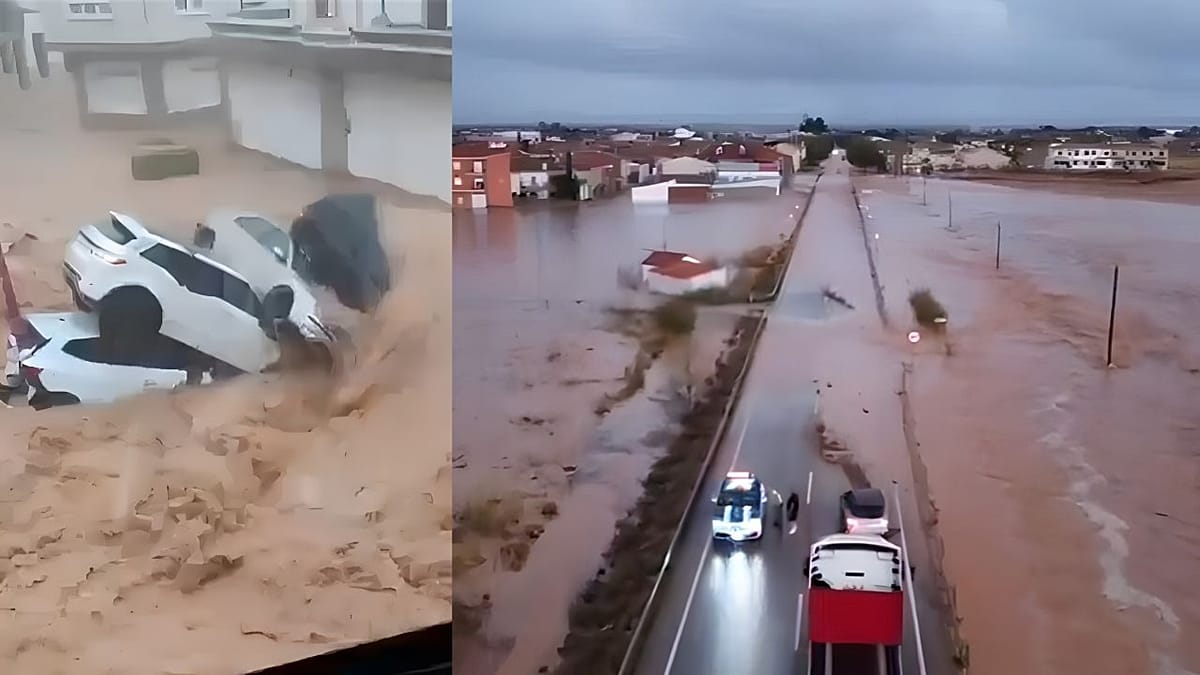
Severe flash flooding in the Castilla-La Mancha town of Madrigueras, in the province of Albacete, has claimed the life of a 102-year-old woman and forced the rescue of around 90 residents. The deluge, which struck on Friday, dumped 142 litres of rain per square metre, overwhelming the town and prompting a large-scale emergency response.
The regional government of Castilla-La Mancha confirmed the fatality and said water levels inside the victim's home reached one metre. Emergency services, including Civil Guard units, carried out dozens of rescues throughout the afternoon and into the night, mostly from homes inundated by the sudden downpour. Officials said they received a flood of calls from frightened residents unsure how to react.
Prime Minister Pedro Sánchez expressed his condolences on X, writing: "All my love to the relatives of the woman who has died as a result of the flooding, and all our support and solidarity to the affected residents." The regional president, Emiliano García-Page, travelled to Madrigueras on Saturday to oversee the clean-up operation.
The tragedy is the latest reminder of Spain's vulnerability to extreme weather, a pattern that has intensified in recent years. The country has seen a series of devastating storms, including the severe storm that battered Crete last month, underscoring the broader Mediterranean climate risks.
Weekend storm outlook
The unsettled weather is far from over. Heavy rain continued overnight and into Friday morning in Tarragona and Castellón, particularly in the Lower Ebro area, where most of the problems were concentrated. By Friday afternoon, orange alerts were in place across Tarragona, the Valencia region, the Balearic Islands, Murcia, and the provinces of Almería, Granada and Albacete, with forecasts of strong storms and hail.
Saturday is expected to bring further torrential rain along the Tarragona coast, where a red alert has been issued, as well as in Extremadura, Salamanca, the Central System and Aragon. From midday, showers and thunderstorms could develop across virtually the entire peninsula, with intense downpours and hail likely in the Iberian System, the south-eastern sierras, the Pyrenees, the north-western quadrant, the Balearic Islands and the Mediterranean coast. Western Galicia and the Canary Islands are likely to escape the worst.
Temperatures will rise in Galicia, Aragon, Navarre, the Basque Country and the Canary Islands, fall in Catalonia, the Balearic Islands and inland Spain, and remain stable elsewhere.
On Sunday, the instability continues, with widespread rain and thunderstorms and the possible formation of a DANA—a slow-moving high-altitude low that can produce torrential rain over the western half of mainland Spain. While this does not necessarily mean heavier rainfall than in Tarragona or Castellón, it increases the likelihood of repeated or spreading conditions. Only the Galician coast is expected to see largely clear skies.
During the early hours, heavy showers and storms could hit the Cantabrian coast, the Balearic Islands and Catalonia. Later, locally intense showers are likely across much of central and northern Spain, with the southern third less affected. The Canary Islands remain largely untouched. Temperatures will change little compared with Saturday, keeping the weekend warm.
The floods have also reignited debates about infrastructure and climate adaptation in Spain, a country already grappling with housing and social pressures. As the storm system moves across the peninsula, authorities urge residents to stay alert and follow official guidance.