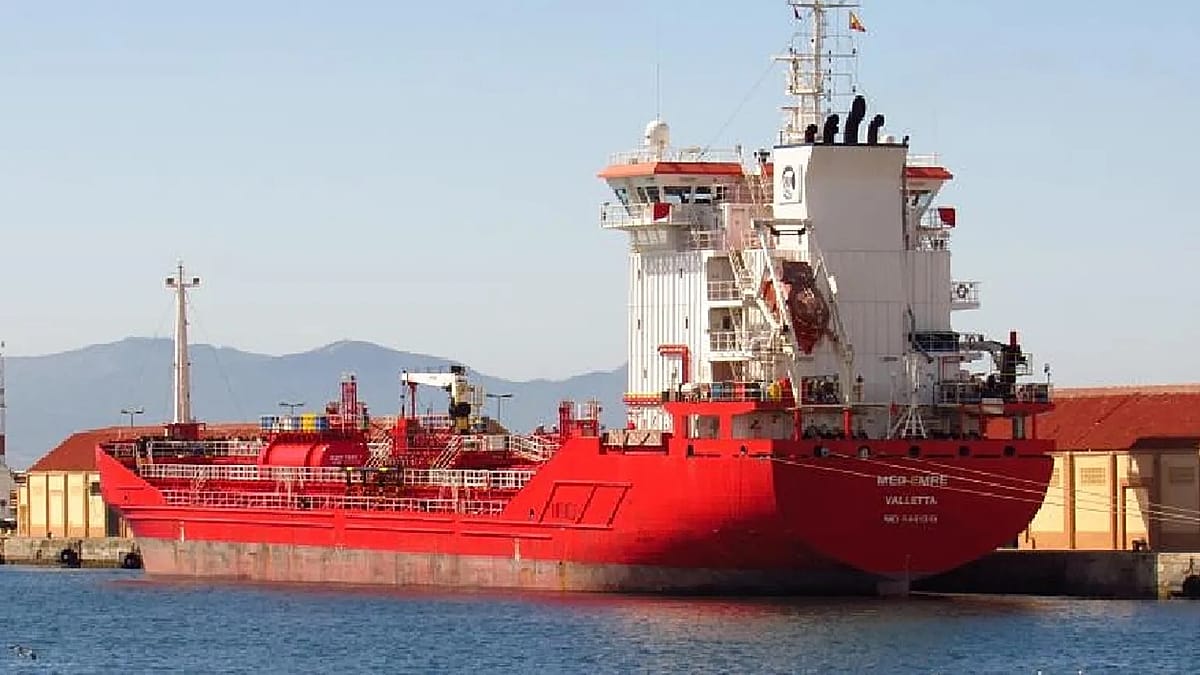
Spanish authorities are working to limit the environmental fallout after a tanker carrying up to 7,000 tonnes of diesel sank in the Mediterranean off the coast of Ibiza. The incident, which occurred in the early hours of Thursday, has triggered a government response mechanism for marine pollution, although officials stress that no coastal contamination has yet been confirmed.
The Maltese-flagged vessel, the Med Emre, was en route from the southern port of Algeciras to Barcelona when it went down. Of the 18 crew members aboard, 17 were rescued, but one later died in hospital. The cause of the sinking remains under investigation.
According to maritime data firm Kpler, the ship was transporting roughly 66,000 barrels of refined products. The Spanish government has activated its marine pollution response protocol, but a spokesperson told AFP that this does not necessarily mean pollution has reached the coast. Salvamento Maritimo, the national maritime rescue service, has deployed a vessel and an aircraft to assess potential damage, while the Balearic emergency services are on alert.
The Civil Protection authority has also requested activation of the European Union's Copernicus Earth observation system to obtain satellite images of the affected area, according to government sources.
Vulnerable waters and blue carbon
Maritime security expert Emilio Rodriguez Diaz from the University of Cadiz described the area as “particularly vulnerable.” Any oil entering the water could harm tourism and the Mediterranean seagrass meadows, which are a major blue carbon sink. These seagrasses trap carbon in their deep rhizome and sediment layers while oxygenating coastal waters, but they are already under stress from rising sea temperatures.
Oil spills are among the most persistent marine pollutants, difficult to clean up and long-lasting in their effects. The European Environment Agency warns that they can “severely pollute marine and coastal habitats, causing damage to the natural environment and the economy.” The agency also notes that the Mediterranean's heavily industrialised coastline—dotted with ports, refineries, and petrochemical plants—amplifies the potential for such incidents.
Rodriguez Diaz, however, downplayed comparisons to the 2002 Prestige disaster, Spain's worst environmental accident, which spilled more than 60,000 tonnes of fuel and blackened thousands of kilometres of Atlantic coastline across Spain, Portugal, and France. The Med Emre, built in Turkey in 2019, has a double hull, which he said acts as a buffer between the cargo hold and the outer layer, reducing the risk of a major release in the event of a leak or collision.
This incident comes amid broader concerns about maritime safety in the region. In December 2024, a US-sanctioned Russian cargo ship sank in international waters off Spain's southern Mediterranean coast, killing two of the 16 people aboard. A Spanish government letter to parliament later revealed that the vessel was carrying components of two nuclear reactors similar to those used in submarines.
While the immediate focus is on containing any spill, the longer-term implications for the Balearic Islands' tourism-dependent economy and the Mediterranean's fragile ecosystems remain a concern. The Spanish government has not yet reported any detected pollution on the coast, but the activation of Copernicus and the deployment of rescue assets indicate a high level of vigilance.