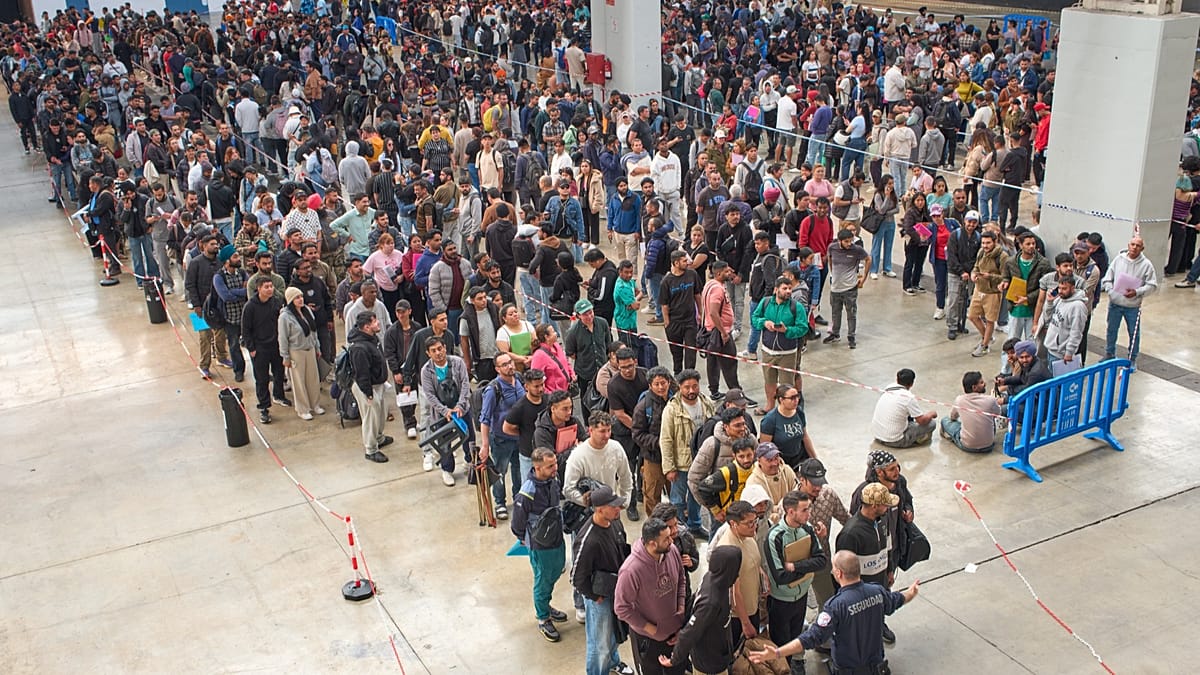
Spain’s ambitious regularisation programme for undocumented migrants has drawn almost 1.2 million applications, according to final figures released on Thursday by the Secretary of State for Migration, Pilar Cancela. The scheme, launched in April by Prime Minister Pedro Sánchez’s Socialist government, stands in contrast to tightening immigration policies across much of Europe, where far-right parties have gained ground.
Between mid-April and the 30 June deadline, a total of 1,174,978 applications were submitted. More than 600,000 are already being processed, Cancela told a press conference in Madrid. The final tally far exceeds initial estimates, which predicted around 500,000 regularisations.
Demographics and Origins
Latin America accounted for 67% of submissions, with Colombia alone representing 25.9% of the total. Morocco followed at 13.3%, Venezuela at 11.8%, and Peru at 8.8%. African nationalities collectively made up 22.9% of applicants. The overwhelming majority of applicants are young: eight out of ten are under 45 years old, and 57% are male.
Applicants must demonstrate a clean criminal record and prove they have spent at least five consecutive months in Spain before 1 January. Authorities have three months to process each case and decide whether to grant a work and residence permit valid only within Spain.
Political Context and Labour Needs
Sánchez has consistently defended the programme as a necessary tool to address labour shortages in sectors such as construction, agriculture, and hospitality. The regularisation is part of a broader push to integrate migrants into the formal economy, a stance that has drawn criticism from conservative and far-right figures across the EU. Manfred Weber, leader of the European People’s Party in the European Parliament, has publicly condemned the scheme and called for stricter EU asylum rules.
Spain’s approach contrasts with measures in other member states. Italy, for instance, has faced scrutiny over its migrant detention centre in Albania, where MEPs were recently denied full access. The divergence highlights the ongoing tension within the EU between humanitarian obligations and domestic political pressures.
The scale of the Spanish programme also raises questions about integration capacity. With nearly 1.2 million applications, the strain on administrative resources and social services could be significant. The government has not yet disclosed how many permits will ultimately be issued, but the processing backlog is substantial.
Spain’s demographic profile—an ageing population and low birth rates—makes immigration a practical necessity for many employers. The regularisation scheme is one of the largest in Europe in recent years, and its outcome will be closely watched by policymakers in Brussels and other capitals.
For further context on Spain’s broader policy environment, see our coverage of Spain Extends Anti-Crisis Measures, Launches 2027 Budget Process and the ongoing debate over EPP's Weber Slams Spain's Migrant Regularisation, Calls for Tougher EU Asylum Rules.