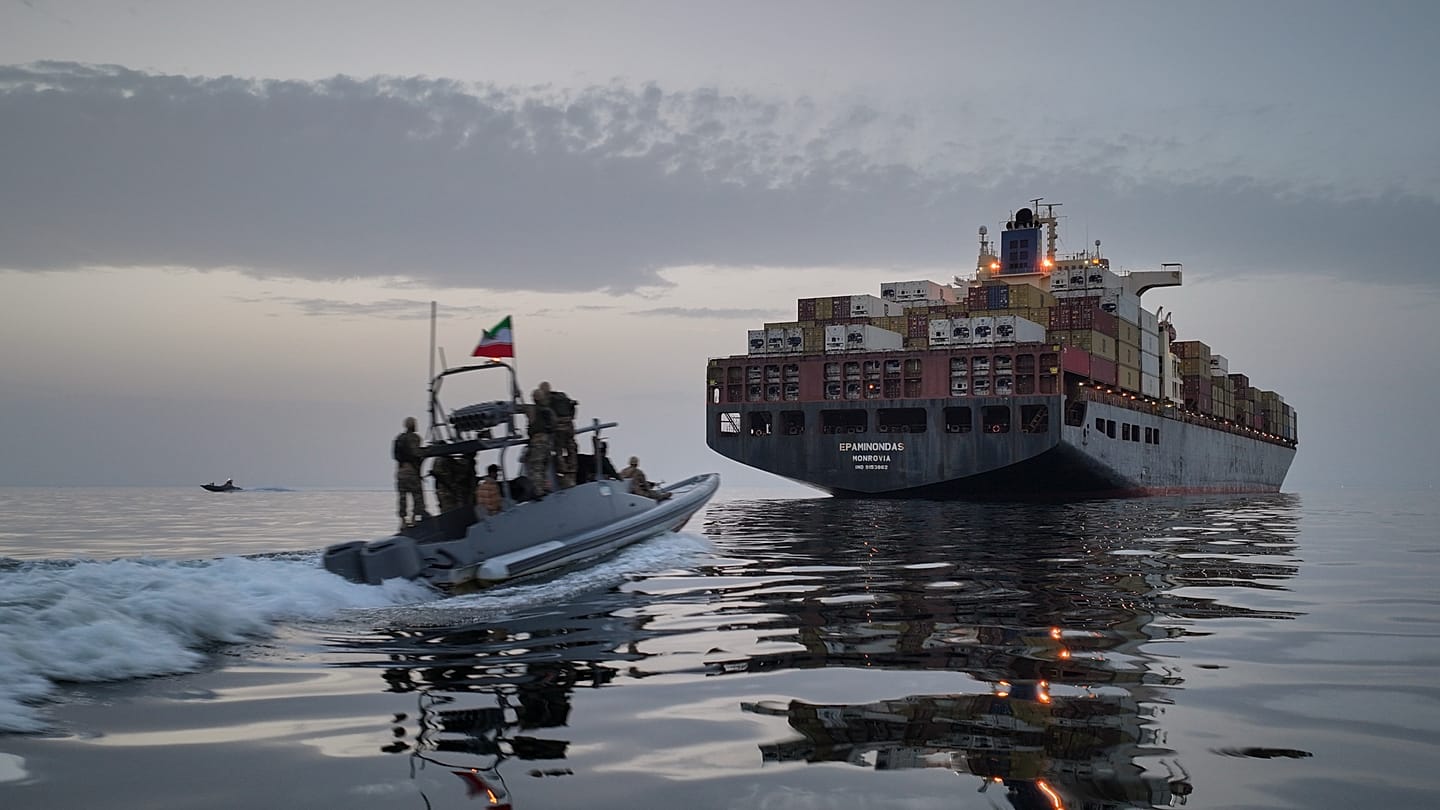
The confusion over who controls the Strait of Hormuz deepened on Wednesday as the United States and Iran offered sharply conflicting accounts of the waterway's governance. President Donald Trump claimed that Tehran had promised not to levy any tolls or charges on vessels transiting the strategic chokepoint, just hours after Iran and Oman announced a joint permit system asserting their authority over the passage.
The Strait of Hormuz, a narrow 33-kilometre-wide channel connecting the Persian Gulf to the Gulf of Oman, is one of the world's most critical energy arteries. Roughly 20 percent of global oil consumption passes through it daily, making its governance a matter of acute concern for European capitals, particularly those in southern Europe that rely heavily on Gulf crude.
Contradictory Signals from Washington and Tehran
Trump's statement, delivered during a press conference at the White House, appeared to contradict the agreement signed in Muscat between Iranian Foreign Minister Abbas Araghchi and his Omani counterpart Badr al-Busaidi. That accord establishes a bilateral framework for issuing permits and regulating traffic through the strait, effectively sidelining the United States and other international stakeholders.
"Iran has assured me there will be no tolls, no fees, no nothing," Trump said. "They understand that the United States will not tolerate any interference with free navigation." The president did not provide details on how or when this assurance was obtained, and Iranian officials have not confirmed any such commitment.
In Tehran, the foreign ministry spokesman Nasser Kanaani reiterated that the strait falls under Iranian and Omani jurisdiction. "The Islamic Republic of Iran and the Sultanate of Oman have full sovereignty over the Strait of Hormuz," Kanaani said. "Any arrangement regarding its use is a matter for the two countries alone."
Rubio's Gulf Mission
US Secretary of State Marco Rubio flew to Abu Dhabi on Wednesday for urgent talks with Emirati leaders, part of a broader effort to reassure Gulf Cooperation Council members that Washington remains committed to freedom of navigation. The visit comes amid growing unease in Riyadh, Manama, and Doha about Tehran's assertiveness in the waterway.
Analysts at the European Council on Foreign Relations in Berlin warned that if Iran succeeds in establishing a permit system, it would represent a major strategic victory. "Control over Hormuz gives Tehran leverage over global energy markets and a powerful tool to pressure its adversaries," said Dr. Anna Sauerbrey, a senior fellow at the think tank. "European governments should be deeply concerned, as any disruption would hit our economies hard."
The European Union imports roughly 30 percent of its oil from the Gulf region, with countries like Italy, Spain, and Greece particularly exposed. The bloc has long advocated for a multilateral framework to govern the strait, but divisions among member states have prevented a unified approach.
The dispute also complicates ongoing nuclear negotiations between Iran and the P5+1. In a related development, Iran called the nuclear framework a 'US defeat' as Trump threatened to end talks over the Hormuz tolls issue. Meanwhile, oil prices dipped earlier this week as talks showed progress, but the latest clash has reversed those gains.
European diplomats in Brussels expressed frustration at the lack of clarity. "We are getting mixed signals from both sides," said one EU official, speaking on condition of anonymity. "The United States says one thing, Iran says another, and we are left trying to figure out what is actually happening on the ground."
The International Maritime Organization, based in London, has called for restraint but has no enforcement mechanism. The UN Security Council is unlikely to act given Russia's veto power and China's reluctance to confront Iran.
For now, the Strait of Hormuz remains a flashpoint where great power rivalries intersect with energy security. European leaders will be watching closely as the situation evolves, aware that any miscalculation could have severe consequences for the continent's energy supplies and economic stability.