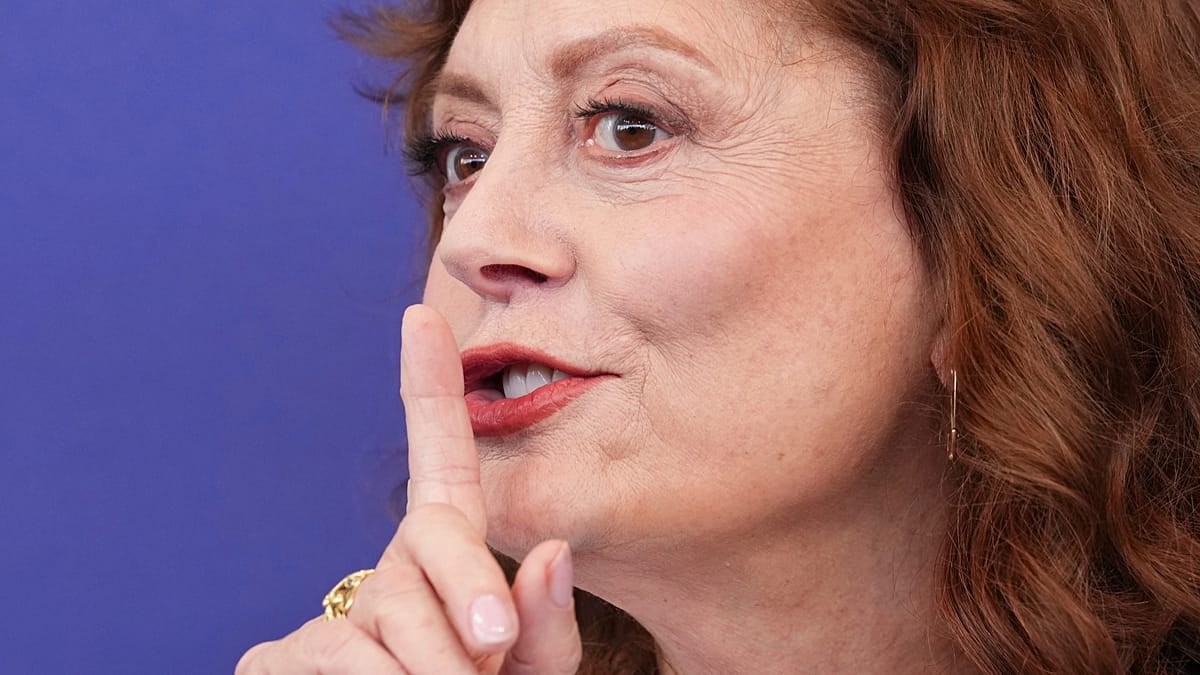
Susan Sarandon has revealed that her outspoken support for Palestine has cost her film roles, with parts of the industry still shunning her over her activism. The 79-year-old Oscar-winning actress spoke at the Venice Film Festival about the professional consequences of her stance on Israel's actions in Gaza.
“In terms of the power structure, I’ve still had movies taken away recently because there are agencies that are telling people not to hire me still,” Sarandon said during a press conference for her upcoming film The Echo Chamber. She thanked director Andrea Pallaoro for not “listening to the warnings” from those opposed to her working in cinema.
Despite the career impact, Sarandon said she believes “the narrative has completely changed in terms of the historical relevance of Palestine and the ties of Zionists with America in our politics.” She added: “That has been a major revelation for people, how much money the United States gives to Israel, nobody really understood that.”
Her comments come as opinion polls show a softening in US support for Israel since the Gaza war began in 2023. A July survey from the Pew Research Center found that Americans now view the Palestinian people nearly as favourably as they view the Israeli people, with attitudes toward both the Israeli government and people growing increasingly negative.
Hollywood's blacklist fears
Sarandon's remarks have reignited concerns about political blacklisting in Hollywood. She was dropped by her talent agency UTA in 2023 after attending pro-Palestinian rallies one month after the Hamas attack on Israel. The veteran star of The Rocky Horror Picture Show, Thelma & Louise and Dead Man Walking has been one of the industry's most vocal pro-Palestinian campaigners, alongside figures like Joaquin Phoenix, Javier Bardem and Mark Ruffalo.
The issue has also drawn in George Clooney, who used his Golden Lion for Lifetime Achievement at the Venice Film Festival to defend Ruffalo's right to criticise the proposed $111bn Paramount takeover of Warner Bros Discovery. “I worry when a big company swallows up another company,” Clooney said. “I always worry whenever big companies are consolidating because it means a lot of people are going to lose their jobs.”
Clooney added: “I support Mark Ruffalo’s ability to speak freely. We’re not going to ban speech. I believe in free speech even when I completely disagree with it. That’s important, right? In fact, it’s part of how a democracy works.”
Ruffalo had accused the Ellison family, which controls Paramount through Oracle co-founder Larry Ellison, of being complicit in the “genocide” of Palestinians, arguing that the company's business model is “built on an apartheid system of oppression powered by Oracle.” He also highlighted Oracle's ties to the Israeli military. Paramount responded by accusing Ruffalo of invoking antisemitic tropes.
Ruffalo rejected the accusation, and more than 170 Jewish artists, academics and public figures signed an open letter titled “Enough!” in his defence. The letter, signed by the likes of Joel Coen, Joaquin Phoenix, Ilana Glazer, Todd Haynes and Hannah Einbinder, warned against the “false and dangerous weaponization of charges of antisemitism against those who are brave enough to point out the obvious: that the assault on the Palestinian people and the assault on our liberties at home are deeply interconnected, and there is nothing antisemitic about recognizing that fact.”
The letter also criticised the proposed merger, saying it would “destroy thousands upon thousands of livelihoods” and “further consolidate the oligarchic control of our media” as part of a “larger project of tech-driven domination.” It ended with the signatories stating that they “stand proudly with Mark Ruffalo, and with all decent people who are bravely rising and speaking truth to power.”
The controversy highlights a growing tension in Hollywood between activism and corporate interests, a debate that resonates far beyond the United States. As European audiences watch these developments, the question of how free speech and political dissent are treated in the entertainment industry remains a pressing one, particularly as Hollywood's cultural output continues to shape global perceptions.