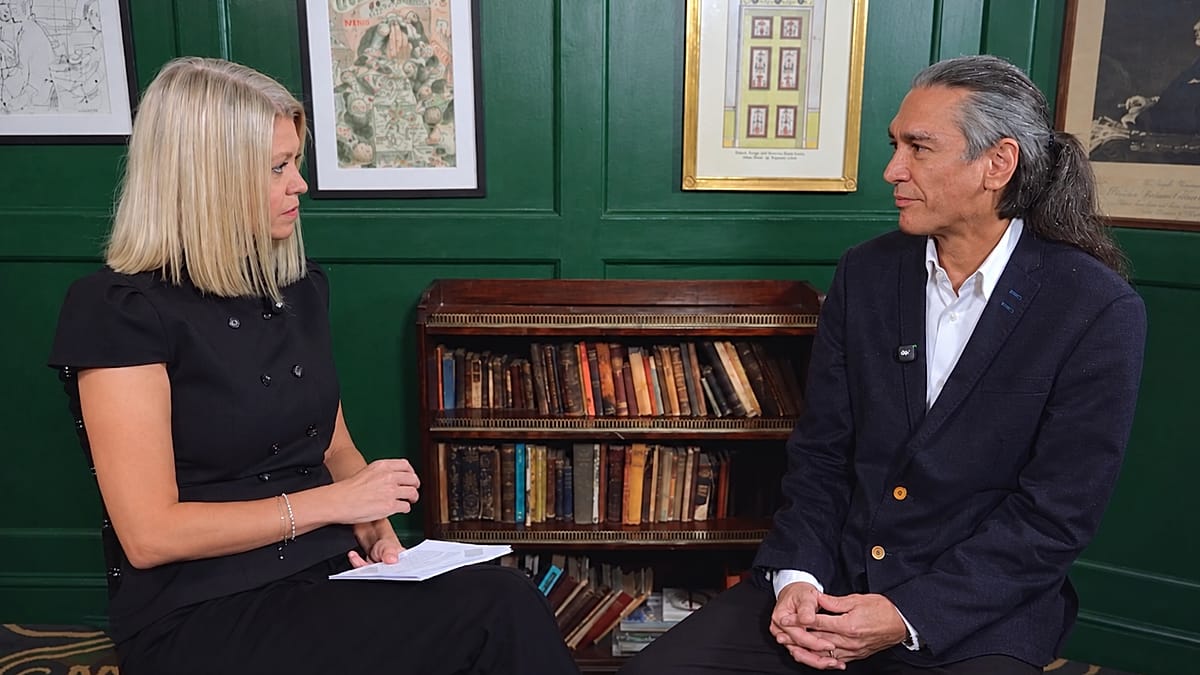
Kim Aris, the son of Myanmar's detained leader Aung San Suu Kyi, has spoken to his mother for the first time in five years. The call, arranged through the British Foreign Office and the Myanmar embassy in London, brought relief but also renewed concern about her condition and the military's motives.
"Obviously I was very happy to hear her voice and it was a huge relief to actually know that she's alive and well after all this time," Aris told Euronews' The World Conversation. For two or three years, the family had not even known whether she was alive.
The 81-year-old Nobel laureate was moved from solitary confinement in a Naypyidaw prison to house arrest at an undisclosed location. Aris, who holds British citizenship through his late father, academic Michael Aris, said the transfer is a public relations exercise. "They call this house arrest, but I do not call this a house arrest. She's not in her own home. She's allowed no access to any sort of media, as far as I'm aware," he said.
A fragile hope
The call was monitored and recorded, and the two stuck to family matters. His mother's first question was whether he had been looking after himself. Aris, who has campaigned for her release since the 2021 coup, said the military is using the gesture to project moderation. He urged the international community to maintain pressure rather than re-engage.
"The military have been able to circumnavigate these sanctions for all of this time, and they're still receiving the money and the weaponry that they need to suppress their people," he said. The junta, led by Min Aung Hlaing, who was elected president in April by a military-dominated parliament, has shown no sign of returning to civilian rule. Aris dismissed the recent elections as "so far from being free and fair."
More than 4 million people are internally displaced, and 2 million have fled abroad, partly due to conscription laws. Asked why young people have taken up arms despite Suu Kyi's commitment to non-violence, Aris said the military left them no alternative. "When they came out in peaceful protests at the start of the coup, they were shot in the streets," he said.
The International Court of Justice ruled last Thursday that Myanmar committed genocide against its Rohingya Muslim minority during the 2017 crackdown. The court ordered reparations, safe return of displaced Rohingya, and prosecution of those responsible. The UK formally recognised the genocide on Monday, sanctioned five senior military officers, and announced plans to restrict aviation fuel supplies.
Aris defended Suu Kyi's decision to appear before the ICJ in 2019, saying she established the Kofi Annan Commission on the Rakhine State on the second day of her term. "They say that she went to The Hague to defend the military. That's just not the case," he said. "She was trying to hold together a very fragile democracy, which the military could have dismantled at any point, which they have done now."
Five years after the coup, Aris believes his mother could still play a role in rebuilding Myanmar. "It's very hard to know what the situation in Burma will be like in 10 years. I hope that the civil war will have finished and democracy will have been re-established," he said.