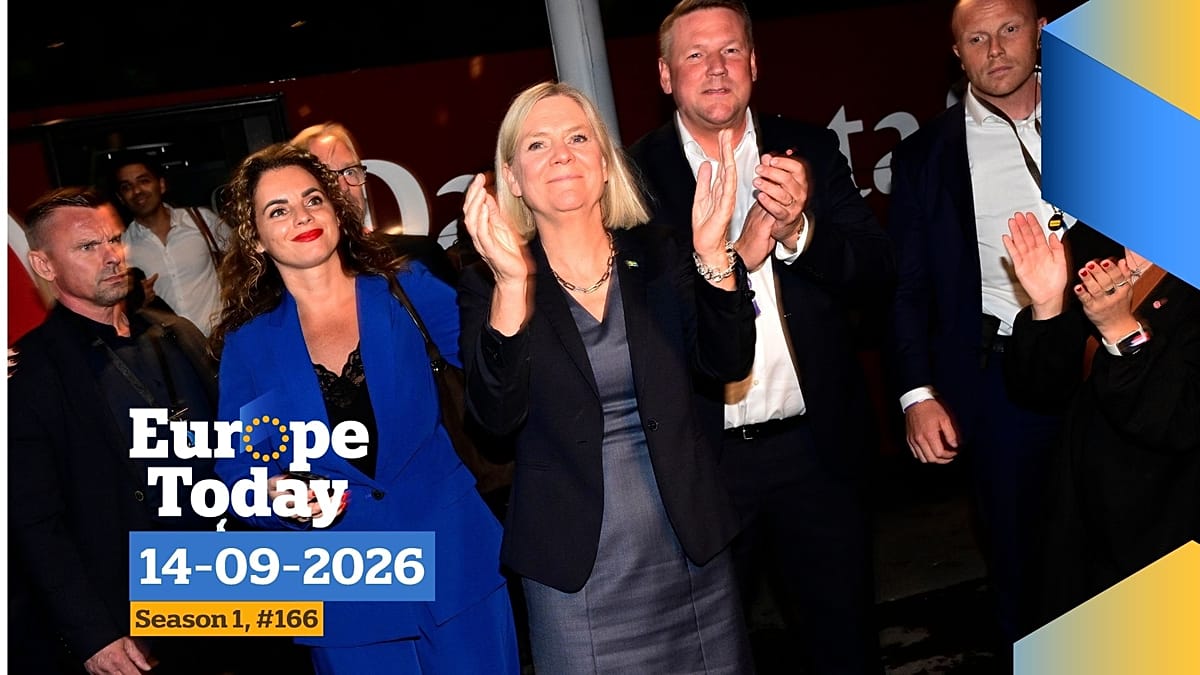
Sweden appears to be shifting toward centre-left governance after Sunday's general election, with exit polls indicating that the red bloc, led by the Social Democrats, has secured a narrow parliamentary majority. Magdalena Andersson, the party's leader, is now poised to form a government, potentially ending eight years of centre-right rule under the Moderate Party.
The final count remains tight, with the red bloc projected to hold 175 seats in the 349-seat Riksdag, just one more than the opposition alliance. The Sweden Democrats, a far-right party, are set to become the largest opposition force, raising questions about the stability of any future coalition. As Sweden's centre-left leads by one seat, the far right's historic gains could complicate negotiations.
Andersson, who served as finance minister before becoming prime minister in 2021, has campaigned on strengthening the welfare state, addressing gang violence, and maintaining Sweden's commitment to NATO membership. "The Swedish people have voted for change," she told supporters in Stockholm. "We will now work to build a government that puts the interests of the country first."
However, the path to power is not straightforward. The Left Party and the Centre Party, both part of the red bloc, have conflicting demands on issues such as energy policy and labour market reforms. Analysts expect weeks of coalition talks, with the possibility of a minority government reliant on external support.
Meanwhile, across the Baltic Sea, US President Donald Trump concluded a two-day visit to Dublin, where he met with Irish leaders and business figures. Trump used the platform to reiterate his support for a united Ireland, a stance that has angered both the British government and unionist communities in Northern Ireland. He also blamed Ukraine for rising diesel prices, urging Kyiv to halt strikes on Russian refineries, a comment that drew sharp criticism from European allies. For more on the trade implications, see Trump's pledge to scrap the whiskey tariff.
Trump's visit was marked by protests in Dublin over his policies on Gaza and trade, but he left without major incident. His remarks on Irish unity were seen as an attempt to appeal to Irish-American voters ahead of the US midterm elections, but they have complicated EU-UK relations at a delicate time for the Northern Ireland protocol.
Baltic concerns over Russia
As NATO's eastern flank grows increasingly anxious about Russian aggression, Latvian Prime Minister Andris Kulbergs sat down with our correspondent Angela Skujins to discuss the threats facing the region. Kulbergs emphasised the need for a robust NATO presence in the Baltics, warning that "Russia's rhetoric is becoming more dangerous by the day." He called for increased defence spending and closer coordination among Baltic states, Finland, and Poland.
"We cannot afford complacency," Kulbergs said. "The security of Europe depends on our ability to stand together." His comments come as NATO prepares for its next summit, where the alliance is expected to bolster its eastern flank with additional troops and equipment.
Orbán's political comeback
In Hungary, former Prime Minister Viktor Orbán is re-emerging from the political shadows, vowing to intensify resistance against the government of Péter Magyar. Orbán, who led Hungary for over a decade before losing power in 2022, has been relatively quiet in recent months, but he now appears ready to reclaim a central role in the country's politics.
Speaking at a rally in Budapest, Orbán accused Magyar's government of betraying "Christian democratic values" and undermining national sovereignty. "We will not let Hungary become a puppet of Brussels," he declared. Political analysts see Orbán's return as a challenge to Magyar's centre-right coalition, which has struggled to address corruption scandals and economic stagnation.
Orbán's influence extends beyond Hungary's borders, as he remains a key figure in European conservative circles. His comeback could reshape the balance of power in the European Parliament, where his Fidesz party has been courted by both the European People's Party and the far-right Identity and Democracy group.
As Europe watches these developments, the continent faces a period of political realignment. Sweden's shift to the centre-left, Trump's disruptive diplomacy, and Orbán's resurgence all signal that the old certainties are fading. For now, the focus is on Stockholm, where Andersson must navigate a fragmented parliament to deliver the change voters have demanded.