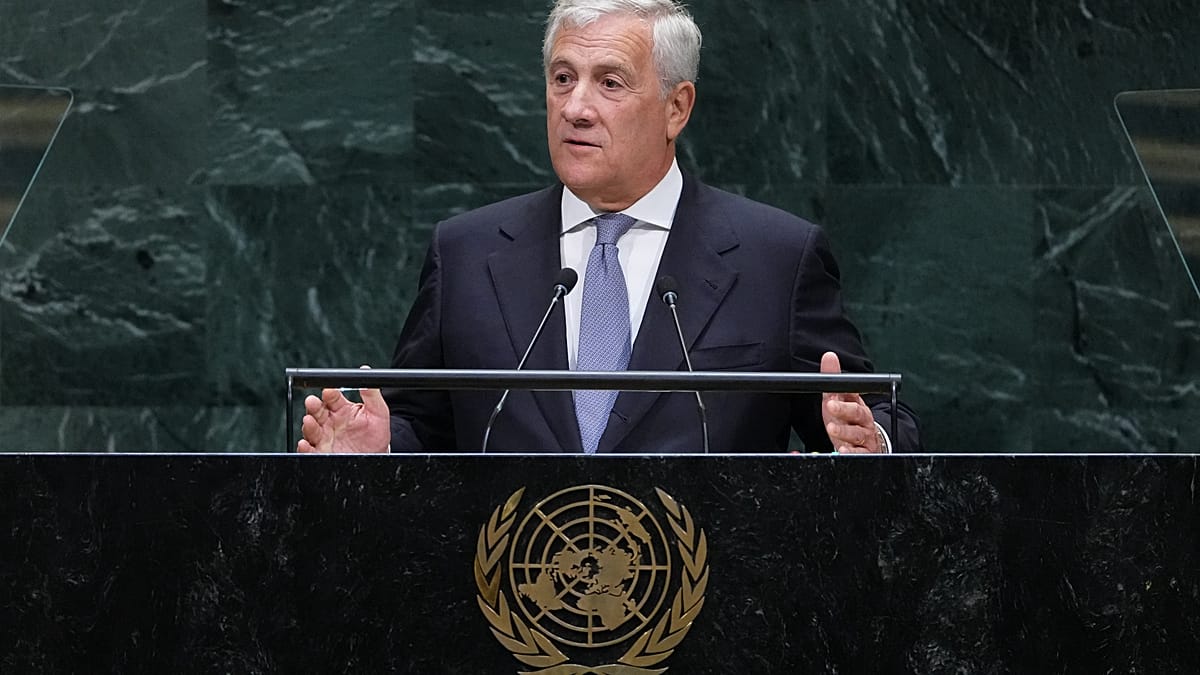
Italian Foreign Minister Antonio Tajani has found himself at the centre of a political firestorm after suggesting that men should choose wives who wear long skirts, a remark that has drawn widespread condemnation and turned him into a social media meme. Despite a formal apology and efforts by Prime Minister Giorgia Meloni to quell the controversy, the fallout has extended well beyond Italy's borders, with international media and online users seizing on the comments.
Speaking at an event last week, Tajani advised men to marry "serious" women who wear "longer skirts," describing them as "less eye-catching, but more reliable, more serious, someone who will be a good mother, who will remain faithful to the love she seals with marriage." He added that he would always choose "the pretty, serious, credible one, who keeps the family together, who is there, who you know will always have an answer and is there when you call."
The remarks triggered an immediate backlash from opposition parties, trade unions, and even the Italian Bishops' Conference. In a symbolic protest, female senators from the Democratic Party, Italia Viva, the Greens and Left Alliance, the Five Star Movement, and the Autonomies group gathered at Palazzo Madama wearing skirts. Raffaella Paita, leader of Italia Viva in the Senate, who conceived the protest, said: "This is an act of freedom to say that we are free to dress as we wish. We believe that women's freedom is measured by every act of freedom, including the length of a skirt or any other choice that women want to make without being judged by men."
Simona Malpezzi of the Democratic Party, who shared a photo of the group on Instagram, argued that Tajani's words "are proof of the intrinsic and unconscious patriarchy, so much so that Minister Tajani then tried to justify himself and apologised, but his justification is even worse. They do not realise what they are saying because it is ingrained in them. Instead we need to show that those remarks are unacceptable."
The controversy was amplified by Roberto Vannacci, leader of the Futuro Nazionale party and a former general, who weighed in with his own provocative comment: "Between a woman in a long skirt and a woman in a short skirt, I always prefer a woman without a skirt." He later posted images of the Venus de Milo and the Venus of Candia on social media, writing: "I do not care about silly criticism. I love women, a gift of the universe."
Many other opposition MPs, and even some men, joined the protest by posting pictures of themselves in skirts. Florence city councillor Andrea Ciulli, a Democratic Party member, shared an AI-generated image of himself wearing a skirt with the caption: "The length of a skirt does not measure a woman's worth, her freedom does."
Former Prime Minister Matteo Renzi, leader of Italia Viva, piled on the pressure, declaring: "Tajani is now a meme, he is no longer a minister." Memes depicting the minister in women's clothing have circulated widely, and the story has been picked up by international outlets including CNN and the BBC.
Institutional criticism
The CGIL union issued a stinging rebuke, stating: "Pitting the 'flashy' woman against the 'serious', 'reliable' and 'good mother', even invoking the length of her skirt, revives an old model of society in which it is still men who decide how women have to be in order to be considered respectable." The union added: "Institutions have a responsibility: to remove stereotypes and obstacles to the full participation of women, not to reproduce the former and weaken the safeguards against the latter. Starting with making the full right to work effective by overcoming existing pay and career disparities. The quality of democracy is also measured by the power that women can really exercise."
The secretary of the Italian Bishops' Conference, Monsignor Giuseppe Batur, responded to questions about the remarks by Tajani and Vannacci, saying: "Every word, every way of looking at women must be filled with respect and admiration; for us Christians the first place where the Word became flesh is a woman's womb, and for those who have faith this forever shapes the way we look at women." He added: "Through our gaze we enter into a relationship with others; towards men, women, children and older people we must show respect, and towards women that respect must be at its highest."
Tajani, who was in New York for the UN General Assembly, apologised on the sidelines of his visit, saying: "I am very sorry that some of my remarks, taken out of a much more wide-ranging speech, have been misunderstood. I apologise if some people felt offended by what I said, but I have never intended to offend women, I have never done so in my life, either in private life or in public."
The episode has reignited debates about gender stereotypes and the role of women in Italian public life, a topic that resonates across Europe. As the EU moves to regulate online content, the rapid spread of memes and the international coverage underscore how quickly political missteps can go viral. The controversy also comes at a time when European politics is increasingly polarised, and disinformation and digital amplification are growing concerns.
While Tajani's apology may have satisfied some, the damage to his reputation appears lasting. As Matteo Renzi suggested, the minister may now be better known for his fashion advice than his foreign policy. The incident serves as a reminder that in the age of social media, a single remark can define a public figure, for better or worse.