A journey to Mars would take months, and the idea of performing complex surgery en route or on the red planet is no longer pure science fiction. Researchers in the United States have taken a first practical step by sending artificial lenses used in cataract operations to the International Space Station (ISS) to see whether they could withstand the rigours of deep space.
The experiment, named JAMES, was designed by Morgan Micheletti, an ophthalmic surgeon and director of research at Berkeley Eye Center in Texas. Micheletti has long been fascinated by space, and once he became an eye surgeon, that fascination turned into a practical question: could he operate in orbit?
“A Mars transit can require almost a year, and returning to Earth for a vision-limiting cataract, injury, or other surgical eye problem may not be realistic,” he said. “Eventually, treatment will need to happen where the patient is.”
Cataract surgery involves removing the eye’s clouded natural lens and replacing it with a clear artificial intraocular lens. Doing that millions of kilometres from Earth would require not only a skilled surgeon but also equipment, sterile supplies, and implants that survive the journey intact.
What happened to the lenses in space?
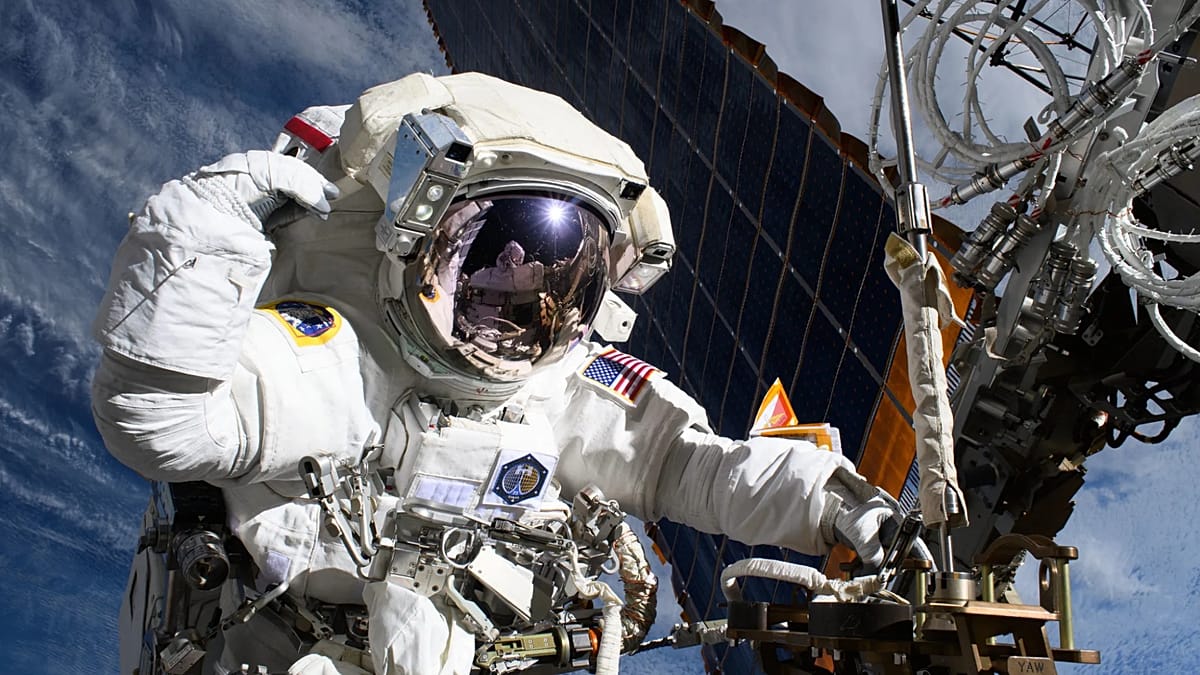
For the JAMES project, Micheletti and his team sent 135 unpackaged artificial lenses to the ISS. They spent about six months outside the station in three different positions, each exposing them to distinct conditions: one faced highly reactive atomic oxygen, another received substantial ultraviolet radiation from the Sun, and a third was partly shielded from both. A control group of 45 lenses remained on Earth.
After the space-exposed lenses returned, researchers at the Intermountain Ocular Research Center at the University of Utah examined 61 of them alongside 20 Earth-bound controls. The results, presented at the European Society of Cataract and Refractive Surgeons congress in London on Sunday, were mixed.
Forty-two of the 61 space lenses showed no notable changes. Among the other 19, eight acrylic lenses developed cracks and surface roughness consistent with erosion from atomic oxygen, while five turned yellow and let through less light at certain wavelengths. All six light-adjustable lenses—which can be fine-tuned with UV light after implantation—developed an unusual cobblestone or “bubble-wrap” appearance, the cause of which remains unknown.
Micheletti cautions that these results do not mean cataract implants would necessarily fail on a Mars mission. The lenses were deliberately exposed directly to the harsh space environment to identify potential failure modes. In reality, they would travel protected inside a spacecraft. The next step is to determine how much packaging and shielding is needed without adding excessive weight or volume.
How realistic is surgery in space?
The experiment tested material durability, not the feasibility of performing surgery in microgravity. Researchers do not yet know whether the observed changes would affect vision or render the lenses unusable.
Micheletti’s next goal is to test the phacoemulsification machine—which uses ultrasound and fluid to break up and remove the cloudy lens—during short periods of microgravity on parabolic flights. If that succeeds, he hopes to move to longer microgravity tests and eventually a surgical experiment in orbit.
“The progression has to be deliberate. First the materials, then the equipment, then the procedure and, ultimately, the surgery,” he said. “My long-term hope is to help make the first eye surgery beyond Earth possible.”
The findings come as European space ambitions grow, with leaders like Emmanuel Macron and Ursula von der Leyen urging greater autonomy in space. While this research is US-led, its implications for long-duration missions are global, and European ophthalmologists are following closely.
For now, cataract surgery on Mars remains a distant prospect, but the JAMES experiment is a small, concrete step toward making medicine work far beyond our planet.