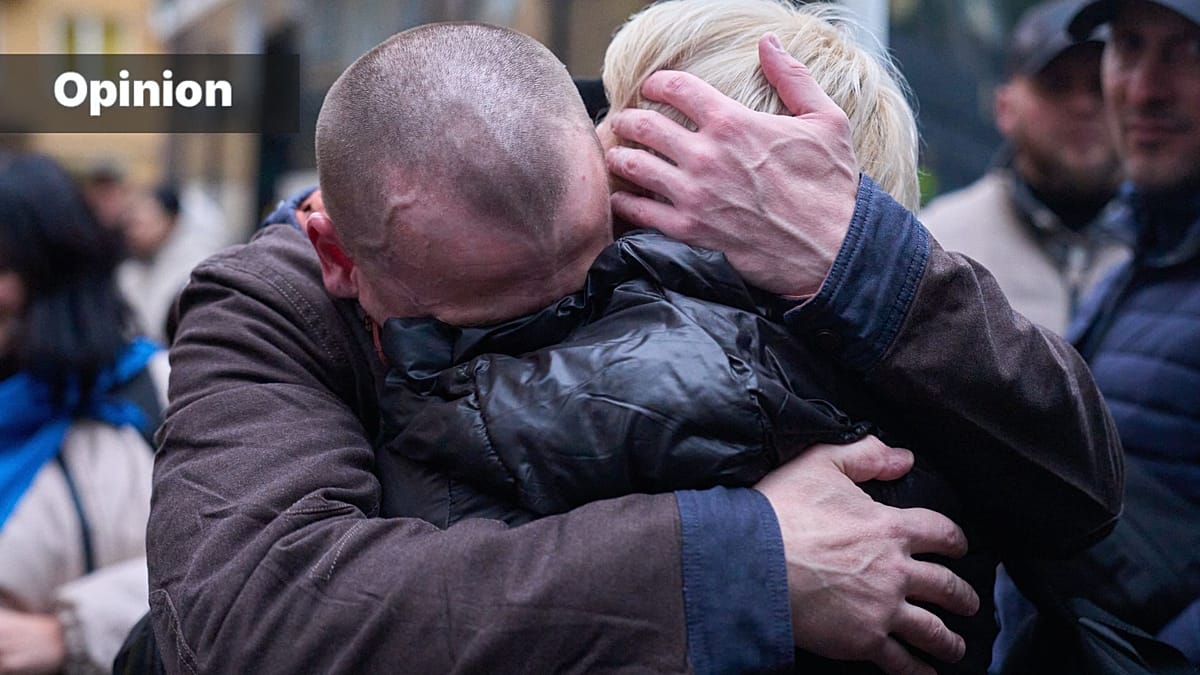
Last year, in a room in Kyiv, a gathering of survivors of conflict-related sexual violence listened as a man spoke. He had been held captive by Russian forces. His voice was soft, his hands trembling until a woman held one to steady him. His eyes carried a pain he did not articulate, but also a determination to see justice done. He had not come to recount his ordeal in detail. He had come to insist that men, too, are survivors of this violence, with wounds and needs that are too often overlooked.
What was done to him in captivity was horrific. Interrogators attached electrodes to his genitals and sent electric currents through him, threatening to leave him sterile. They called it a lie detector test. And there was something else. Through the walls, he could hear women being threatened with gang rape during interrogations, and he could hear women screaming during torture. He never knew who the threats were aimed at—it might have been his wife, a friend, someone close to him. He could do nothing but listen.
That detail captures something often missed about sexual violence in war. A threat made against one person can haunt everyone forced to hear it. An assault on one prisoner marks a whole cell, a whole family, a whole town. The damage spreads through marriages, friendships, and families long after release.
A Hidden Toll
The UN human rights office has documented 664 cases of conflict-related sexual violence committed by Russian forces since February 2022—against prisoners of war, detained civilians, and people in their homes under occupation. Each documented case required a survivor to sit with an investigator and relive the worst moments of their life. Based on operational experience in Ukraine, the UN Population Fund (UNFPA) estimates that for every documented case, there may be ten to twenty survivors who have not come forward, and may never do so.
What makes Ukraine's response remarkable is that it has refused to treat healing as something that only comes after peace. While the war continues, Ukraine has passed a law guaranteeing survivors of conflict-related sexual violence free rehabilitation and urgent interim reparations. Together with the government and women-led organisations, UNFPA supports survivor relief centres across the country and a rehabilitation programme built around retreats, where survivors spend two weeks in safety learning to manage what captivity and violence left in them. One participant arrived having three or four panic attacks a day; by the end, she had learned to steady herself through them.
Because the harm reaches whole families, the retreats now welcome partners and children, learning alongside the survivor how to live in the same house again. Survivors themselves train as facilitators and run sessions for others. In Zaporizhzhia, a survivor-led network signed an agreement with its regional administration to rehabilitate survivors and their families, paid for from the regional budget. In a region still under fire, survivors are helping one another heal—with public support.
It is worth emphasising who is driving this. The relief centres, retreats, and rehabilitation programmes grew out of women’s organisations and women-led networks—services developed over decades to respond to gender-based violence. And it is worth noticing whom they are now healing. In Ukraine, most documented survivors of conflict-related sexual violence are men: men tortured in detention as prisoners of war and in temporarily occupied areas.
This matters because, around the world, support for women's organisations is in open retreat. Funding for women-led organisations is being cut as if it does not affect us all. In 2026, nearly four in five Ukrainian women's organisations reported that funding cuts had hit their work, and two thirds now run waiting lists or turn people away. An estimated 63,000 people stand to lose access to support this year. When that infrastructure goes, it is not only women who are left without help. It is the tortured man, his wife, his children. Defund women's organisations and you abandon everyone they reach.
On this International Day for the Elimination of Sexual Violence in Conflict, we remember the man I met in Kyiv. He now leads a network of men who lived through captivity, to ensure accountability and justice. We must protect and sustain the support networks survivors rely on, with rehabilitation made a permanent part of Ukraine's health and social systems rather than a project that ends when a grant does. The women-led and survivor-led organisations doing this work—in Ukraine and everywhere—need long-term funding. They are not a special interest. They are a vital part of our societies. They cannot always repair what war breaks, and some of it can never be repaired; but they hold up a light to follow when everything around is darkened by violence.
Meanwhile, the war continues to exact a brutal toll. Russian drone barrages hit Kyiv and Mykolaiv, sparking major fires, and Kharkiv's residential areas have been struck as attacks intensify. The EU has been urged to prepare a mandate for talks with Russia on Ukraine, as Ursula von der Leyen pushes for a unified strategy. And Ukraine's path to EU membership remains a central issue, with President Zelenskyy advocating for fast-track accession.