In the winding streets of Thessaloniki's Upper Town (Ano Poli), a quiet transformation is underway. Where bare walls once invited scribbles and spray-paint tags, residents are now commissioning artists to cover their facades with vivid murals. The result is an open-air gallery that is drawing both locals and visitors, and offering a novel answer to the city's persistent problem of visual vandalism.
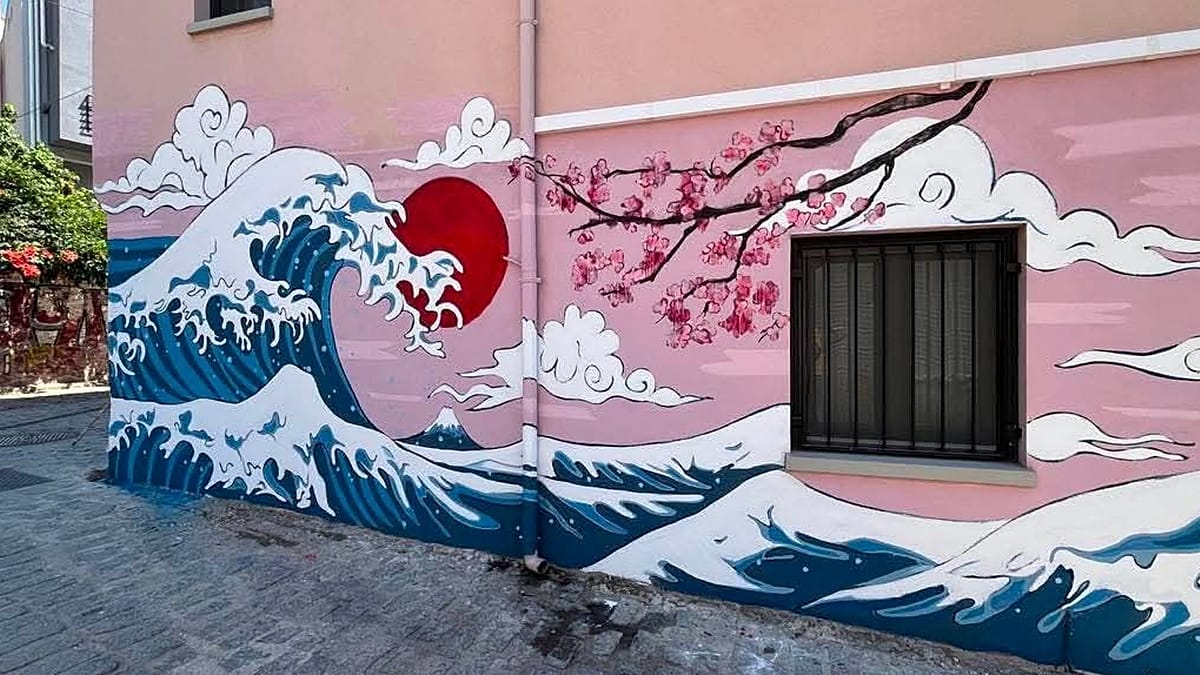
The latest addition is a striking mural on the outer wall of a traditional house, inspired by Katsushika Hokusai's iconic Great Wave. The composition features the famous wave, blossoming cherry trees, traditional Japanese architecture, and the red sun of the rising flag. It was created by artist Souzy Kamaliani at the owners' request, who share a deep affection for Japan. The work has quickly turned the spot into a small photo destination, with passersby stopping to admire the fusion of Greek and Japanese aesthetics.
But the choice was not purely aesthetic. The homeowners had grown weary of repeatedly repainting their walls after vandalism. By handing the surface to an artist, they hoped to create something that vandals might respect—or at least find less inviting to deface. The idea had already been tested on another house in the neighborhood, where Kamaliani painted a colorful composition of plant pots, flowers, and bougainvilleas in February. According to the artist, that wall has remained untouched since.
Art as a shield against vandalism
Kamaliani, who has been painting since 2009 and has recently expanded from canvas to large-scale murals, explains that the difference is not just in size. “A large wall offers a different field of expression and greater freedom of composition than a conventional canvas,” she says. The mural format allows her to engage with the architecture and the community in a way that a studio piece cannot.
The problem of uncontrolled slogans and scribbles is not limited to private property. The Municipality of Thessaloniki has long struggled with the issue, as clean-up operations often prove short-lived. Deputy Mayor for Technical Works and Sustainable Mobility, Prodromos Nikiforidis, notes that the Upper Town is among the hardest-hit areas. Its urban layout, with many low-rise and ground-floor houses, leaves a large number of surfaces exposed to unauthorized markings. “It is a problem that has been plaguing the city for many years,” he says.
The municipal administration believes that clean-ups alone are insufficient. “Broader awareness-raising and mobilisation of citizens is needed,” Nikiforidis adds, “as well as partnerships with businesses that could contribute materials and equipment for restoring surfaces.” The idea of “protection through art” has already spread to the commercial center, where many shopkeepers have commissioned artists to paint their metal shutters, particularly in areas where facades are often covered with slogans after marches and demonstrations.
This approach is not unique to Thessaloniki. In Rome, a restorer has taken a different tack against graffiti, using a sandblaster to clean historic walls, as reported earlier. But in Thessaloniki, the emphasis is on turning the problem into an opportunity for creativity.
A structured future for street art
To give public art a more organized framework, the Municipality of Thessaloniki is creating an open database and networking platform for mural artists. The initiative invites creators to register, providing a documented track record and representative portfolios. The goal is to use this registry for future murals and artistic interventions in public space, strengthening the presence of art in the city's everyday landscape.
For now, the change is most visible in the Upper Town, where homes themselves are becoming canvases. Where a bare wall might once have been a target for a tag, today a Hokusai wave, a blossoming sakura, or a bougainvillea tells a different story. The trend is also a reminder that even in a city known for its vibrant street life, the battle against visual pollution requires both creativity and community engagement.
As Thessaloniki continues to grapple with broader challenges—from airline route cuts to security concerns—the murals offer a small but meaningful counterpoint: a way to reclaim public space with beauty rather than neglect.