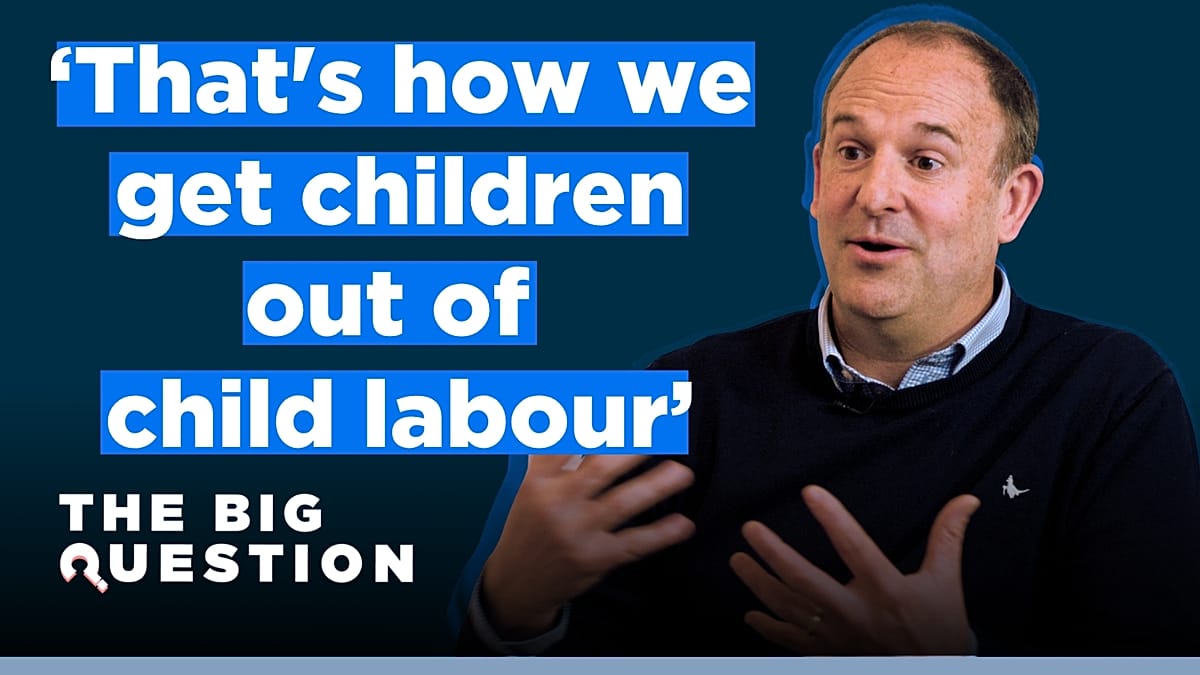
Douglas Lamont, CEO of the Dutch chocolate maker Tony's Chocolonely, is candid about his ambitions. “Do I want to double the size of the company? Of course I do,” he told Euronews. But unlike many corporate leaders, his motivation extends beyond profit. “More volume equals more beans, equals more impact on the ground for farmers,” he explained. “That's doubling the number of beans we're sourcing in an ethical way, paying a living income price to West African farmers.”
Tony's Chocolonely was founded in 2005 by Dutch documentary producer Teun van de Keuken, after he uncovered the scale of exploitation in the chocolate supply chain. When his documentary failed to spark change, he decided to reform the industry from within. Two decades later, the company has become one of the fastest-growing chocolate brands globally, with a turnover exceeding €240 million in 2025.
The scale of exploitation
Most of the chocolate consumed in Europe comes from cocoa beans grown in Côte d'Ivoire and Ghana. Across the industry, an estimated 40% of cocoa-growing households involve child labour. Tony's says it has reduced that figure within its own supply chain to around 4%. The key, according to Lamont, is establishing a living wage for farmers, paid regardless of the volatile market price of cocoa.
“We give them long-term contracts, asymmetric contracts, so we will always buy from them at the living income price. They don't have to sell to us, if they get a higher price from somewhere else. It puts the power in their hands,” Lamont said. “Right now we're paying a 45% premium to the farmgate price in West Africa, so that combination of things means the farmer has a little bit more money in his pocket, can invest in his farm and can afford to send his children to school.”
Traceability is a crucial first step. Lamont stressed that the EU's deforestation regulation will be fundamental in mandating this more widely. “What it does in cocoa is put traceability into the mix so that every single company then needs to know which farms their cocoa comes from,” he added. “Once you know your farmer, you then have a much more direct relationship and it's about the economic argument of then paying them a living income.”
The EU's push for supply chain transparency has drawn support from some US lawmakers, who have urged the bloc to keep its deforestation law strong ahead of a review. US lawmakers urge EU to keep deforestation law strong ahead of review.
The price of ethical chocolate
Tony's Chocolonely is often perceived as expensive, but Lamont insists it is not a super-premium brand. “Our bar is really big and chunky compared to most bars on the shelf,” he said. “On a per kilogram basis, our chocolate is typically at a 20-25% premium to other bars on the shelf, which I think is a price worth paying.”
The company's growth—20% in value in 2025, with the US overtaking the Netherlands as its top market—suggests consumers agree. Lamont acknowledged that ethics alone are not enough. “We're not naive and know that if you've only got the ethics and it's really high-priced and it's a poor product, people won't buy it and won't repeat buy it. I think we're showing that that is possible, and I think you just need a damn tasty product too.”
Climate change and the future of cocoa
Extreme weather has hit cocoa harvests hard, sending bean prices soaring. In 2025, chocolate prices across the EU rose by 17.9%, outpacing all other food and non-alcoholic drinks. Prices have since partially reversed, but Lamont is not celebrating. “We're not celebrating those low prices in the market. What we want is a consistent, strong living income price for the farmer,” he said. “That's how we create a more stable industry. That's how we get children out of child labour. That's how we change the industry.”
Lamont is confident that chocolate is not going anywhere, provided the industry invests in farmers. “If you invest in productivity, if you invest in the farmer and enable them to earn a living income so that it's an attractive industry for people on the ground in West Africa to go into, you'll have a more stable and consistent crop and yield,” he said. “And yes, you will then have climate variability year to year, but the change in yield will be much less if you have a much more invested industry.”
He concluded: “There's also then a moral benefit that we reduce child labour, we drive some of the systemic issues like deforestation out of the industry as well. So that's what we see as the path forward. I think there's just a really clear economic and moral case for that change.”
The broader challenge of protecting children from exploitation extends beyond cocoa. The EU has recently taken steps to hold tech companies accountable for failing to protect children online, and is developing a free age verification app to safeguard minors. These efforts reflect a growing recognition that systemic change requires both regulation and corporate responsibility.