Canadian Prime Minister Mark Carney, who holds both Canadian and British passports, arrived in Yerevan this week for the eighth European Political Community Summit. His presence underscores a growing push for deeper ties between Ottawa and Brussels, even as the legal path to full membership remains blocked.
Carney is spearheading efforts to form a Middle Powers alliance, a diplomatic grouping that could counterbalance the influence of larger global actors. But the summit also provides a platform for Canada to explore a more formalised relationship with the European Union, one that some observers have dubbed the '28th member' scenario.
Public opinion in Canada is increasingly favourable. A recent survey found that 57% of Canadians support joining the 27-member bloc, with 84% prioritising stronger economic ties as a buffer against political instability in the United States. Across the Atlantic, polling shows that majorities in Germany and Spain back Canada's accession, while in Poland, France and Italy, proponents significantly outnumber opponents.
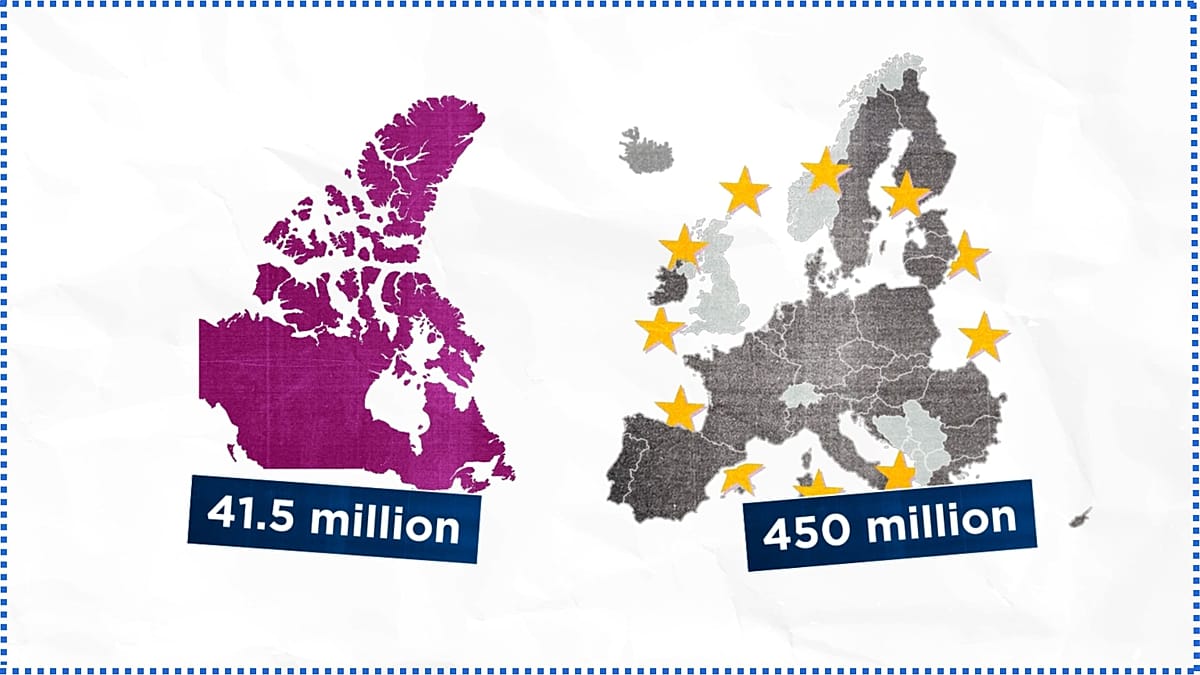
Canada is no minor player. With a population of roughly 41.5 million—about 10% of the EU's—and a GDP per capita well above the EU average, Ottawa would be a wealthy net contributor if it ever joined. Yet the country remains outside the European Economic Area, despite being a founding member of NATO.
The Legal Hurdle: Article 49 and the 'European State' Requirement
Despite the enthusiasm, the European Commission has issued a sobering reality check. European Commissioner for Enlargement Marta Kos recently stated that Canada fails the 'European state' requirement enshrined in Article 49 of the Treaty on European Union. Unlike Ukraine, Turkey or Cyprus, Canada lacks the geographic and ancient cultural connections necessary to satisfy current treaties without a total legal overhaul.
This legal barrier is not insurmountable, but it would require a fundamental change to the EU's founding treaties—a process that would demand unanimous approval from all member states and likely years of negotiation. For now, the 'Brussels bubble' views Canada's membership as a distant prospect.
A Bespoke Model: Norway or Switzerland as Templates
Given the legal constraints, the relationship could evolve toward a bespoke model mirroring that of Norway or Switzerland. Both countries enjoy deep integration into the single market and participate in various EU security programmes, without holding formal membership. This 'close family' bond would provide Canada with access to the EU's economic and security frameworks while stopping short of a full political union.
Such an arrangement would align with Canada's existing ties to Europe. The country is already a member of NATO and participates in several EU-led missions. A deeper partnership could also complement ongoing efforts to strengthen transatlantic relations, particularly as the European NATO members boost defence spending by 14% in 2025, with Germany leading.
Cultural and Linguistic Affinities
Canada's bilingual status—English and French are both official languages—adds a cultural dimension to its European aspirations. French is spoken by over 7 million Canadians, primarily in Québec, and the province maintains strong ties with France and the Francophonie. This linguistic bridge could facilitate integration into EU institutions, where French remains a working language alongside English and German.
Yet the cultural connection is not enough to satisfy the EU's legal criteria. As Commissioner Kos noted, the 'European state' requirement is rooted in geography and history, not language or shared values. Canada may be the world's 'most European' non-European country, but it remains firmly on the other side of the Atlantic.
What Comes Next?
For now, the most likely outcome is a gradual deepening of bilateral ties rather than a formal accession process. The European Political Community, which includes non-EU members like the United Kingdom, Norway and Ukraine, provides a forum for Canada to engage with European leaders on shared challenges. The Yerevan summit is a case in point: it allows Carney to build relationships and explore new avenues for cooperation.
In the longer term, a bespoke agreement could give Canada access to the single market and security programmes without the political baggage of full membership. For Canadians, the question may not be whether to join the EU, but how to say 'yes'—or 'oui'—to a deeper partnership that respects both sides' interests.