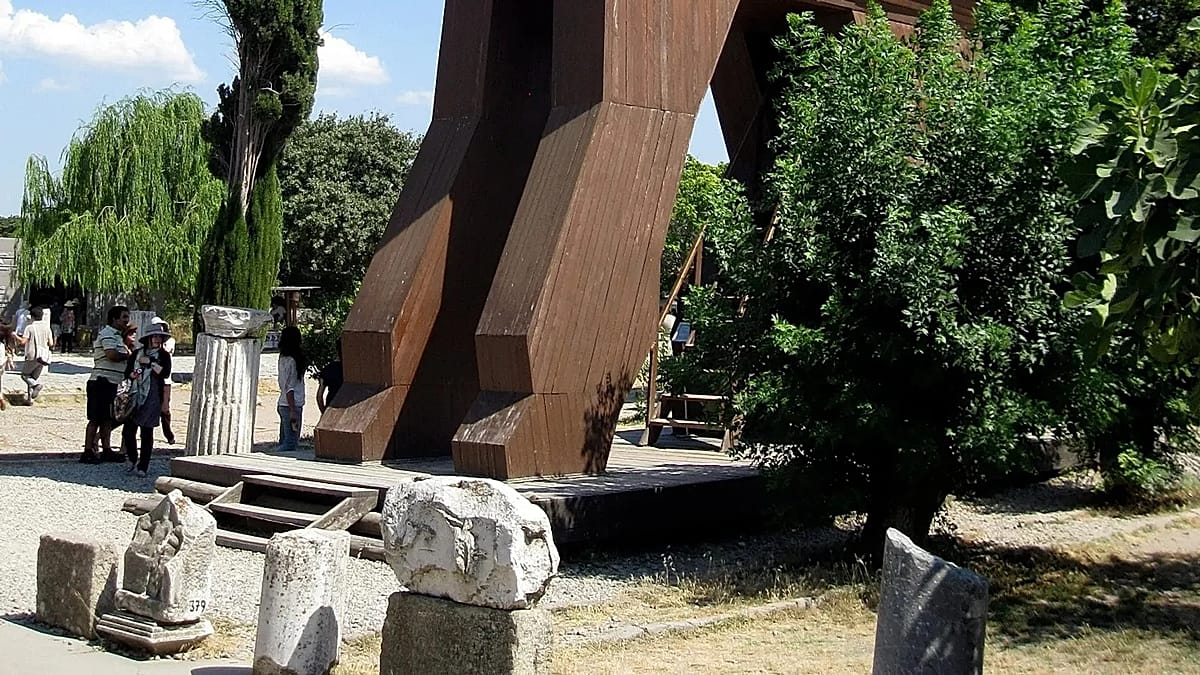
On the Hisarlik hill in north-west Turkey, the layers of Troy have yielded another correction to the story the ancients told about themselves. Excavations led by the Turkish Ministry of Culture and Tourism and Çanakkale Onsekiz Mart University, running since 2014, have brought to light the oldest agora yet identified at the site, a public space dated to roughly 2,800 years ago. The find, reported as interest in the Homeric epics enjoys a fresh cinematic revival, unsettles a long-standing assumption about what happened to Troy after it fell.
The conventional chronology places the city's destruction in 1184 BC. Historians have generally held that the site then stood largely empty for several centuries, until Aeolian Greeks arrived in the 8th century BC and gave it the name Ilion. The new evidence points in a different direction. According to Reyhan Körpe, deputy director of the excavations, newcomers settled on the hill just 80 or 90 years after the war, reusing the old defensive walls to raise their own houses.
An agora on the ruins of a Bronze Age peak
The area now under investigation corresponds to a public space attributed to Troy VI, the phase spanning roughly 1700 to 1300 BC that scholars regard as the city's zenith before the legendary conflict. Alongside the agora, the team has uncovered a paved road running toward the southern gate and a scatter of Iron Age ceramics. Together these traces describe a community that reoccupied the site rather than a ruin left to the elements.
The discovery matters because it compresses the gap between catastrophe and recovery. A hiatus of centuries would have made Troy a memory before its Greek successors arrived; a hiatus of decades makes it a place that people returned to while the destruction was still within living memory. The distinction is not merely academic. It shapes how archaeologists read continuity in the Troad, the wider region around the Dardanelles, and how they interpret the layers that Heinrich Schliemann first began to peel back around 1870, working from the Iliad and the Odyssey.
Schliemann's campaigns established the nine-phase chronology, Troy I through Troy IX, that still structures work on the hill. His methods were rough by modern standards, and later generations of archaeologists have spent decades refining what he disturbed. The site joined the Unesco World Heritage list in 1998, recognition that has helped sustain the long, patient excavation seasons that produced the current results.
A regional story with wider echoes
For Turkey, the find is part of a broader archaeological and cultural push in the Çanakkale region, where the ancient Troad meets the shipping lanes of the Dardanelles. The area has drawn renewed attention for reasons that have little to do with Homer: security incidents and economic pressures have kept the wider country in the news, from a shooting outside a school in western Turkey to Ankara's revised inflation forecast. Against that backdrop, the slow work of stratigraphy offers a different register of national attention.
European scholars have long treated Troy as a shared reference point, a site where Anatolian, Aegean and later Greek worlds overlapped. The new agora adds detail to that overlap. It suggests that the settlement's revival was not a single event but a process, with old walls serving new households and public space re-established on ground that had earlier held a Bronze Age city. The paved road and the ceramics give the resettlement a physical footprint, not just a date.
Questions remain. How large was the community that returned? Did it maintain ties with Aeolian settlers who would arrive later, or did those arrivals displace an existing population? The excavation team's findings so far point to reuse and continuity rather than a clean break, but the full publication of the Iron Age material will be needed before the picture settles.
What is already clear is that the story of Troy's aftermath is more crowded than the traditional narrative allowed. Between the fall and the renaming, people lived on the hill. They built, paved, and left behind the kind of everyday debris that archaeologists value more than epic. For a site that has been excavated, looted, romanticised and filmed for more than a century, that is a notable achievement: the ground still has something to say that the poems did not.