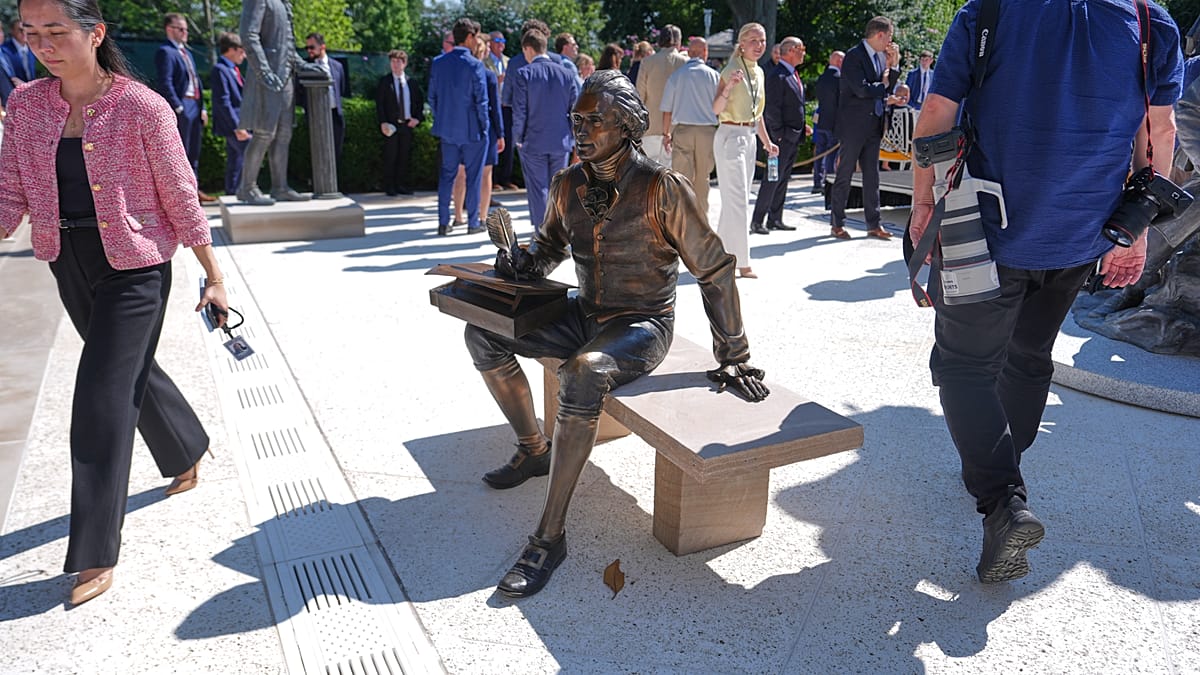
The White House Rose Garden is undergoing a striking transformation under President Donald Trump, with the latest addition being a bronze statue of Thomas Jefferson. Created by Colorado sculptor George Lundeen, the Jefferson figure joins an expanding collection of American Founding Fathers, turning the once-botanical space into a curated open-air monument to the nation's early history.
The statue, which depicts Jefferson in a statesmanlike pose, now stands alongside sculptures of George Washington, Alexander Hamilton, and Benjamin Franklin, as well as a monument honoring Revolutionary War soldiers. The ensemble gives the garden a distinctly patriotic, almost museum-like character, a deliberate shift from its previous role as a venue for presidential ceremonies and quiet strolls.
This redesign began shortly after Trump returned to the White House for his second term, and it is part of a broader initiative to reshape both the interior and exterior of the presidential residence. The Rose Garden's makeover is not an isolated project; similar efforts are underway elsewhere on the grounds, including the installation of new columns in the White House ballroom, sourced from Indiana limestone and shipped to Italy for crafting. That project, detailed in a separate report, underscores the administration's focus on classical aesthetics and traditional materials.
A garden with a political message
The choice of statues is telling. Jefferson, Washington, Hamilton, and Franklin are not just historical figures; they represent different strands of American political thought. Jefferson, the principal author of the Declaration of Independence, embodies democratic idealism. Hamilton, a champion of federal power and a modern financial system, stands in contrast. Washington, the unifying general and first president, and Franklin, the diplomat and inventor, round out a pantheon that speaks to the administration's preferred narrative of American greatness.
Critics, however, see the transformation as a heavy-handed exercise in political branding. The Rose Garden has historically been a space for bipartisan events, from treaty signings to holiday receptions. Filling it with bronze likenesses of the founding generation, some argue, turns a living garden into a static monument, prioritizing ideology over horticulture. Supporters counter that the redesign honors the nation's heritage and provides an educational backdrop for visitors and officials alike.
The trend is not limited to the garden. The White House's broader renovation, which includes the ballroom column project, reflects a taste for neoclassical grandeur that echoes European influences. The decision to send Indiana limestone to Italy for carving is a nod to the craftsmanship of the Old World, even as the administration pursues an America-first agenda. This juxtaposition of American symbolism and European artistry is a recurring theme in the current White House aesthetic.
For Europeans observing from across the Atlantic, the Rose Garden's evolution may seem like a purely domestic affair, but it resonates with broader transatlantic dynamics. The Trump administration's relationship with European leaders has been fraught, as evidenced by Italian Prime Minister Giorgia Meloni's recent admission that ties with Trump are tougher than expected. The White House's visual messaging, with its emphasis on American exceptionalism, can be read as a subtle assertion of national identity in a period of transatlantic friction.
Meanwhile, the garden's transformation has also drawn attention to the White House's role as a symbol of continuity and change. Each administration leaves its mark, but few have so deliberately curated the physical environment to reflect a specific political vision. The addition of Jefferson, a figure associated with both liberty and the contradictions of slavery, adds a layer of complexity that historians are quick to note.
As the Rose Garden continues to fill with statues, the question of what it will ultimately look like remains open. The administration has not announced further additions, but the pattern suggests more could be on the way. For now, the garden stands as a testament to a presidency that is unafraid to rewrite the visual language of the White House, one bronze figure at a time.