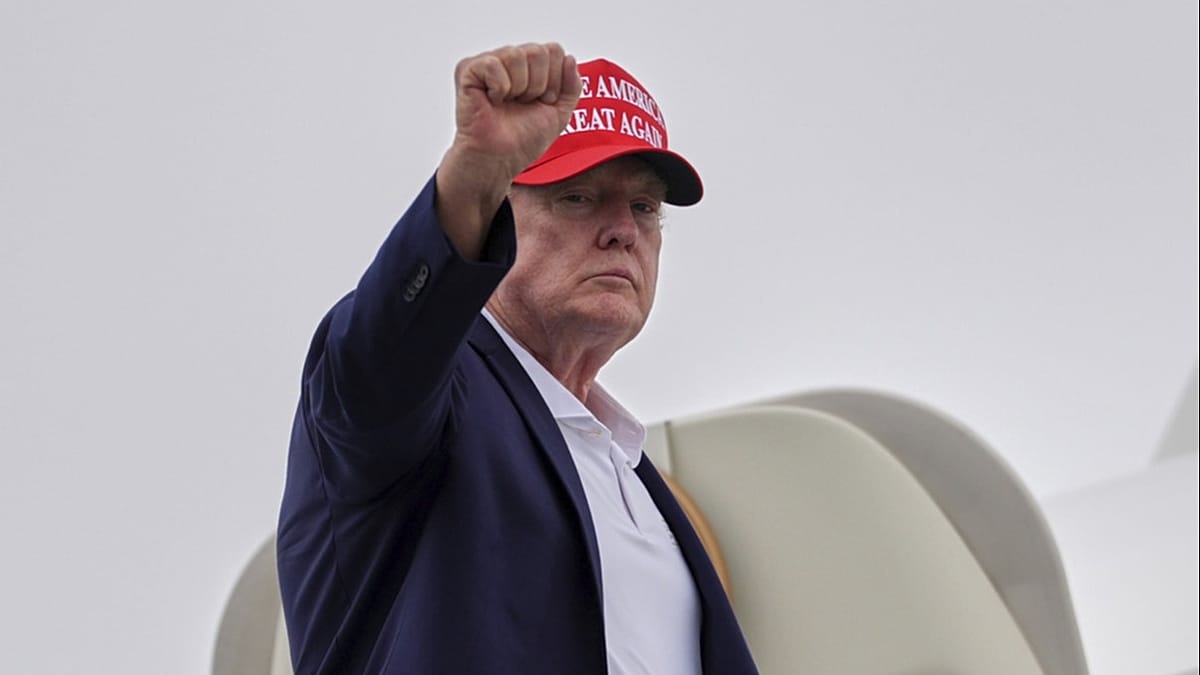
US President Donald Trump has ordered the Pentagon to scale back the annual joint military exercises with South Korea, a move that breaks with decades of alliance practice and comes just as the drills were set to begin. In a social media post on Sunday, Trump said the exercises were not only expensive but also sent a signal that was "totally inappropriate and hostile" to North Korea, which he described as "unthreatening and respectful" during his time in office.
"Therefore, and based on the fact that it is too late to cancel, I have instructed Secretary of War, Pete Hegseth, to substantially reduce the Joint Military Exercises!" Trump wrote. The decision marks a sharp reversal from the administration's earlier praise for Seoul's defence commitments and raises questions about the future of the US-South Korea alliance, a cornerstone of regional security.
Seoul's Iran snub cited
Trump linked the move to South Korea's refusal to join US military action against Iran. He said he had recently asked South Korean President Lee Jae Myung whether Seoul would participate in the "denuclearisation" of Iran, and "they said, 'No thanks!'". The remark underscores the transactional nature of Trump's foreign policy, which has often prioritised bilateral deals over long-standing alliances.
The decision is the latest example of Trump appearing to favour a leader that previous US administrations treated as an adversary. He has also criticised NATO allies for what he perceives as insufficient support for his war against Iran, even as European countries confront a more assertive Russia in the Baltic region. The move could have ripple effects across Europe, where security planners watch US commitments in Asia as a proxy for Washington's global reliability.
In May, Defence Secretary Pete Hegseth had praised South Korea for its "commitment to increase defence spending" and its "leadership in assuming primary responsibility for the security of the Korean Peninsula" during a meeting at the Pentagon. He added that it "demonstrates alliance burden-sharing that all of America's partners would do well to follow." Those comments now stand in stark contrast to the latest order.
The Ulchi Freedom Shield exercises, which involve about 18,000 South Korean troops and run for 11 days, are designed to bolster readiness against North Korean threats. The US military has described them as reinforcing "the role of the alliance as the linchpin for regional peace and security" and reaffirming "the ironclad commitment between the United States and the Republic of Korea to defend their homelands." Alongside springtime training, they are one of the two main combined drills conducted annually.
North Korea has long condemned the exercises as a "rehearsal for an aggressive war" and on Friday threatened unspecified stern steps against the United States and South Korea. The regime has continued to expand its nuclear and missile arsenals since Kim Jong Un's high-stakes diplomacy with Trump collapsed in 2019. Experts suggest Kim likely believes a larger weapons stockpile would strengthen his hand in any future negotiations.
Trump met Kim three times during his first term, most recently in 2019, and has expressed interest in resuming talks since returning to office. In September last year, Kim said he held "good personal memories" of Trump and hinted he could return to dialogue if Washington abandons its "delusional obsession with denuclearisation."
The reduction in drills may be welcomed in Pyongyang, but it has unsettled allies in Seoul and Tokyo, as well as European capitals that view US security commitments as essential to global stability. The move also comes amid broader tensions in the region, including Russian military exercises near Japan and ongoing concerns about China's assertiveness.
For Europe, the decision is a reminder of the unpredictability of US foreign policy under Trump. Analysts note that if Washington can scale back commitments to a key Asian ally over a dispute about Iran, European NATO members may also question the durability of US guarantees. The recent imposition of drone tariffs on European goods has already strained transatlantic trade relations, and this latest move could further erode trust.
As the exercises proceed in reduced form, the long-term implications for the Korean Peninsula and the broader Indo-Pacific remain unclear. What is certain is that Trump's decision has introduced a new element of uncertainty into an already volatile region, with potential consequences that extend far beyond the peninsula.