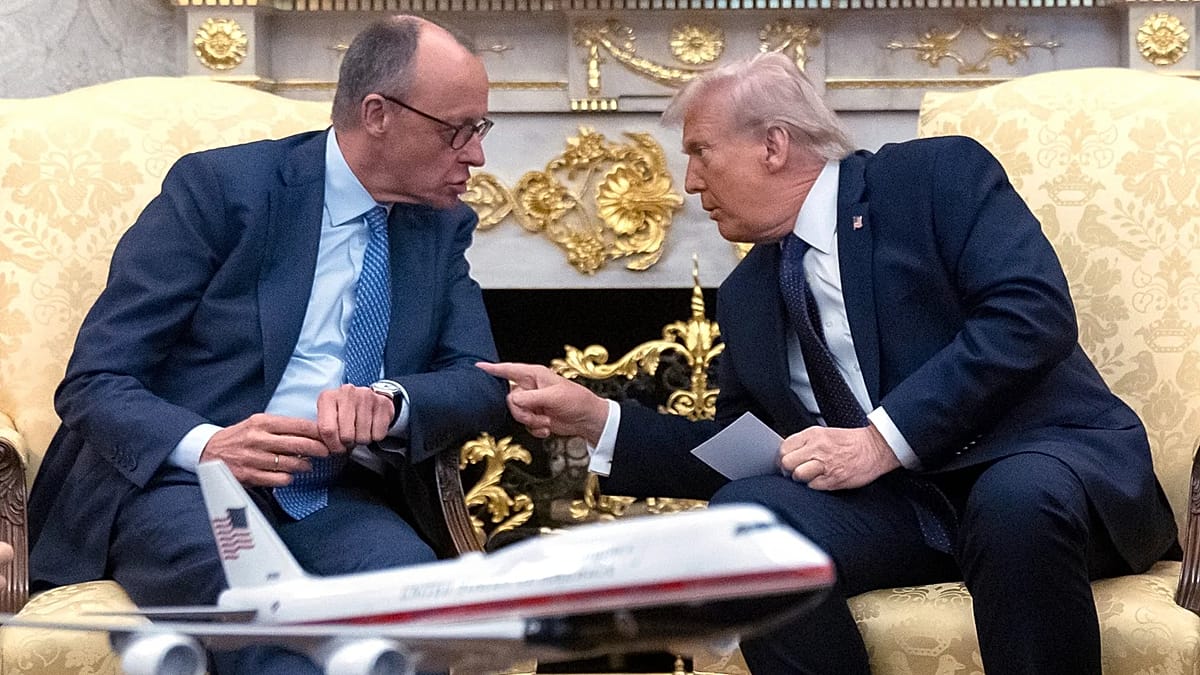
US President Donald Trump has escalated his public feud with German Chancellor Friedrich Merz, issuing a blistering social media post that questioned Berlin's role in the Ukraine war and its domestic policies. The exchange, unfolding on Trump's Truth Social platform, marks the latest flashpoint in a deteriorating relationship between Washington and one of its key European allies.
"The Chancellor of Germany should spend more time on ending the war with Russia/Ukraine (Where he has been totally ineffective!), and fixing his broken Country, especially Immigration and Energy, and less time on interfering with those that are getting rid of the Iran Nuclear threat," Trump wrote. The post came just hours after he threatened a "significant reduction" in the number of US troops stationed in Germany—a move that would reshape the security architecture of Europe.
Merz's Iran Comments Spark Fury
The confrontation began on Monday, when Merz told students in Marsberg that the United States was being "humiliated" by Iranian leadership during nuclear negotiations. "An entire nation is being humiliated by the Iranian leadership, especially by these so-called Revolutionary Guards," Merz said. He added that Tehran had outmaneuvered the White House negotiating team, stating, "The Iranians are clearly stronger than expected and the Americans clearly have no truly convincing strategy in the negotiations either."
Trump's response was swift and personal. In a late-night post on Wednesday, he wrote, "The United States is studying and reviewing the possible reduction of Troops in Germany, with a determination to be made over the next short period of time." The threat is not new—Trump has floated similar ideas before—but NATO experts say the repeated pronouncements have eroded trust in the alliance irretrievably.
During a visit to troops at the Bundeswehr base in Münster on Thursday, Merz did not directly address Trump's troop drawdown threat. Instead, he emphasized the endurance of the transatlantic partnership. "On all these [world] issues, we maintain close and trusting contact with our partners, including, and especially, those in Washington," he said. "We do this in the shared transatlantic interest. We do so with mutual respect and a fair sharing of the burden."
Europe's 'Boiling Frog' Moment
Fabrice Pothier, a former NATO Policy Director, told Euronews that the time has come for Europe to think of "Europe without the US." He described the continent as experiencing a "boiling frog moment" in its relationship with Washington, where "the situation gets worse every year," but European states are repeatedly reassured that the US remains a good ally. Pothier argued that Europe must immediately scale up its collective defense to stand alone against future threats. "There has to be an assumption that the US will not be in the Article 5 mindset if and when it's presented with scenarios" where Europe needs its support, he said. Article 5 of the NATO charter, the cornerstone of the alliance, states that an attack on one member is an attack on all.
Pothier noted a growing "tiredness among European leaders for dealing with Trump's bully tactics." This fatigue has been compounded by recent US actions, including the revocation of sanctions on Russian oil—a key pillar of the Western response to Russia's war in Ukraine—and threats to annex Greenland, a semi-autonomous territory of Denmark. Trump has also frequently launched verbal assaults against NATO allies for not joining him in the Iran war, despite having not consulted them before it began. Last week, a leaked Pentagon email floated the idea of punishing Spain and the UK for their leaders' criticism of the conflict.
"The US has put itself in a stupid situation which has massive global consequences," Pothier said, adding that European leaders are now less concerned about criticizing Washington. The broader context includes Trump's cancellation of Iran talks and the imposition of a naval blockade, which has sent the Iranian rial to record lows, as reported by European Pulse. Meanwhile, the EU is grappling with its own challenges, including a jet fuel crisis threatening regional airports and a climate crisis that the Copernicus report calls an unequivocal threat to food, health, and the economy.
The standoff between Trump and Merz underscores a fundamental shift in transatlantic relations. As the US president continues to undermine the alliance, European leaders face a stark choice: either accelerate their own defense integration or risk being left vulnerable in an increasingly volatile world.