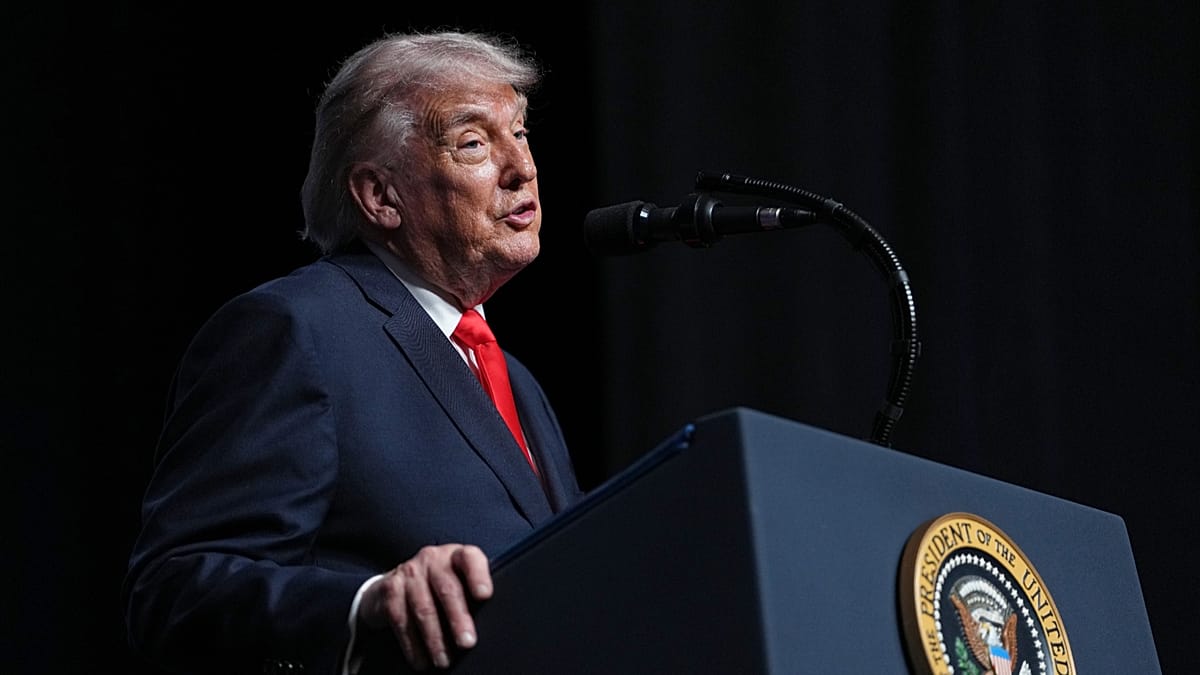
US President Donald Trump raised eyebrows on Friday with a joke that the US Navy would seize Cuba on its way back from Iran, as his administration announced a fresh round of sanctions targeting the island nation. Speaking at the Forum Club of the Palm Beaches in Florida, Trump told attendees that the military would be "taking over (Cuba) almost immediately," suggesting the USS Abraham Lincoln aircraft carrier could anchor 100 yards offshore and demand surrender.
"Now Cuba's got problems. We'll finish one first. I like to finish a job. On the way back from what we'll do... on the way back from Iran, we'll have one of our big, maybe the USS Abraham Lincoln aircraft carrier - the biggest in the world, will have that come in. Stop about 100 yards offshore, and they'll say, 'thank you very much. We give up'," Trump added.
The remarks come amid an ongoing US military campaign in Iran, where Trump has maintained a naval blockade and rejected peace proposals, as the conflict shows no signs of resolution. The joke also follows months of escalating US pressure on Cuba, including Washington's intervention in Venezuela in January, which toppled President Nicolás Maduro.
New Sanctions Target Cuban Economy
On Friday, Trump signed an executive order imposing sanctions on individuals operating in broad sectors of the Cuban economy, including energy, defence, metals and mining, financial services, and security. The order also targets Cuban officials accused of "serious human rights abuses" or corruption, barring them from entering the United States. Foreign banks that do business with those listed face potential penalties.
The sanctions are the latest in a series of measures that have crippled Cuba's economy. Trump has accused Havana of providing security personnel to protect Maduro's alleged drug-trafficking operations in exchange for money and oil, both of which Washington cut off after the January operation. The island has since suffered severe oil shortages, shutting down many sectors and halting national healthcare services. The United Nations has repeatedly warned of a humanitarian crisis unfolding in Cuba due to the US embargoes.
Cuba's Foreign Minister Bruno Eduardo Rodríguez Parrilla denounced the new measures as "collective punishment." In a post on X, he wrote: "We firmly reject the recent unilateral coercive measures adopted by the United States government. These actions demonstrate an intention to impose, once again, collective punishment on the Cuban people."
Parrilla noted that the sanctions were announced on May 1, the same day millions of Cubans marched to protest the US blockade and energy siege. He also criticised the Trump administration for repressing its own citizens while claiming to fight for democracy abroad. "While the US government represses its own people in the streets, it seeks to punish ours, who are heroically resisting the US imperialism's attacks," he wrote.
The foreign minister added that the measures are "extraterritorial in nature and violate the United Nations Charter. The US has no right whatsoever to impose measures against Cuba or against third countries or entities."
The White House has repeatedly called on Cuban leaders to engage in talks with Washington, warning they must do so "before it is too late." However, Havana has shown no willingness to negotiate under the current pressure.
Trump's joke about a naval takeover, while seemingly offhand, reflects a broader pattern of aggressive rhetoric toward Cuba that has alarmed European observers. The US president has already threatened troop cuts in Germany, Spain, and Italy over disputes related to the Iran war, deepening the transatlantic rift. European allies are increasingly concerned about the unpredictability of US foreign policy under Trump, particularly as he appears to consider military action against another sovereign nation.
For now, the prospect of a US invasion of Cuba remains a joke, but the combination of Trump's comments and the new sanctions suggests that Washington is prepared to tighten the screws further on Havana, with potentially severe consequences for the Cuban people and for international stability.