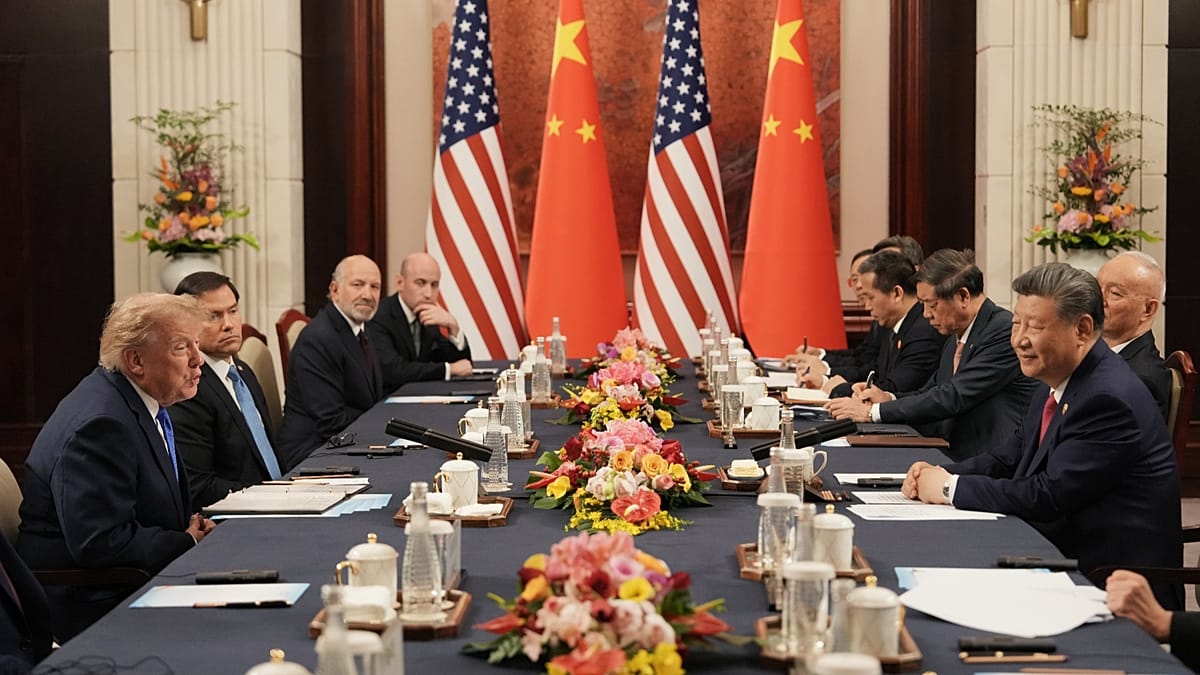
US President Donald Trump said on Thursday that the United States and China both want to help bring an end to the war in Ukraine, speaking just before he sat down with Chinese leader Xi Jinping and Russian President Vladimir Putin for an unprecedented trilateral summit in Shenzhen.
“We're looking to both help with respect to the war with Russia and Ukraine. I'd like to see it ended, I think I can speak for both of us, very much,” Trump told reporters at the Kylin Villa, the venue for the talks on the sidelines of the Asia-Pacific Economic Cooperation (APEC) forum.
The meeting marks the first time the leaders of the three global powers have gathered for a joint summit, an event Beijing has framed as being about “world peace.” Analysts, however, expect the gathering to be heavier on symbolism than on concrete breakthroughs, particularly given the entrenched positions on Ukraine.
A meeting of three, with separate agendas
Before the trilateral, Trump held a one-on-one meeting with Xi — their third substantial encounter this year. The US president praised their friendship and highlighted a shared interest in keeping oil flowing through the Strait of Hormuz, a critical chokepoint that has seen attacks amid the ongoing Iran conflict. Trump also indicated he would press Xi to increase Chinese purchases of American agricultural products.
“I'll be asking you to do some more for our farmers,” Trump said.
Xi responded that relations between the United States and China have been “generally stable and improved” during Trump's presidency, adding that “the efforts you have made are there for all to see and will go down in history.”
Trump also added a separate bilateral meeting with Putin to his schedule — their first talks since a failed attempt in Alaska last year to broker a deal to ease Russia's full-scale invasion of Ukraine. After shaking hands with Putin, Trump called him “my friend” and said, “Wonderful things can come out of this — or at least start.” The two leaders spoke for roughly 40 minutes.
The trilateral session at the Kylin Villa is expected to last no more than an hour, according to the Kremlin, which said the agenda had not been finalised but that it would be hard to avoid discussing Ukraine. Washington initially signalled that Ukraine was off the table, but Trump later said the war would feature. Beijing has offered only a vague description, saying the trio would hold “in-depth exchanges on safeguarding world peace and promoting strategic stability in major-power relations.”
Xi has not treated the conflict as China's problem to solve, and European capitals are watching with unease. The summit has stoked fears that the three leaders might seek to carve the globe into spheres of influence, potentially making decisions about Ukraine's fate without Kyiv or Europe at the table.
Germany was due to host a separate “Coalition of the Willing” meeting on Thursday, bringing together Ukraine's allies and including US envoys Jared Kushner and Steve Witkoff. That gathering underscores the parallel track that European governments are pursuing, even as the Shenzhen summit grabs global attention.
For Europe, the stakes are high: any deal brokered without European input could reshape security arrangements on the continent. The EU has been exploring ways to support Ukraine, including a proposed €45bn loan, but the bloc's ability to influence the outcome of the Shenzhen talks remains limited.
Trump, meanwhile, is under pressure at home over his war with Iran, which has choked oil supplies and pushed up consumer prices worldwide. An ascendant China is looking to strengthen its hand in East Asia, and Putin is seeking to break Russia's diplomatic isolation. The trilateral meeting, whatever its immediate results, signals a shift toward great-power politics that could have lasting consequences for Europe's place in the world.