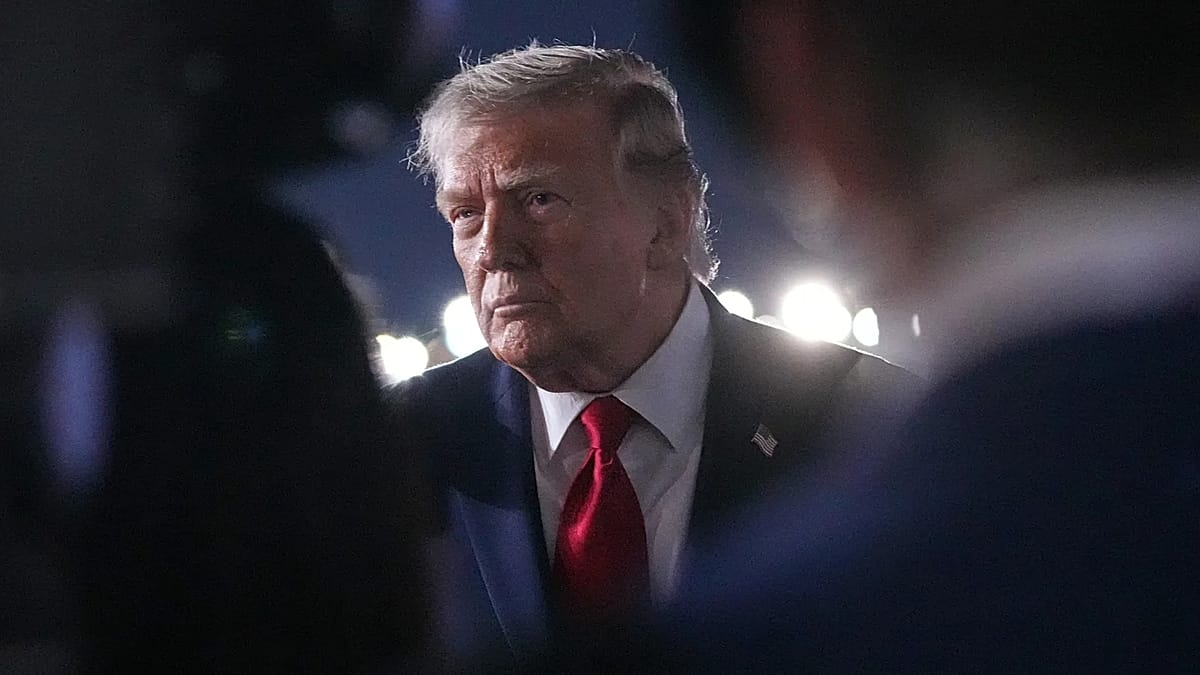
US President Donald Trump declared on Wednesday that Iran has exhausted its window for negotiation and will now face repercussions, as fresh military exchanges between Washington and Tehran threaten to unravel the fragile ceasefire established in April.
In a post on his Truth Social platform, Trump wrote: "The Bully of the Middle East is DEAD!!! They’ve taken too long to negotiate a deal that would have been great for them, now they will have to pay the price!!!" The statement came shortly after the United States conducted airstrikes against Iranian targets early Wednesday, and Iran retaliated by launching missiles at several countries in the region.
Speaking to Fox News journalist Trey Yingst, Trump indicated that he is considering targeting Iran's power plants and bridges, saying: "I may keep going. They had a chance to sign a deal and survive." This marks a sharp departure from his comments to reporters on Tuesday, when he described negotiations for an enduring settlement as being in their "final throes" and suggested a deal could be concluded within "two or three days."
In a separate social media post, Trump praised the US naval blockade of Iranian shipping, calling it "the most successful" in history and describing it as a "steel wall." He claimed the blockade has halted Iranian business and prevented the payment of military wages, while still allowing other countries to export "lots of oil." He added: "Praise be to Allah!"
Regional Escalation: Missiles Over Jordan, Kuwait, and Bahrain
The latest round of tit-for-tat strikes began after Iran downed a US Apache helicopter near the Strait of Hormuz, an incident that prompted Trump to vow retaliation. On Wednesday, Iran's Islamic Revolutionary Guard Corps (IRGC) announced it had fired "long-range missiles" at targets in Jordan, Kuwait, and Bahrain. State-run IRNA news agency reported that the missiles struck four major targets in Jordan, including F-35 fighter nests at an air base and the US command centre in Al-Azraq.
Jordan's armed forces confirmed they intercepted five missiles launched from Iran towards the historic town of Azraq, approximately 100 kilometres from Amman. The area hosts the Muwaffaq Salti air base, which is home to the Jordanian Air Force's 1st, 2nd, and 6th Fighter Squadrons and has previously been used by US and NATO allies for operations against the Islamic State group in Syria. The Jordanian military stated: "We intercepted and shot down five missiles launched from Iran towards Azraq. The interception resulted in debris falling, but there were no casualties or material damage."
Kuwait's military reported that its air defences were engaging "hostile aerial targets," though it did not immediately identify the aggressor. Iran has recently carried out deadly attacks on Kuwait. Meanwhile, the Bahrain Defence Force said it had successfully intercepted an unspecified number of missiles, accusing Tehran of pursuing a "systematic hostile approach" through "unlawful attacks using missiles and drones targeting civilians in the Kingdom."
The escalating conflict has raised concerns across Europe, particularly among EU member states with diplomatic missions in the region. The European Union has repeatedly called for de-escalation and a return to negotiations, but the latest developments suggest that diplomatic channels are under severe strain. The situation also echoes broader geopolitical tensions, as seen in the ongoing efforts by Ukraine's President Zelenskyy to force Russia into peace talks, highlighting the fragility of ceasefire agreements in multiple conflict zones.
As the US and Iran exchange fire, the risk of a wider regional war looms, with potential consequences for global energy markets and European security. The Strait of Hormuz, a critical chokepoint for oil shipments, remains a flashpoint, and any disruption could have immediate economic repercussions for European nations reliant on Middle Eastern crude.