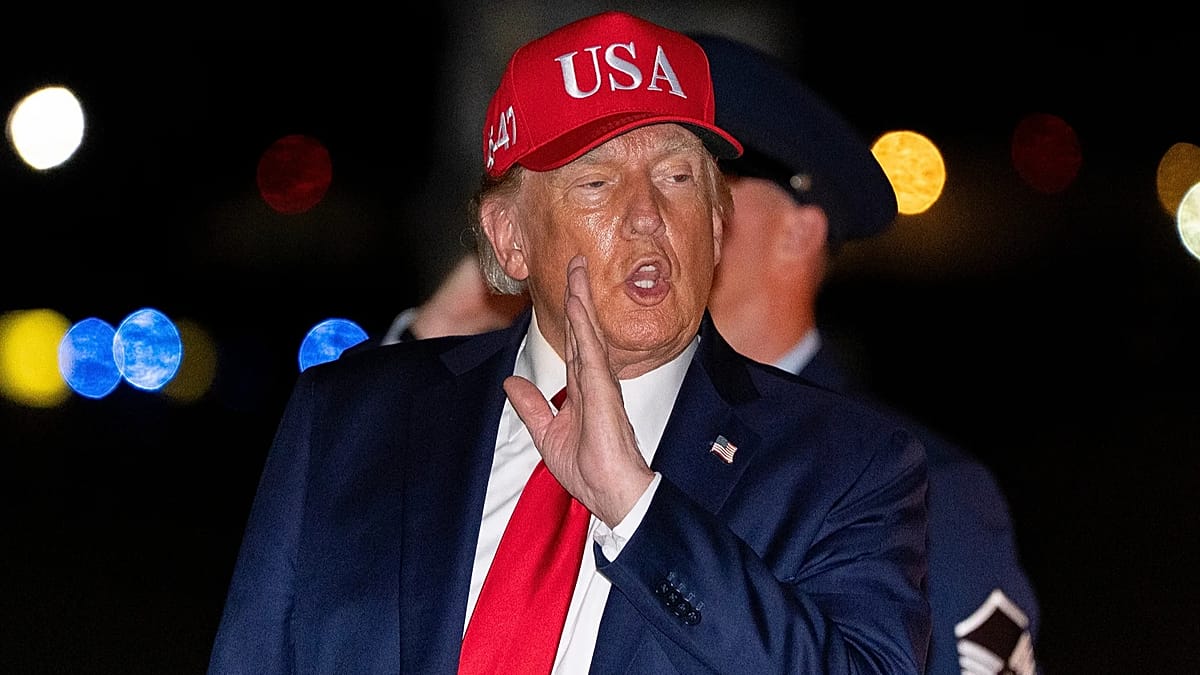
US President Donald Trump has escalated his rhetoric against the European Union, suggesting that allowing Canada to become an associate member would be a “hostile act” and threatening to respond with heavy tariffs on the bloc. Speaking on Wednesday, Trump said he would judge the EU's intentions before deciding on any trade measures.
“If it’s a good intention, that’s fine. If it’s a bad intention, we’ll put very heavy tariffs on Europe,” Trump told reporters. He also floated the possibility of cutting off trade with Europe in certain sectors, without specifying which ones. The president dismissed the idea of Canada joining the EU as “laughable” and called the United States' northern neighbour a “terrible trade partner.”
Trump's comments came in response to European Commission President Ursula von der Leyen's annual State of the European Union address, delivered in Strasbourg on Wednesday. In her speech, von der Leyen proposed a broader “Alliance for the Future” with Canada, building on the existing Comprehensive Economic and Trade Agreement (CETA) to create “a common prosperity and economic security space.” She framed the closer relationship as rooted in shared democratic values, addressing Canadian Prime Minister Mark Carney directly: “Above all, dear Mark, Europe and Canada believe in democracy.”
Carney, who received a standing ovation at the European Parliament, is scheduled to address the assembly on Thursday. The proposed partnership would extend beyond trade to cover advanced manufacturing, technology, defence production, the Arctic, energy, critical minerals, batteries, artificial intelligence, quantum computing, cybersecurity, and economic security.
Canada's pivot toward Europe
The warming of EU-Canada relations is not new. In a widely watched speech at the World Economic Forum in Davos in January, Carney urged middle powers to cooperate more closely to increase their leverage in an era of great-power rivalry. “When we only negotiate bilaterally with a hegemon, we negotiate from weakness. We accept what is offered,” he said at the time.
Canada is seeking to reduce its dependence on the United States, which absorbs roughly 70% of its exports. Trump's tariffs and his repeated talk of making Canada the 51st state have soured relations between the two North American neighbours. Ottawa has retaliated against US tariffs and rejected trade terms that Carney says would weaken Canadian sovereignty.
Jonathan Wilkinson, Canada's ambassador-designate to the EU, confirmed on Wednesday that Ottawa had discussed associate membership with European officials before von der Leyen's speech and “knew that that was something that was on the table.” He said Canada is not seeking full EU membership because it would require surrendering some sovereignty. Instead, Ottawa wants “to get as close as we possibly can” to the bloc in a way that strengthens Canadian sovereignty rather than diminishes it.
Carney's office welcomed von der Leyen's proposal, saying Canada was deepening ties with the EU “to strengthen our sovereignty” and supported a move beyond CETA. Canada has already joined the EU's defence procurement programme, and talks are underway about participating in the Erasmus+ student exchange scheme, as reported earlier.
Trump's latest threats add to a pattern of transatlantic friction. The US president has previously imposed tariffs on European steel and aluminium, and has threatened further measures against European cars and other goods. In contrast, the EU has pursued a more conciliatory approach with Washington, reaching a trade agreement that set a 15% tariff ceiling on the vast majority of EU exports while Europe eliminated tariffs on US industrial goods.
On Wednesday, Trump also signed a memorandum directing the US government to remove Canadian goods from the federal procurement system, which the White House said was retaliation for Canada's “Buy Canadian” policy. The White House called that policy unfair and said in a fact sheet that “President Trump is taking action to hold Canada accountable for its continued unreasonable and discriminatory treatment of U.S. goods, which has burdened and disadvantaged hard-working Americans.”
The EU's proposed associate membership for Canada would be a first, creating a new category of partnership that stops short of full membership. Von der Leyen's proposal is seen as a strategic move to strengthen ties with like-minded democracies amid global uncertainty. For Canada, the EU represents a counterweight to US pressure, offering access to a market of 450 million consumers.
Whether Trump follows through on his tariff threats remains to be seen. His administration has shown a willingness to use trade as a weapon, but also to negotiate when it serves US interests. For now, the EU and Canada are moving ahead with their plans, undeterred by the president's warnings.